The Amorgos Travel Guide

Amorgos made us feel like old money millionaires.
Not because of costs, finery, or company, but the sense that this Greek island was somewhere exclusive.
This didn’t come with any airs and graces attached, and as it slips quietly past people chasing hotspots, the crowd that come to be seen or tell others they’ve been somewhere are nowhere to be found.
The easternmost of the Cyclades, Amorgos is a place that requires a little time and intentionality to reach. Unhurried days bounce between the rugged and the refined, with many of your key decisions shaped by the whims of the winds. Sometimes, they can be so strong up in the craggy hills and high-wire roads that it feels as if the island itself might set sail across the sparkling Aegean.
Of course, this understated destination has got all those signature elements of the Cyclades - staircases leading to the big blue, secret beaches beneath chapels, whitewashed villages dusted across the land, and a wonderful food scene based on that morning’s catch - but it’s what Amorgos lacks that makes it special. Small and considered, there’s no mass tourism, daily cruise ship dumps, huge day-tripper numbers or extortionate beach clubs. Here, in a rocky field that on some nearby islands would have already sprouted a high-rise hotel, a few dozen gnarled sheep and goats remain resident, whilst a ginger cat keeps company with a donkey further down the road .
After last year’s accidental trip to Santorini, Amorgos was our first intoxicating taste of what a Greek island can still be.
In this guide, we’re going to share everything you need to know to decide if Amorgos is a good fit for your travel style, along with all the advice you’ll need to plan your time there. From the best beaches and villages to visit to our favourite things to do and places to eat, there’s also accommodation recommendations and the practical tips that’ll save you time, money, and hassle once you arrive.
This is our guide to the beautiful Greek island of Amorgos.

The Amorgos Essentials
Arrive / By ferry from Athens or another island
Discover / The beaches of Kalotaritissa, Paralia Mouros, Aegiali, Maltezi & Agios Pavlos
Explore / Pretty Chora by day and night
Visit / The Monastery of Panagia Hozoviotissa
Learn / To prepare traditional Greek dishes in this highly-rated cooking class
Wander / The hilltop village of Lagada
Sunset / Drinks and dinner in Katapola
Go / Scuba diving or snorkelling in the big blue
Walk / The various coastal and hill hiking trails
Tick / Off the island’s biggest sites on a full-day guided tour
Stay / By the sea in this Airbnb or at the gorgeous Aliori Art Caves
How To Get To Amorgos
One of the reasons that Amorgos feels so special is because it lacks an airport: this keeps a lid on mass tourism, and means that anyone who’s arrived on the island has made an intentional, thoughtful decision to do so.
Everyone arrives by ferry, and the route depends on whether you’re focussed on Amorgos as a standalone destination or part of your island-hopping Greek odyssey.
It’s 6-9 hours by boat from Athens (Piraeus), but a popular alternative is for travellers to fly into Naxos or Santorini (Thira) to connect with a ferry to Amorgos; this option often requires an overnight stay on one of them though.
Amorgos is also connected by ferry with Paros and the Small Cyclades island group - Koufonisia, Astipalea, Iraklia, Schinoussa, and Donoussa - as well as Astypalea and a few other islands in the Dodecanese.
We opted to fly into Mykonos, spend the night at the cheapest accommodation by the ferry terminal, then take the early morning ferry to Amorgos.
There are 4-5 ferry companies serving the island, but price and travel time can vary wildly depending on the type of boat - we recommend looking + booking via FerryHopper and DirectFerries. Also, as Amorgos has two ferry terminals - Katapola (south) and Aegiali (north) - it’s essential to know which one is closest to your accommodation base before booking your ticket (and disembarking!).
For more detailed advice on prices, ferry types, and travel times, take a look at our How To Get To Amorgos explainer


The Best Things To Do in Amorgos, Greece
Visit Kalotaritissa Beach
If your vision of a 'holiday beach’ means it has to be big, sandy, and covered in deckchairs and bars, then Amorgos is possibly not the right Greek island for you.
Whilst it has a fine selection of sandy beaches, the general appeal is more suited to those happiest in secluded pebble coves, sunbathing on smooth rocks, or diving into the deep blue with hardly another soul around.
At the far south however, the peaceful Kalotaritissa beach offers a good compromise.
This stunning bay emerges like an oasis in a rugged, barely populated area of the island, where it feels like nothing can grow in the scorched terracotta earth that crumbles between your fingers and even the goats seem to have declared it inhospitable.
The water is that dream shade of blue and, as it’s in a relatively sheltered bay, the wind doesn’t whip up too badly here in summer, meaning it’s a wonderful place to swim and sunbathe. Unlike most of Amorgos’s beaches, it’s also got a decent number of chairs and umbrellas available for rent on the sand (€30 a pair on our visit, cash only) as well as plenty of free areas to lay your towel down.
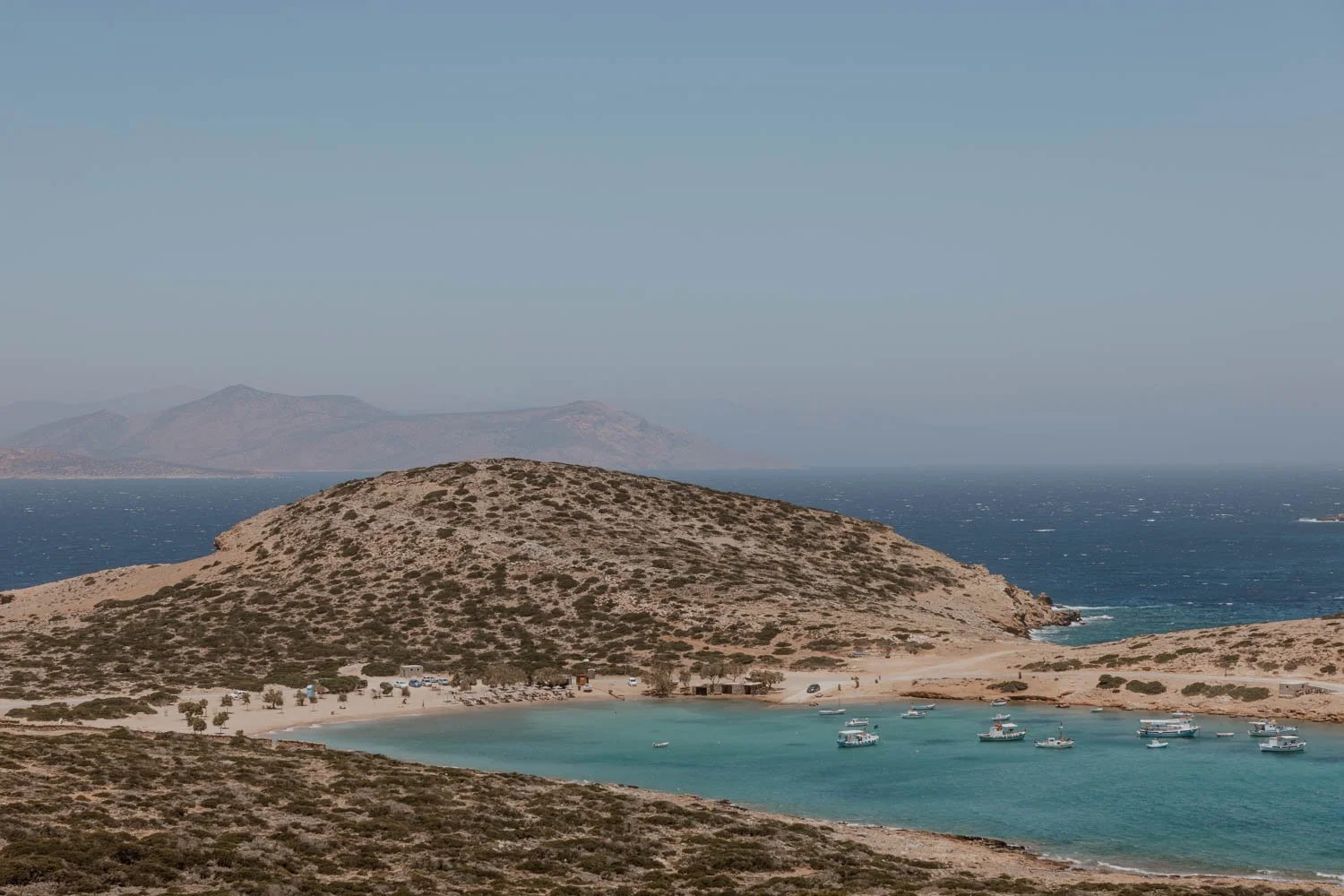
Where | You can find Paralia Kalotaritissa here on Google Maps, about a 35-minute drive from Chora and 45 minutes from Katapola. Be cautious on the hairpins, especially on a windy day if you’re on two wheels. A daily bus also runs down there in the summer season.
Know | There’s plenty of free parking space right by the beach and a toilet, and the beach is easy to access. The simple, family-run Kalotaritissa Beach Canteen is the only option for food, and is usually open from June to mid October(ish), thought they were actually operating from May last year as it was so hot.
They have drinks, snacks, and good fresh lunch options, including Greek salad with cheese and caper leaves served in tinfoil and hearty chunks of handmade spinach pie. Card accepted, but it’s a good idea to have cash as the signal can fail.
Do | Amorgos Roussetos Cruises operate daily boat trips from here, allowing you to explore the wild and uninhabited coastline and swim in the best spots, or visit Gramvousa island - find out more details on their Facebook page. From here you can also take a five-minute boat taxi across the water to the beaches and trails of the even more remote Nisida Gramvoussa island.
Travel Tip // On the drive in or out of Kalotaritissa, you may wish to stop by the rusted Shipwreck of Olympia. Due to strong winds and captain’s error, the vessel ran ashore in this small cove back in 1980. Everyone survived, but the ship abandoned, and it’s been a photogenic tourist stop-off ever since (helped by Luc Besson’s 1988 film Le Grand Bleu). It’s often touted as one of the best things to do in Amorgos, but we think it’s more deserving of side-trip status - you’re best to park on the roadside (here on Google Maps) and then walk down the path for five or so minutes.


Paralia Mouros & Paralia Ammoudi
If you’re coming to the Cyclades for something entirely different to sun-loungers, then you’ll definitely want to carve out enough time for Paralia Mouros.
Tucked away on the island’s rugged southwest coast, it’s an absolutely stunning spot where one can take your pick between smooth, solitary rocks or a place upon the patch of pebbles.
The swimming here in the deep, cooling waters is also divine.
Despite the seclusion, and the fact it requires a bit of a trek from the towns and villages, Mouros beach is by no means a secret.
Where | You can find Mouros here on Google Maps, about a 25-minute drive from Chora and a 35 minute from Katapola. It’s a narrow, winding road down to the car park, with a few tight bends along the way. It’s easy to miss the entrance to the free car park on the left, and there’s space for around 20-30 vehicles if people park diligently (frustratingly not always the case). If it’s full, you don’t really have any option but to wait or come back later, as there’s not much room for rogue roadside parking.
The same daily bus mentioned above also runs to / from Mouros in the summer season.
From the car park, it’s a few minutes’ walk down the new-ish stone staircase with a handrail to the water. This won’t pose many issues, but it’s quite tiring and steeper than you expect on the way back up.

Bring | There are no facilities down on the beach, but there is an excellent Mouros Cafe-Bar at the top (maps). It offers a great open-air deck with killer views, but the prices of food and drink are a little higher than elsewhere to reflect that and the location (still affordable though). If you’re doing your beach day right, then lunch in the shade or a drink there before you leave should definitely be involved.
Otherwise, bring everything you’ll need for the beach.
Based on our experience, we think the optimal time to be there is the afternoon before the sun dips behind the mountain.
If you take the trail to the left of the cafe, there's a tiny, remote cove for nudists.
Travel Tip // Paralia Ammoudi (Google Maps) is nearby, and more accessible than ever thanks to the surprising decision to install a lovely new road down to, effectively, the windswept side of a cliff. It’s also stunning but, due to the nature of access, we think only for the brave and those seeking out true solitude.
It’s a steep, uneven scree trail down that definitely requires trainers but is not fun in the wind, and would be even less fun on the way back up. By all means give it a go, but for most it won’t be essential to visit given the easier-to-reach alternative of Mouros.


Tips For Beaches in Amorgos
Most beaches have a bar, café or taverna nearby - even the “secret” ones.
Learn to love rocks and pebbles. If you need golden sand and sunbeds, this isn’t your island.
Officially no nudism on a number of beaches, and you’ll see quite a few signs more up about this than other Cycladic islands
Unofficially though…it happens, so expect the occasional rogue willy. There are also very nudist-friendly spots.
The wind really matters. One side of the island can be calm while the other’s getting battered - check before you commit.
Boat or hike-only beaches exist, but you don’t always need to bother - some of the best swimming spots are easy to reach.
Buses run in summer, but services are sparse and restrictive. If you want freedom, rent a car or scooter.
Car parks are decent, but fill up fast.
Bring your own towel, suncream, snacks, cash, and plenty water - shade and card machines aren’t guarenteed.
A book is much better than squinting at an overheating phone screen.
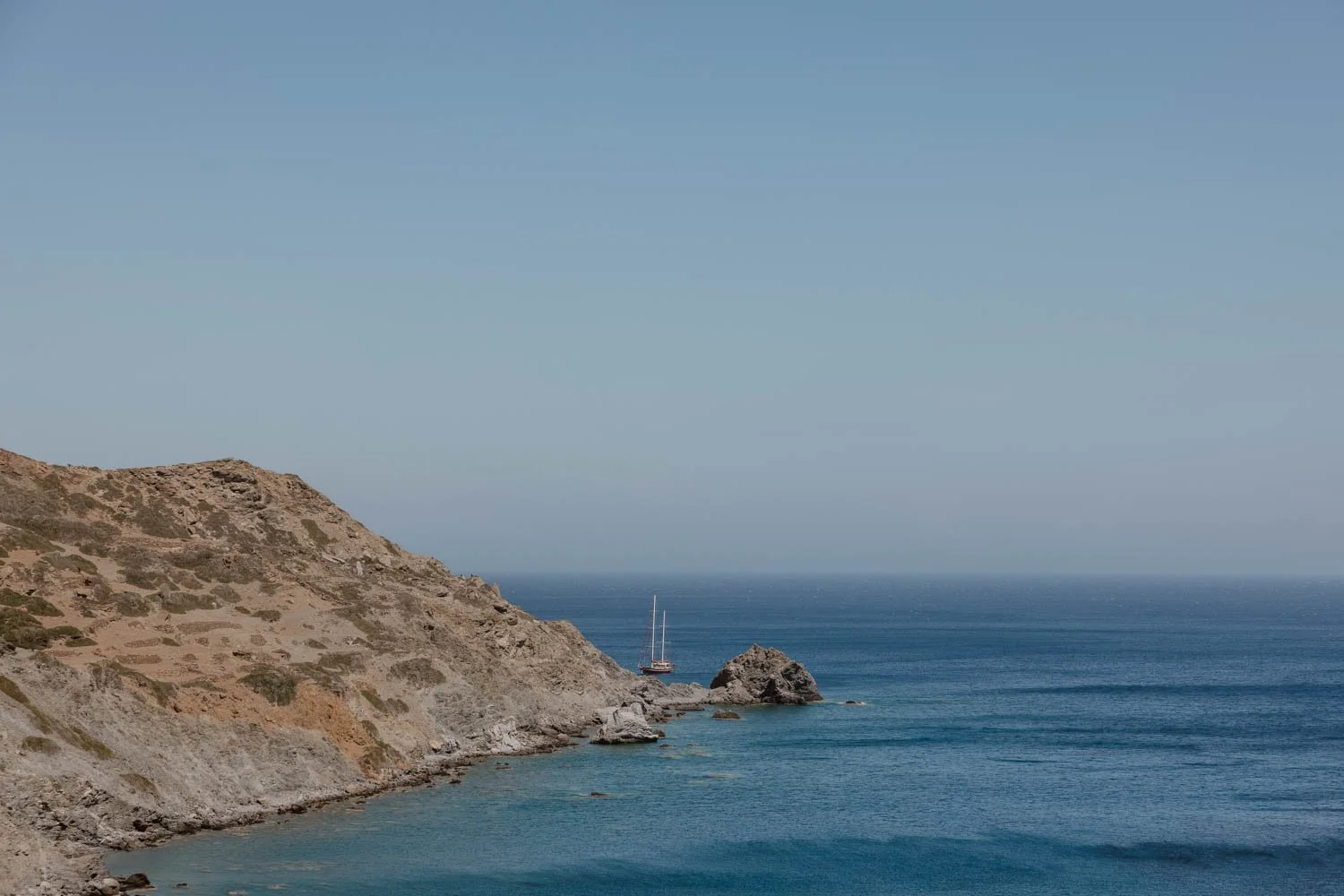
Explore Chora By Day & Night
Set on a blustery hilltop, the town of Chora is a tangle of sun-bleached lanes, crumbling chapels, suspicious cat gangs, and doors painted the blues of sky and sea.
Visit at the wrong hour or get lost in the wrong direction, and it may seem hollow and half-abandoned. Yet, as day turns to night, tavernas open their doors and spill out into narrow alleys, the music of tiny bars grows louder, and artisans dress the whitewash walls with their wares.
Though popular with visitors, most of the restaurants and bars in Chora - whether classic or contemporary - are considered: it’s not the place of a laminated picture menu in primary colours. With hand-crafted, thoughtful elements everywhere, and a bohemian set that have resettled or returned from the mainland to live the slow life, it brought to mind small enclaves in Mexico and Argentina.
So, although a walk to its line of 10 iconic red and white windmills should be on your list (especially at sunset), our recommendation is to set aside at least one late afternoon wander and evening meal here.


Where | Chora is a 10-minute drive up the hill from Katapola port, and they’re well-connected by bus - find it here on Google Maps. For parking, we suggest heading to this car park or to this one a wee bit closer.
There is also walking trail (#2) that you can take between the two, which thankfully avoids the roads, but expect it to take up to seventy to ninety sweaty minutes on the up.
By the way, it’s pronounced ‘whora’ with a very, very phlegmy ’wh’.
Eat | A few followers recommended Transistoraki restaurant - renowned for its inventive take on traditional Greek cuisine - and we had a memorable dinner there. The huddle of tables on the narrow street and the cats trying to mooch food of you are part of the appeal, but the food is worth the likely wait for a table (try to reserve if you’re a big group or on a tight timetable). Giannakos Bakery is a good shout for savoury snacks!
Drink | Jazzmin was a real favourite of ours, set in and out of gorgeous little space for books, games, and fairytales - go there for good cocktails (they also do breakfast and light lunches). Botilia is a popular alternative to consider. We also liked Loza, a cafe in a lovely little square with a large tree and a few shops to peruse, but there are a bunch of charming places you’ll stumble along and upon the stairways.

Do | Beyond wandering around the photogenic nooks and crannies (which you could realistically cover in less than 30 minutes), a walk up to the traditional windmills of Chora is the main activity. Built on the breezy hilltops to harness the power of the wind to grind grain, they reflect a vital part of Amorgos’s agricultural history and stand like guardians of the island’s past.
Sunset is the best time to head up via the short, easy trail from town, with exceptional golden views of the folds and layers of the Amorgian mountains, barely distinguishable from the horizon and other islands. Be aware that it can be very blustery up there! Find the windmills here on Google Maps.
Precariously balanced atop the rock overlooking Chora, the view from the Castle of Amorgos (maps) is equally blustery and worthwhile, but some may not wish to follow the rocky steps all the way up. Unfortunately the door was locked on our visit, but supposedly you can source the key from a few businesses in town.
Also, pop into the Amorgion Shop (maps) and Ta Katzatzioakia directly opposite for souvenirs, which where we bought little stone replica of the Amorgos figurines.
Stay | Whilst we adored our choice to stay in Katapola at this stunning Airbnb on the sea (more on both later), there’s no doubt that Chora may be a preferable option for some travel styles. We’ve hand-picked the following to help you find a great place:
There are very few guest hosues in Chora, but when Vorina Ktismata is one of the options, it doesn’t really matter - you stay here!
The wonderfully traditional Tsouklou
Travel Tip // Whilst there is a bus network on Amorgos, we found having a car for a few days meant we could really explore the island at our own pace. If you’re really not interested in renting a vehicle, you may wish to join a guided tour of Amorgos which allows you tick off a number of the island’s biggest attractions in one day without having to rely on public transport!


The Monastery & Paralia Agia Anna
The Monastery of Panagia Hozoviotissa is arguably the island’s most important landmark.
Perched dramatically on a sheer cliff face, this 11th-century Orthodox monastery is thought to be the second oldest in Greece. Built to honour and protect the precious religious icon of Panagia Hozoviotissa (the Virgin Mary), monks and nuns lived here for centuries, and it’s still an active, important religious site rather than a tribute to past belief.
Due to this, it’s essential that visitors fully understand and respect the dress code: everyone must dress modestly, with men wearing long trousers and shirts (not vests) and women in long skirts and shirts/t-shirts with sleeves. Also, no hats inside. Obviously, that isn’t most tourists’ go-to style on a sunny Greek island, so one must plan your visit rather than casually drop in on your way back from the beach.
This becomes even more important given that, just a short walk in the other direction from the entrance, is another of Amorgos’s stunning and much-loved swimming spot. Due to its proximity to both Chora and the monastery - and the fact it’s dramatically photogenic - Paralia Agia Anna sees a more regular flow of visitors than Mouros or Ammoudi. At first glance, space may seem a little limited, but there are actually three intimate sections of coast from which to choose.
For the best experience, we recommend you plan to visit the monastery first, then head down to unrobe and unwind at Agia Anna.

Where + When | Both can be easily accessed from Chora on foot along trail #1or via a short drive down the hill, whilst there are regular bus connections from the latter and Katapola.
Note that the Monastery is open from 9am-1pm, then 5pm-7pm daily. Entry is free, but the small accompanying museum charges €3 entry.
You’ll first arrive at the small monastery car park on your left (maps). Keep driving down the road and you'll reach the larger car park for Paralia Agia Anna (here on Google Maps)
From the car park, go left on foot and follow the stone steps to the pretty little chapel; continue past that and down to a gorgeous tiny cove - that’s the most popular bit of Agia Anna beach with shallower water overlooked by a cliff that appears a bit like a muzzled dog.
Alternatively, head right from the car park - past the small cafe/restaurant shack - and down the manmade rock staircase to the grey-silver patches of pebble and smooth rock. This is the place for glorious deep swimming and finding your own rock to lay on. Keep in mind that Agia Anna is relatively small and doesn’t have lots of space for lying down - let alone pitching beach tents or holding large groups - making it perfect for a couple of unhurried hours of swimming, sunbathing, and soaking up the serene surroundings.
Nudity is common at the latter section, but proper nudists may prefer to continue on for 10-minute along the rocky shoreline on the right to the much more secluded Kambi Beach (maps).
The only option for shade and snacks here is at the cute Big Blue Cafe by the car park.
Travel Idea // For an alternative take, consider joining this full-day guided hike along the ancient path from Aegiali bay to the Monastery of Panagia Hozoviotissa


A Beach Day in Aegiali (Ormos Egialis)
The main settlement and transport hub on the north of the island, the harbour town of Aegiali is the place that comes closest to a modern holiday resort sort of atmosphere and aesthetic.
There’s a floating souvlaki/gyros stand covered in palm trees, and several restaurants, bars, beach clubs, and souvenir shops on the waterfront - plus a very family-friendly sliver of long beach.
However, it's important to add that all of this is done in a small-scale, tasteful way, steering well clear of anything gaudy or overly package-touristy. This makes it all quite pleasant and laid-back, and a big reason why Aegiali is the most popular place to stay for holidaying Greek families in July & August (as well as young campers).
Another pull factor is that the gentle, shallow waters are ideal for swimming and paddling, plus the convenience of the ferry docking just a five-minute stroll from the beach.
Therefore, for those looking for more facilities and restaurants on their door step, and an easy-going base that’s steps from the beach, this is a sound choice.
Is it absolutely essential for those based elsewhere on the island to drop by Aegiali on a day trip? For us, it’s a no as there are better beaches, swimming holes, and little villages, but that doesn’t mean it would be a bad place at all to spend your lazy beach-eating-drinking day. It’s also located very close to a handful of other places mentioned in this guide so may offer up a decent spot for lunch if nothing else. .
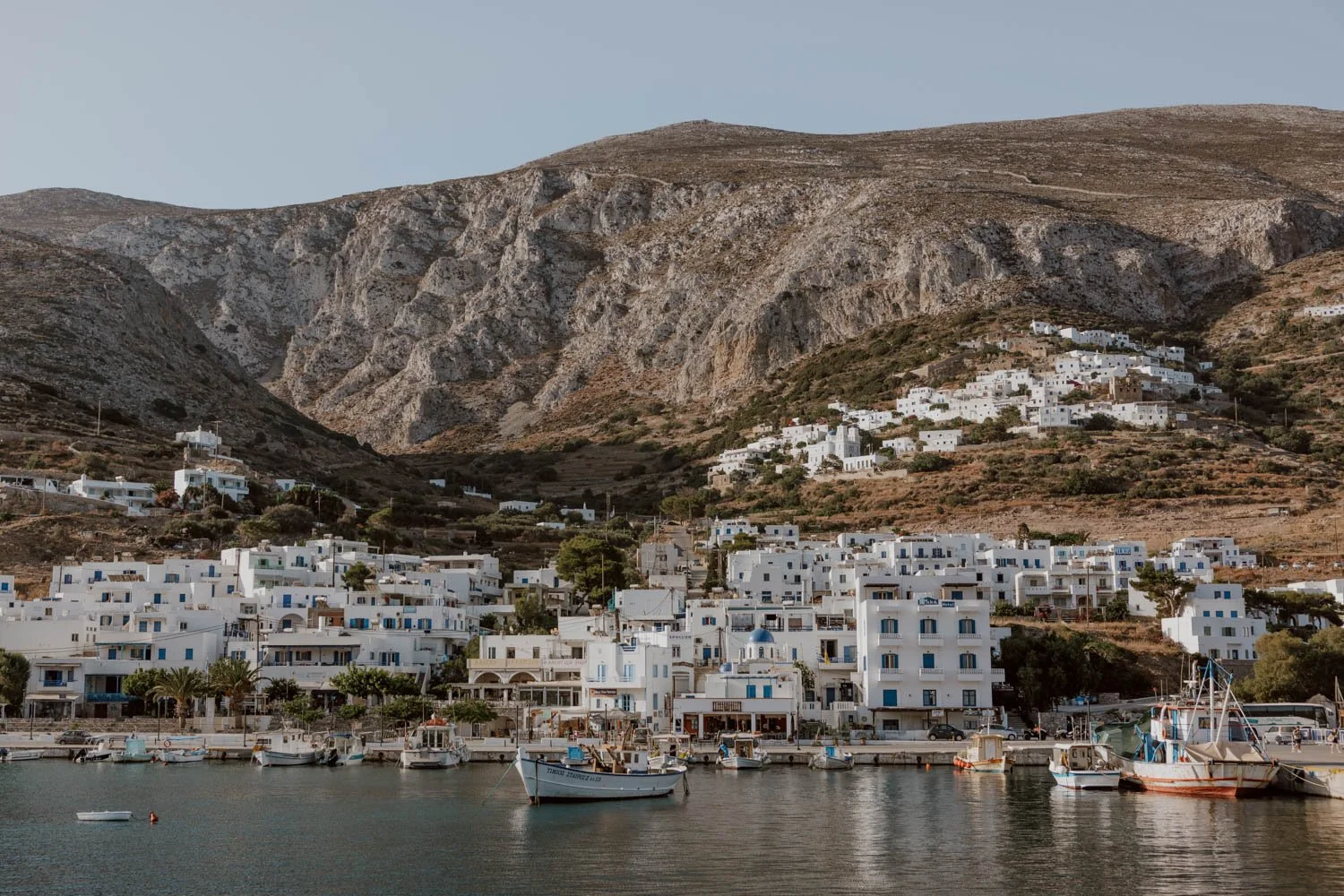
Where | On the north of the island, you can take the ferry direct to Aegiali port (maps). The town is also easily accessed by car or bus from elsewhere in Amorgos - park here on a day trip. Note that it’s also sometimes referred to as Ormos Egialis.
For more on ferry connections and schedules, see our How To Get To Amorgos explainer.
Eat | On the left side of town is the marina of area, where small fishing boats bob away and foot traffic multiplies whenever there’s a ferry docked. There’s a decent selection of restaurants, cafes, and bars to choose from, with most offering outdoor seating a lovely views.
Across the road running parallel to the beach, you’ll find more bars and restaurants - the kind of places you can dip into for a drink or settle in for the day (usually for free if you eat or drink there).
A few suggestions from us are:
To Syrma · Meat-free options are common across all menus in Greece so we never really feel the need to seek out veggie or vegan restaurants when we travel here. We did make an exception for this place though and had a bloody brilliant souvlaki wrap!
LOKO · Whether you opt for a lazy lunch out of the sun or golden hour cocktails, this cool little spot with killer views is a must-visit in Aegiali. Also has a few chairs on a small suntrapped deck.
Frou-Frou · If you need a break from Greek food (although as we write this, we do wonder if that’s even possible…), this place is regarded as serving up the island’s best pizza.
Limani Restaurant · Authentic little taverna a couple of streets back from the water that serves up simple, traditional and excellent Greek food.
Disco The Que · We only popped into this bar / restaurant for a quiet afternoon drink but it’s apparently the place to party in the evenings.
Yachendo · Offering Amorgian and Mediterranean cuisine in an attractive space, this also caught our eye.
Know | Aegiali’s beach is the most accessible and kid-friendly beach in Amorgos, just a few flat steps from the car park and several accommodations. It’s also one of the few with lifeguards. Due to its narrowness though, there are no deck chairs / beach clubs on the sands of Paralia Egiali, but several of the beach clubs and restaurants on the road backing it include free deck chairs for customers (the set-up means you’re looking at the road primarily though).
Stay | We’ve chosen the following as we’d happily stay in them, and they all have a good location and excellent reviews:
Idothea, a large one-bed is ideally suited to a couple really wanting to relax. It’s beautifully decorated throught and has a HUGE terrace replete with hot tub and various hang-out areas.
The one-bed Dimitra Studios is simple but tastefully decorated, benefits from a lovely balcony with exceptional sea views and - best of all - is incredibly well priced. This is actually one of several in the same development so if it’s not avaialble, be sure to check out the other properties.
The modern but sympathetically designed Araklos Summer House is large, light and airy and offers wonderfully views over the bay. One of three in the same complex.
The Aliori Art Caves guest house is simply stunning. Offering just a hadful of rooms, each personally designed, crafted and curated by the owner Roberto, it offers a stylish retreat up in the hills over Aegiali - but still only a short walk to the beach.
Amorgos Elegant Villas offers some of the most stylish holiday home in Aegiali (like this gorgeous little one bed). They’re more expensive than others in town but all definitely worth taking a look at! See all listings on the host’s profile. Also available on Booking.com
Galaxy is a good shout if you’re after a highly-rated simple, budget-friendly guest house - somewhere that’s more of a base than somewhere to spend your days within.
Travel Tip // If based in Aegiali, then you should consider the sandy, sheltered Levrossos beach as one that’s on your doorstep. A short drive or 25-minute walk from Aegiali, it’s a really pleasant little bay that you have to walk to down a dusty road. It’s got lovely little Lebrosso restaurant (maps) and Petradi Beach Bar (maps), so some of you may wish to consider as an alternative / complement to Aegiali on a day trip.
Levrossos Beach Apartments are also there, if you’re looking for a romantic, lush setting overlooking the sea for a few days.
You can also continue hiking out along trail #4 to the more remote Psili Ammos and Hochlaka beaches - but we aren’t 100% certain they’re worth it unless your main aim is isolation.
If arriving by car, park at the end of the road (here on Google Maps). There's space for 15-20 cars, depending how Greek your approach to parking is, but it fills up and nervous drivers won't enjoy reversing or trying to squeeze in. If there's no room, there is a bit more space to park on the roadside further up, before the last bend.


The Northern Village of Lagada…
Beyond the sea, much of Amorgos is a harsh, barren, parched landscape of hills, cliffs, and ridges.
The exception comes from the handful of whitewashed hillside villages that dust the landscape like icing sugar.
Lagada is the pick of the bunch. We gasped at almost every turn around the soothing curves of its Cycladic homes and streets, where wooden signs and curious white doodles of hearts, cats, and stars led the way. There are a handful of lovely little restaurants and cafes for espresso freddo or cocktails, and we felt the balance between being a place for locals and a place for visitors was a good one.
Unfortunately, we only had a single morning in the village, but this is definitely one to savour for a few hours, or consider as a base if you’d prefer to stay up in the hills rather than by the beach.
Where | Lagada is short, steep drive up from Aegiali, and there are several buses a day connecting the two. They’ve built out a few car parks right outside the village, so head for this one and you’ll hopefully find a space in one.

Eat & Drink | Pergalídi is a real gem - a perfect little cafe spot by day (the breakfast menu goes until 3pm), it gradually transforms into a cocktail bar open to the wee small hours. How we wish we were back in the village for that! We really liked the look and menu of Moschoudaki, and the reviews back up that gut feeling - we’d go for lunch or dinner. The covered terrace of the Nikos bakery and restaurant is another good option.
Raki psimeni is a version of the grape-based spirit that's unique to Amorgos. It translates as 'roasted raki' and it's very palatable due to the cinnamon, honey, and clove with which it's blended. You'll sometimes be given a small complimentary glass at the end of your meal, but you'lll also see it sold across Amorgos - often homemade. We bought little plastic bottles of it from a little place we stumbled across in Lagada, but we can’t recall precisely where it was!
Feel free to share any favourites you discover in the comments!
Do | Honestly, beyond eating, sitting with a drink and wandering around with a camera, we’re not entirely certain what else there is to do in Lagada, but you should make a point of stopping by Agapi by NIAK (maps), where the talented French lady can change your mind on macramé.
Stay | A couple of places that we like in Lagada are Viviana's Anoi House and Villa Nina.
Know | Low rainfall and the heat often leads to fresh water shortages on Amorgos, and a lot of the supply arrives on ships, so make sure to use it sparingly and responsibly .


… And Perhaps The Other Hilltop Villages
There are a couple of other villages on this norther part of the island that, whilst not essential visits, are still pleasant and pretty.
Our main reason for visiting Tholaria was for a late lunch of traditional foods at the Taverna Panorama but we ended up having beers and some simple small plates elsewhere. We were the only guests, the lady working there was a warm-hearted soul, and the interiors and decorations were just fantastic - find it here on Google Maps. Compared to Lagada, Tholaria is smaller and sleepier, but offers some stunning views across the land and features on a few hiking trails.
A popular way to visit it is via hiking route #6, which takes you from Aegiali to Tholaria, then onward to Lagada. It can also be done as a 7.7km loop - find more detail here. From Tholaria, you can also take a rocky trail along #4a to the secluded Mikri Vlychada beach.
The other village is Potamos - a 10-minute drive from both Lagada and Tholaria. Whilst it also offers nice views and has a bunch of renovated accommodations - like this gorgeous property - it’s probably the one you can skip over unless you’re starting a hike there.
Travel Idea // If you’ve fallen in love with Greek food during your visit to the islands, consider joining this highly-rated cooking class in the village of Tholaria where you’ll learn to cook a selection of traditional dishes with spectacular views out over Amorgos and the Aegean beyond.

Did You Know?
A major archaeological find in Amorgos were collections of minimalist, elegantly carved white marble sculptures: the Early Cycladic Figures.
Discovered at burial sites on the island, particularly in the cemeteries around Chora and other northern settlements, they’re relics of the Early Bronze Age Cycladic civilization (circa 3200–2000 BCE). Whilst they’re believed to have held spiritual or protective significance, their exact meaning remains a mystery.
Their simple, elongated form didn’t just capture the imagination of archaeologists; their influence on 20th century modern art and the abstract forms of Picasso, Brancusi and Modigliani is quite clear. We were also struck by their similarity to pre-Colombian art.
Unfortunately, the originals are housed at The National Archaeological Museum and The Museum of Cycladic Art, both in Athens, and a few other major museums - you can however pick up a few cool versions of them as souvenirs! Read more about them in this excellent article.


Walk To Maltezi Beach
Whether you’re based in Katapola or crafting where to visit on your day trip beach day, Paralia Maltezi is an essential addition.
(By now you’ve hopefully picked up that paralia means beach in Greek!)
Set in a shallow, sheltered cove just beyond Katapola, it’s protected from the prevailing northwesterly winds by the low hills behind it, and best reached on foot along a sliver of pebbles just wide enough for a stroll.
The scenery is classic Cycladic: newly planted olive trees, crumbling dry-stone walls, and the striking Church of St. Panteleimon perched on a finger of rock nearby.
The main sandy beach area is found at the end of the walk, where there’s a casual beach bar with a couple dozen parasols and loungers, a portaloo, and a generous amount of free beach where you can lay a towel. The water is wonderfully clear, calm, and shallow - ideal for relaxed paddling.
If you prefer a quieter spot, you may prefer to pitch up at the smaller, intimate areas at the water’s edge that you’ll pass as you walk along the shoreline. Most are just wide enough for two people to lounge right by the water’s edge, but bear in mind you’ll have people walking past to/from Maltezi.

Where + When | Due to the road types and access issues, we recommend walking out from Katapola as part of the experience.
The set of stone stairs to head toward can be found here on Google Maps - there are also hand-painted ooden signs - and these lead down the strip of pebble beach and along the shore to the main section of Maltezi beach here on Google Maps. That part takes about 15 minutes, gets quite very narrow in parts, and feet may get wet. Maltezi and Plakes beach blend into each other, so we’ve just viewed them as one in this guide.
Note that the route we initially followed on AllTrails is a bit out of date, given that it led us toward a quirky no-entry sign and private land of a farm, so the quickest and best bet is just to go to the stairs we’ve linked to.
If you do insist on driving to Maltezi, note there is a very small area for parking but there’s only room for one or two small cars and some scooters - you’re more likely to get stuck than find a space.
A better alternative to walking would be the water taxis from Katapola port: departures are every half hour from 10am and a return ticket costs €3.50.
We think it’s best to come from noon onwards for the best of the sun, and note that there are various signs up advising that nudism is prohibited.


Drinks & Dinner in Katapola
Amorgos’ main port, we settled on Katapola as our base more from a practical perspective than anything else.
Located in a sheltered curving bay in the (sort of) centre of the island, transport connections are better here than elsewhere, with regular buses running to Chora, Aegiali and all the main beaches in summer, as well as several rental companies found by the port.
We knew we'd be trying to cover the north and south of Amorgos on our trip, so its location meant we'd save some time on driving, but Katapola also happened to be the location of a new Airbnb with no reviews that we decided to take a punt on (spoiler alert: it’s not got loads of excellent reviews!).
By the first sip of the cocktail, sitting on a rickety wooden chair by the sea at sunset, we knew this was the place we were meant to be.
Katapola can loosely be split into three areas: the port side where there's a few cafes, tavernas, and most of the rental companies, the quieter middle stretch along the waterfront, and then the cluster of whitewashed houses, restaurants, and bars on the northern end of the day.
You can easily wander between them on foot in 10-15 minutes and it's the latter part, especially in the early mornings and soft evening light, that you'll want to make a point of visiting before the sun goes down for early evening drinks and dinner under the stars.
Though visitors come and go, Katapola very much ticks along as a working port community, with a school bell that rings, locals on the same café chairs each afternoon, and a laid-back, lived-in feel that hasn’t been packaged for tourists. This is obviously part of its charms, but these things can obviously change quickly.
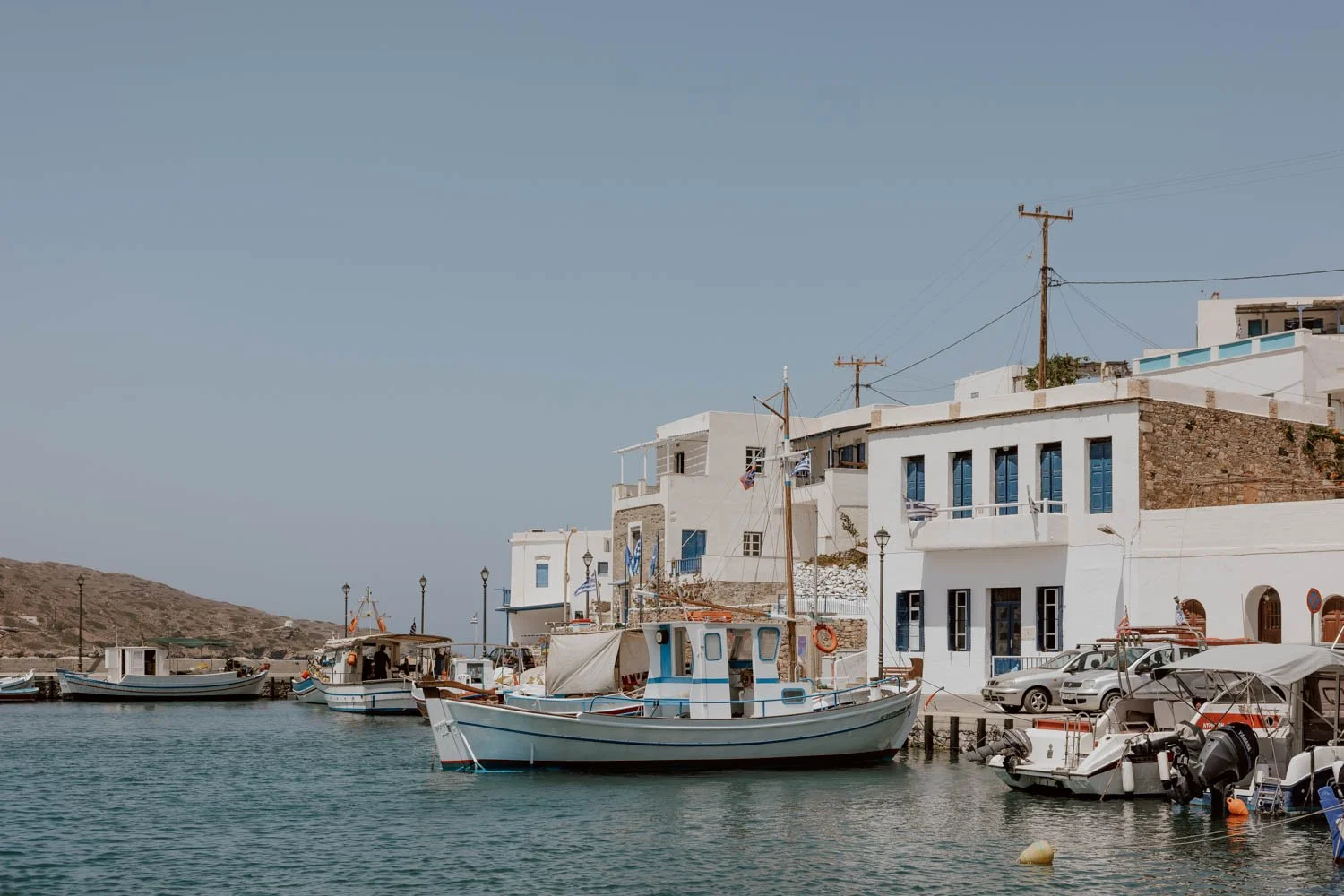
Eat & Drink | The northern end is home to wonderful Fata Morgana, which is in a glorious location and nailed the vibe, playlist, flavours, fonts, and service. It was possibly the best meal from our two/three weeks in the Small Cyclades, and we highly recommend it. It does a good breakfast, but it will be most memorable for dinner.
Moon Bar is super cool and perfect for evening drinks, whether inside or on the wooden chairs upon the pebbles watching the cats work their charms on local fishermen. The cocktails aren't the best, but everything else makes up for that.
Erato, the family-run Italian restaurant on the corner, was surprisingly good if you've worked up a proper appetite for pasta and has a one-of-a-kind couple running the show
Youkali (maps) is arguably the most popular restaurant, but unfortunately our meal didn’t meet expectations (despite a lovely atmosphere, service, and The National providing much of the soundtrack). Perhaps it was an off-night.
Wander over to the middle section of Katapola, and Bastet is another great sundowner spot with excellent cocktails. It also seemed especially popular with the younger local crowd on weekends, and is open until 3am every day.
The mezze dinner we had next door at Anemi was also very good.
If you're eating back at your accommodation, head to the the little Traditional Market store (maps) for local produce and everything else, where there’s often a few regulars outside playing backgammon.


Know | If you're arriving on a day trip, or need somewhere to leave your rental car overnight, then this is the main car park to aim for.
Stay | For most visitors, the easy pace, convenience, beauty and character Katapola will far outweigh the absence of a golden beach. Here are a few of our picks:
If you’re a couple looking for somewhere to stay in Katapola, we honestly couldn’t recommend our wonderful little Airbnb highly enough. With access to a private swimming and sunbathing spot, it was all sorts of perfect. If you want a little extra space, the host also has this equally lovely place next door.
We ummed and ahhed about staying at the highly-rated Soil Amorgos, a modern new development offering a number of different room types.
This gorgeous one bedroom property is not only sea front but is ideal for those that want a porper kitchen during their stay.
There is a bit of a dirth of larger properties in Katapola, but this two-bedroom would suit a small family. The interiors are basic but comfortable, and it has a wonderful outdoor space.
There are several hotels and guesthouses in Katapola that won’t win any style awards but our well-loved, excellently run and extremely popular - places like Hotel Landeris, Pension Titika and Hotel Minoa.
The modern and tastefully decorated Porto Katapola Pension is a fantastic option for those that want the comforts of a guest house but with added extras like a small kitchen.
Other properties that caught our eye include: Kykladonisia, Achinos II Studio, Xylokeratidi, CarobNest Studio, The Olive Garden Above the Sea, and Gialos Studios.
Travel Tip // There’s a wee secret beach near a church that we’re not going to link to on Google Maps as we think it’s worth a little effort to discover, but we promise, it’s really special.

Go Scuba Diving
That old money millionaire feeling really came to the fore on the day we headed out diving.
Blessed with some of the clearest waters in the Aegean, Amorgos is simply a brilliant spot for all levels, so we were surprised to be the only two people with our guide as we headed across the silky blue. Having learned to dive in a legitimate Caribbean paradise a few years earlier, our standards are pretty high in terms of ‘vibes’, but the setting that morning was truly irresistible.
We did a two-tank dive focussed on the Deep Blue Wall, which includes dozens of amphora (Ancient Greek storage jars) left on the seafloor from a shipwreck in 322 BC, and Nikouria’s Cavern. There are however over a dozen or so sites other sites rich with rocky reefs, caves, and vibrant marine life.
Due to the conditions and accessibility to these sites from shore and by boat, Amorgos is also a great place to have your first scuba diving experience too or get certified over a few days.
We paid to go with the Amorgos Diving Centre, and are happy to recommend them. Operating out of Aegilia, the kit was good and the approach and communication was professional throughout. As well as daily diving boat trips, they also snorkel trips and freediving courses - for more detailed information on dive sites and their excursions, visit their website.
You can also book two dive trips with them via GetYourGuide (if you’d prefer to the flexibility of free cancellation).
The other dive company on the island is We Shall Sea.
Know | Amorgos found unexpected fame in 1988 as the backdrop for Luc Besson’s cult freediving film Le Grand Bleu (The Big Blue), with its hypnotic underwater scenes turning the island into a magnet for divers, film pilgrims, and French tourists.


Agios Pavlos & Nikouria Island
Arrive when the Cycladic winds are howling, and you’ll wonder why on earth we’ve included this spot in our best things to do in Amorgos.
Jutting out like an accusatory finger - or a severed whale’s tail - Agios Pavlos beach just looked a bit unkempt and unappealing the first time we stopped by.
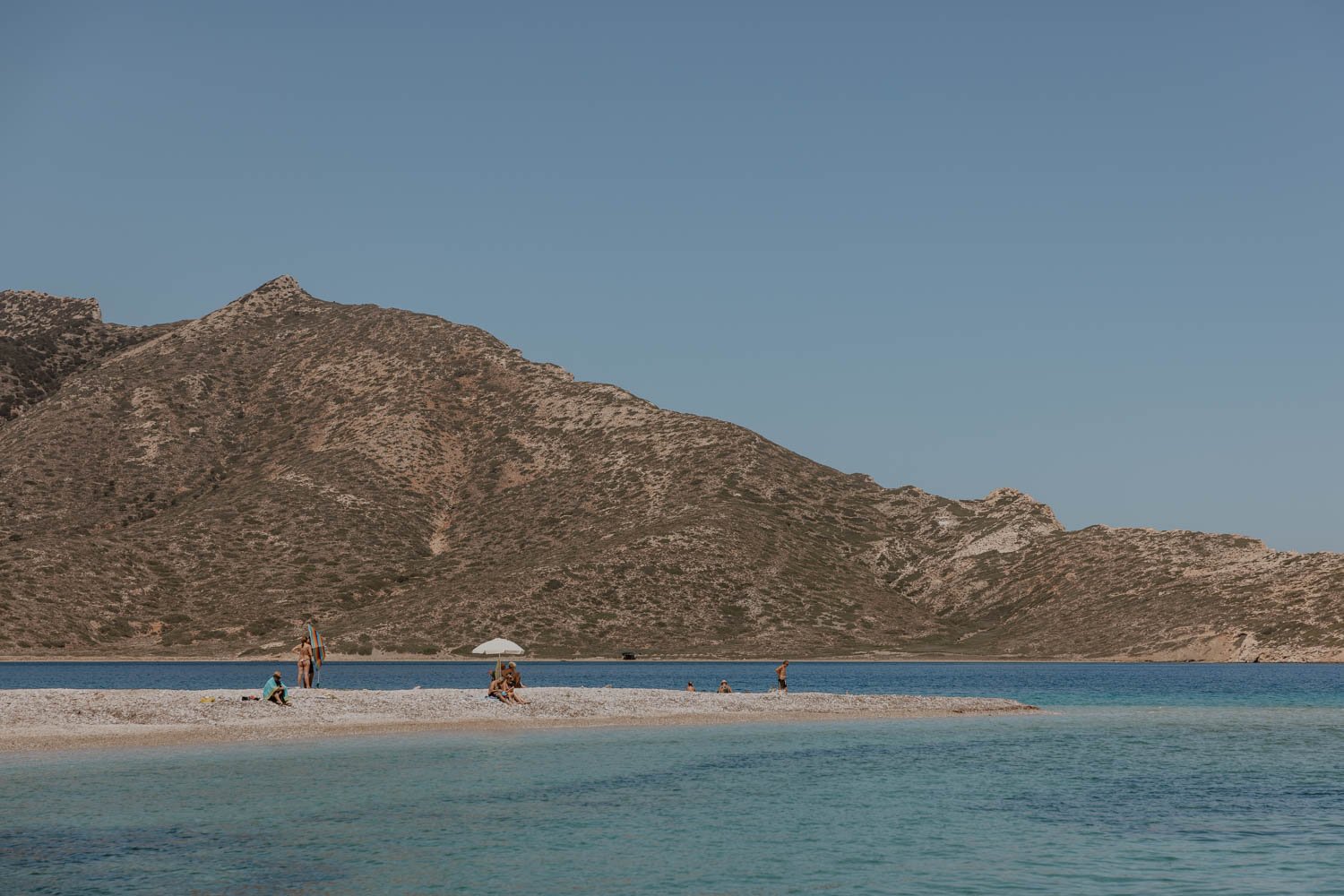
Returning couple of days later, on a much calmer morning, we could really appreciate why this spot - for a certain type of traveller - will be a little Greek gem. Mostly grey pebble and shingle, with the uninhabited Nikouria island across the water providing a dramatic backdrop, you can lay your towel down either side of the ‘finger’ in near perfect solitude, with pristine shallow waters all around.
The understated Aqua Petra Hotel backs onto the beach, and has various sunbeds available for guests, and whilst we wouldn't necessarily recommend it as the best base for most travellers, its reviews are very good.
If you’d like to go one step further in search of perfect solitude, then you can even hop over to Nikouria! Once a leper colony, the island is now home only to goats, cicadas, and three small, sandy beaches. Unfortunately, we didn’t have the time to go there ourselves, so do let us know if you don’t think it’s worthwhile or it ends up being much busier than it sounds!
You can access Nikouria island via the small daily boat from the Agios Pavlos jetty, with departures every hour from 11am to 7pm and a return ticket costing €6. Just remember to bring absolutely everything you need! Note that Nikouria is also spelled ‘Nikoyria’.
Where | Agios Pavlos is a 6km / 10-minute drive from Aegiali - find it here on Google Maps. It’s served by several daily buses from there as well as Chora and Katapola, whilst a one-way taxi will cost €10.
The Hiking Trails of Amorgos
Long-term readers of Along Dusty Roads will know that we are big hikers.
However, we were just off the back of two weeks walking the Fishermen’s Trail in Portugal and the heat of our late June visit to Greece made the beach more sensible and pleasant than hiking in 30+ degrees for a few hours.
This was also the summer of Michael Mosley's death and an American man tragically died in Amorgos on a hike just one week before we arrived, with black and white missing posters still eerily taped up on doorways and windows.
There are however a myriad of trails and ‘waymarked cultural routes’ that permit one to meaningfully explore and join up a lot of Amorgos’s coast, villages, and wild mountains on foot. You'll accidentally walk parts of these on your way to certain beaches and if walking between the villages, with wooden signs with red and white trail markings and timings a common sight.
Whilst you’ll still see people on sections and shorter hikes in summer, we’d highly recommend any major plans to walk a lot on Amorgos are best saved for visits in the cooler spring/autumn shoulder season months. For those looking for more of a challenge, the 13.5km Chora to Langada route, which goes via Monastery & Aegiali Bay, is the classic.
Another popular option is hiking route #6, which takes you from Aegiali to Tholaria, then onward to Lagada, which can be done as a 7.7km loop - find more detail here
The excellent AllTrails website has many Amorgos trails listed, whilst there's also a large map near the Katapola ferry dock that details the main waymarked hiking routes and variants. This website also has a good overview and guide to seven of the main trails, including several easy, shorter ones.
Alternatively, if you’d prefer to head into the hills of Amorgos with a guide, there are a few popular options that you can book online:
· Hiking Along the Ridges of Mt. Krikelos
Travel Tip // Despite the heat, there are still people out walking during summer. It’s vital you research the route, conditions, and forecast before making a decision. Whatever the weather, tell somebody about your plans, try not to hike alone, start early to avoid the worst of the heat, bring plenty water and suncream, wear a hat, have a route map available, know your limits, take plenty breaks in the shade, and ensure your phone has plenty charge.
If it’s going to be too hot, then just don’t hike.


Getting Around Amorgos
Whilst Amorgos isn't huge and is largely empty, its size can be deceptive if you expect to be able to cover all of it in a few days.
These points, as well as its general vibe, mean it’s not really a day trip island pick.
For most stays, we think it’s going to be best to have a single base and split the island into east + west for your day trips. For example, if you’re heading to Aegiali on the eastern side, it’s a good idea to tag on Lagada and Agios Pavlos.
Buses & Taxis
There is a decent bus network that connects most of the main bases and best things to do in Amorgos - including the remote beaches - and they’re a great option for those who don’t want to drive or prefer to keep costs down.
You just need to have a little more patience, flexibility, and forward planning to sync your activities with the schedule!
The number of routes and departures ramps up significantly in the peak summer months, so make sure to take a photo of the first colourful bus schedules you’ll see taped up! Helpfully, you can also find and download the latest 2025 schedule over on the Amorgos Bus Company website.
Tickets cost €2-4 per person, are free for children under 7 years old, and can be purchased on board with cash. Most buses we saw were large 40-50 seaters, but it’s still a good idea to turn up 5-10 minutes early at the bus stops to improve your chances of a seat in July-September (though the overcrowding is nowhere near as bad as Santorini’s buses)
We saw a few signs up in Aegiali and Katapola for taxis, and you can find prices for popular routes and booking info on the Lyviakis Taxi website. If you’re relying on the buses, it’s not a bad idea to have a note of their number just in case you end up stranded.
Note that ride apps like Uber don’t currently operate on Amorgos.

Car Rental & Scooters
Renting a car won’t be essential for every visitor, but it’s ideal for those who are only visiting Amorgos for a few days and wish to cover all sides.
However, the driving distances and conditions mean it’s not always going to be a great choice for the faint of heart or inexperienced. Blind hairpins, mountainside ascents and switchbacks, sheer drops, a whipping wind, and a feral goat or two all conspire to make it a little more interesting - but 99% of people will have no issues.
It’s important to always expect your driving times to be quite a bit longer than Google Maps and your initial expectations - Katapola to Aegiali took us 40 minutes - and remember the useful advice we received about the wind: “do not have both doors open, or the car becomes a plane”.
We usually book our cars in advance online via RentalCars.com or AutoEurope, but in Amorgos we simply popped into the family-owned ‘Thomas Rental’ in Katapola and got a very rickety white Suzuki Alto for €30 per day (cash only discount as the charismatic owner doesn’t like cards). We were told not to worry about the rattling and it transpired that if you turned the horn went off it you turned the car too much to the left, so perhaps set your expectations accordingly on the vehicle type and condition.
There are a few other options on the port side, as well as a bunch of rental companies over in Aegiali.
Importantly, demand can outstrip supply, so if you arrive in Amorgos and know that you’d like to have a car in a few days’ time, we’d suggest popping in to reserve.
You’ll also see quite a few people buzzing around on rental scooters. We’ve done this in lots of places, and think that it’s not going to be a good idea for many (especially first-timers or younger travellers) due to the wind buffeting you from all sides and several of the more acute hillside bends making it a riskier / more unenjoyable ride than you may expect. Quad bikes are also an option, though a bit more expensive.
Plan // Find all our money and stress-saving suggestions in 9 Essential Car Rental Tips for Travellers
By Boat
It’s also very possible to join up the north and south of the island by ferry, but we only realised this as were were moving on to Donoussa!
The ports of Katapola and Aelia are about an hour apart, and often served by each ferry that arrives in Amorgos. Therefore, instead of the taxi or waiting for the first bus of the day, it’s perfectly possible to do that to access the other side of the island - but its efficacy really depends on what you’re actually planning to do once you arrive.
For ferries in Greece, we recommend looking and booking on FerryHopper and Direct Ferries.
As mentioned, there are also boat taxis to some beaches and Nikouria island.