13 Wonderful Things To Do in Perugia, Italy
Planning a trip to Perugia? Our guide has got you covered for one of our favourite Italian cities.

With days to spare between Milan and Rome, we decided it was the right time to finally prioritise Perugia.
The capital city of Umbria - one of Italy’s few landlocked regions - had been on our radar for years, partly because it always came up as a budget airline wildcard, but kept losing out to the big-hitters of Central Italy. It’s a familiar story: most travellers head for Florence, or maybe Siena, and leave the oft overlooked Perugia for those who have already fallen for the country and seeking out less touristic, more intimate places.
So, if nearby Siena is the alternative to Florence, then Perugia is the alternative to Siena.
Consider it the hipster’s hipster’s choice - the fermented sour to their craft ale and lager - so that come the evenings, when day tour groups have long since departed, you are left with the last burning embers of the lowering sun, the passegiata on the cobbles, and young couples on the cathedral steps.
A jumble of layers, tunnels, fortifications, built upon buildings, extended vaults, passageways and dark sloping alleyways, to many outside Italy, the compact city will forever be linked with the tragic, high-profile 2007 case involving students Meredith Kercher and Amanda Knox. The years of international press coverage that generated - and continues to generate - cast a long shadow over Perugia, but we were astonished to see the latter’s name still on the front pages of every local paper in 2024.
Yet, this remains a city of students - many drawn in by the acclaimed University for Foreigners (Università per Stranieri di Perugia) - which undeniably generates an immediate sense of Perugia not being a medieval museum piece, but somewhere thriving, modern, cool and creative. Given it’s the home of one of Europe’s best jazz festivals, perhaps that shouldn’t have been such a surprise.
So, while it was the old which drew us to Perugia, it was the new which made us love it.
In this guide, we’ll share everything you need to plan the perfect visit, whether it’s for a day trip, city break, or stop on your Umbrian road trip.
From our favourite things to do in Perugia and where to find the best views of the city and the countryside, to practical tips on getting around with its unique monorail and escalator network that links the medieval and the modern. We’ve also got lots of personal recommendations on where to eat, drink, and stay.
This is 13 Wonderful Things To Do in Perugia, Italy.

The Perugia Essentials
Enjoy / Sunrise or set from Porto Sole
Eat / Pastries at Sandri dal 1860, devour truffle strangozzi at Osteria a Priori and dinner at La Fame - or join this popular local-led food tour
Walk / The medieval aqueduct & north from Arco Etrusco
See / Art at Galleria Nazionale dell’Umbria
Visit / The Cathedral and Piazza IV Noviembre
Drink / Until the wee small hours on Via della Viola
Seek / Out the Umbrian Landscapes from Torre deli Sciri and the other viewpoints
Go / Underground in Rocca Paolina
Do / A lakeside wine-tasting or Assisi day trip
Know / Escalators and monorail connect old and new towns
Stay / Sina Brufani for old-school charm and killer views, or the more contemporary Times Suites. If you’d prefer an Airbnb, we loved the one we stayed at or check out La Casa dei Pellari
The Best Things To Do in Perugia
Savour The View from Porto Sole
Perugia rises like a crown atop a series of rolling Umbrian hills and valleys. Like many Etruscan-founded cities and towns, its elevated position was primarily for protection, fortification, and strategic defensive views over the landscapes.
For the traveller today, it simply makes your heart swell.
There are no shortage of excellent viewpoints to seek out on all sides of Perugia, but Porta Sole is one you definitely shouldn’t miss.
The massive fortress built here in 1373 - described as the finest in Italy at the time - was remarkably demolished just two years later during a citizen’s revolt against Gérard du Puy, the papal governor who had demolished parts of the city for the project. Once you reach the top of the stairs, it’s a gorgeous panoramic view of terracotta rooftop layers, olive groves, cypress trees, and the far-off peaks of the Apennines.
Where & When | Find the Porta Sole entry here on Google Maps, but this belvedere a little walk down Via Delle Prome is where we actually think the best viewpoint is found.
This is most popular for sunset, with people bringing drinks to sit on the stairs and walls, or grabbing a spritz at the nearby bar. However, we actually preferred the view and setting with the swallows circling around in the soft, golden light of sun rise.

Coffee & Pastry At Sandri dal 1860
There’s a certain curse that tends to settle on cafés once they make it onto tourist recommendation lists. The places that were once loved for their easy, worn-in charm and local rhythm can start to feel a little staged; faded imitations of their former selves where everyone on the table is from somewhere else.
This is why we usually avoid them or, after visiting, they don’t make it into our guides.
Sandri dal 1860 was wonderfully different.
An iconic Perugian institution on Corso Pietro Vanucci, this little historic café still clings to its vintage interiors: chandeliers, faded frescoes, and uniformed waiters in red jackets and black bowties. It feels a little like stepping into a vintage train carriage - narrow, bustling, and unmistakably old-school. The service is brusque and unsentimental (as it should be), the coffee good, and the pastries - especially the cornetto cubo - excellent.
The trick if you’re inside is to be quick, cool, and not linger too long - basically, less of a tourist - or to go for the tables outside if you want to prolong your Italian breakfast of coffees, cornoettos, and cigarette smoke.
Hopefully, we don’t cast the curse its way…


Where + When | Find Sandri dal 1860 here on Google Maps. It’s open 7.30am-8pm, closed Mondays
Know | Corso Pietro Vannucci is Perugia’s central thoroughfare, a broad, stone-paved street lined with shops, cafés, and historic buildings. It’s the city’s natural meeting point, where locals, students, and visitors gather for a passeggiata and evening aperitivo, much as they have for centuries. It’s also where you’ll find Galleria Nazionale dell'Umbria, and you’ll walk up, down, and across it a lot during your stay.
Travel Tip / Whilst Sandri’s and others on Corso Pietro Vannucci do an aperitivo, for the late afternoon / early evening Italian ritual, we think you’re best to seek out the final dollop of sunshine in the nearby Piazza IV Noviembre. Turan is a good shout, and does a decent Campari spritz (maps)
For this who want to go deeper into the food scene, then consider joining the highly-rated ‘Taste Perugia’ food tour. If it’s already booked up for your dates, then this alternative also has excellent reviews.
Walk The Medieval Aqueduct
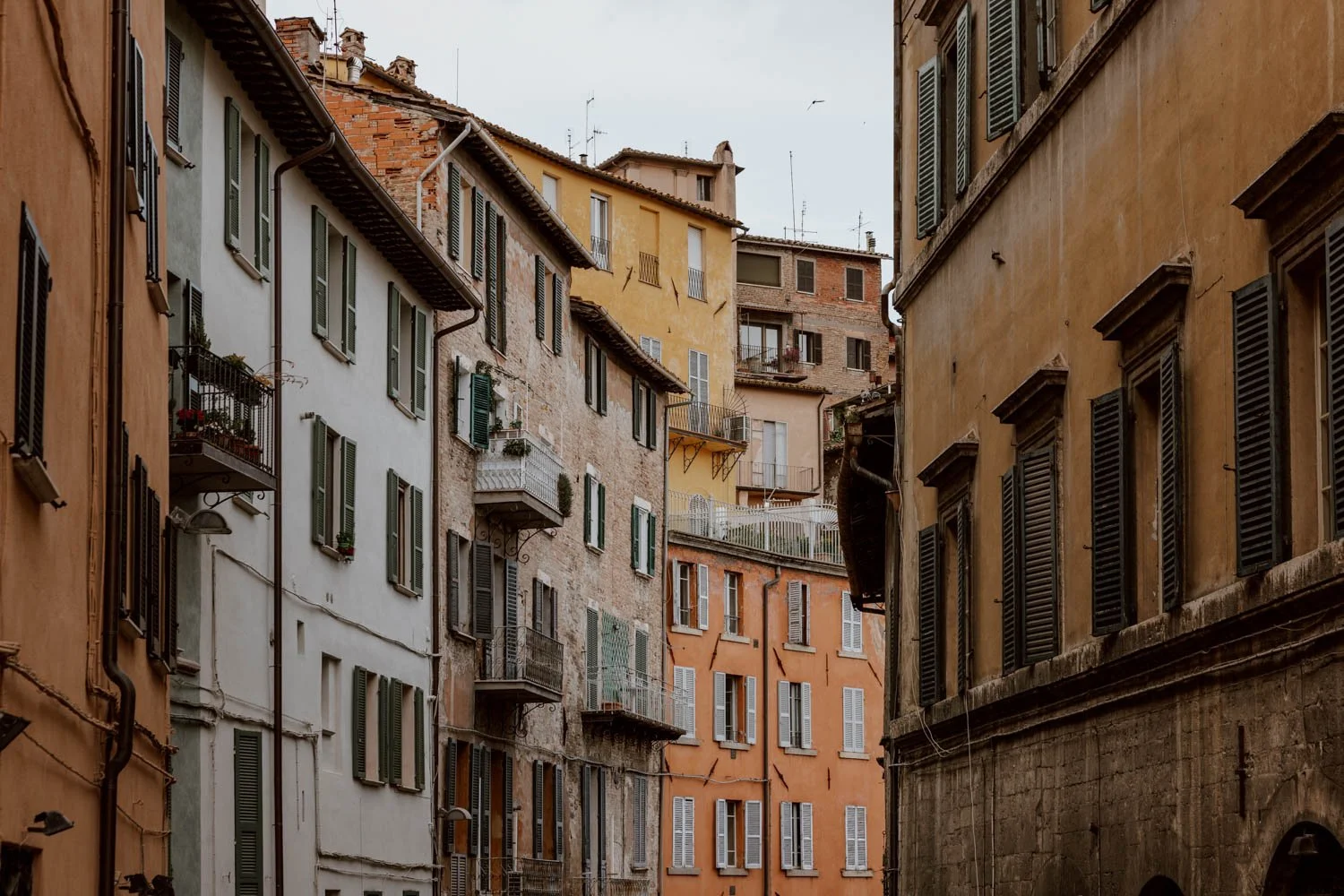
Built at the tailend of the 13th century, Perugia’s medieval aqueduct once carried fresh spring water from Monte Pacciano to Fontana Maggiore, the city’s main fountain. These days, its long stone channel transports awestruck tourists and non-plussed locals from Via Cessare Battisti toward the University of Perugia.
Now, telling you to visit basically a raised pedestrian walkway may only set the pulses racing for engineering enthusiasts, the important point is just how unique and scenic this area is: a not-so secret ribbon of stone that snakes through and past the washing lines and windows of the cramped honey-coloured houses that have grown around the arches like ivy.
In an overdone, over visited city, this would be littered with crowds and Instagram posers, and simply written off as a place to appreciate - but here in Perugia it’s still simply a practical way to take you from A to B and a place to appreciate the clash and the cooperation between Perugia’s past and present.
Where | You can find the Acquedotto medievale di Perugia here on Google Maps, and you can enter from either side. However, we suggest the best first impression is to descend through the arch and down the steps - just head toward the late-night craft beer joint and you’re in the right place (maps)
Know | At times, you’re literally pressed up at eye level with bedroom windows and front doors of the houses and apartments,, so do respect the privacy of those who stay here. If you’re planning to study in Perugia, one of these places would be such a romantic, quixotic place to rent.


Art at the Galleria Nazionale dell’Umbria
Part of the appeal of Perugia as a city break is that it doesn’t present the same amount of overwhelm when it comes to galleries and museums. Not only does this prevent Stendhal syndrome symptoms - a serious risk in Florence - but it allows you time to savour the myriad other joyful elements Italian travel.
The Galleria Nazionale dell’Umbria is the standout that will feature one everyone’s list.
Set inside the Palazzo dei Priori, a Gothic masterpiece in Perugia’s historic centre since 1292, it houses one of Italy’s most important collections of medieval and Renaissance art, with works by Pinturicchio, Piero della Francesca, Fra Angelico, and native son Perugino - one of the leading Renaissance painters.
The palace was the seat of the City Council since the Middle Ages, ands its historic spaces across two floors are full of light and well-adapted, making it more interesting to wander than many a modern ‘white cube’ gallery. Overall, it was excellent.
The only drawback? Personally speaking, there was almost too much to take in, with the entire 800-year history of Italian art traced through the prism of the Perugian and Umbrian influence, meaning that, by the time we’d reached the18th century after two hours, we were near the limit of our attention and appreciation span. This was a real shame, but not unknown in the large national Italian galleries, so do be aware that you don’t necessarily have to front load and take in everything you see at the start!
The most treasured works to seek out are the cusp of Perugino’s Decemviri Altarpiece (the rest is in the Vatican), the Polyptych of Perugia, an original from the city’s fountains, but a few personal highlights included Bartolo’s Pentecost, the Madonna di Sant’Agostino, a bizarrely modern ‘Miracles of Saint Bernardino’, the frescoes in the Priors’ Chapel, Forli’s ‘Salvator Mundi’, and laying back on the orange sofa to take in the rather trippy, debaucherous roof.

Where & When |Find the National Gallery of Umbria here on Google Maps.
It is open from 8.30am - 7.30pm seven days a week during peak season, but from November through to the end of June it’s closed Mondays. Note that the ticket office closes at 6.30pm. We suggest you need two to three hours for meaningful visit, but bear in the mind that there are regular exhibitions in addition to the permanent collection (when we visited, it a very enjoyable one on the Master of Saint Francis icons).
Tickets | Standard entry is €10, rising to €12 when there are special exhibitions. It’s just €2 for EU citizens aged 18-25, and free for anyone under 18 years old.
Entry is free for everyone on the first Sunday of the month, but may require a €2 reservation - find more details and buy tickets on the official gallery website,
There are digital lockers available inside for securely storing your bags.
Good to Know // Housed in a former Dominican convent, the Museo Archeologico Nazionale dell’Umbria (MANU) is the Perugia’s other major museum, focusing on Etruscan, Roman, and medieval finds from the city and wider region. It’s open 8.30am to 7.30pm Tuesdays to Sundays.


Head Up Torre degli Sciri
As any visitor to Bologna, Siena, and Lucca will know, medieval Italian power brokers were obsessed with erecting large towers.
These weren’t just defensive structures but status symbols, where wealthy families competed to outdo each other.
The logic was simple: biggest tower wins.
A dick-measuring contest in pale pink limestone.
Perugia was once filled with these skyward statements - even known as the “città turrita” (turreted city) - but many were destroyed through war, urban restructuring, and by order of rulers keen to curb the power of the city’s families.
Built in the late 13th century by the degli Oddi family (but nabbed by the Sciri’s when they had to leave Perugia), the 42m Torre degli Sciri is the last one standing.
Recently restored and run by really friendly volunteers, it’s currently free to climb the 232 steps to the top - with the reward being one of the best views of Perugia and beyond.

Where & When | Find the Sciri tower here on Google Maps - there’s no requirement to reserve tickets or timeslots. It’s open every day except Tuesday, and in summer 2025 the hours are 11am-12.30pm, then 3.30pm-7.30pm.
If you want to confirm, WhatsApp them on +39 39 351 457 93.
Note that there’s no shade at the top and, whilst Torre degli Sciri would be an incredible spot for sunset, the opening hours unfortunately don’t make it possible most months. There are occasional star-gazing evenings from the top of the tower - keep an eye out for posters around town.
Nearby on Via dei Priori is the student-favourite hangout Oma (maps). Its piazza is sunlit in the mornings for a coffee and pastry, whilst it’s open post-midnight for beers and cocktails.
Travel Tip // Perhaps it was because a year had passed since our last Italy trip - or because the tourism of Milan meant our body clocks were still off - but Perugia’s rhythms caught us out. We always do our best to adjust to the hours of the morning coffee, the passiegata, the aperitivo, and the late dinner, but the schedule here seemed so purely Perugian - so unbothered about catering to outsiders - that we found ourselves constantly getting it wrong!
Perhaps it’s because there’s less tourism filling out empty bar and restaurant tables at odd hours - bridging the gap between ‘normal time’ and ‘Italian time’ - or the transition from day to night is more dictated by the whims of students. At our favourite bars, we were told that it’s sometimes gone midnight before it comes alive.
Whilst that sort of schedule isn’t outwith our travel style, this definitely wasn’t that trip for proper boozy nights to the wee small hours.
Our experience of the rhythms may have been unique, but we just wanted to give a heads up in case you also find yourself nursing a Negroni in an empty bar at 8pm, wondering where everyone else is.


The Piazza & The Cathedral
The beating heart of Perugia is Piazza IV Novembre, a gently sloping square that’s served as the city’s civic stage for centuries. The site of Roman debates, medieval executions, papal pronouncements, student protests and evening get-togethers, its name commemorates the day the First World War ended in Italy.
Anchored by Palazzo dei Priori and Cattedrale di San Lorenzo - the historic seats of political and religious power - several of Perugia's streets fan out from it. Most flâneurs ultimately end up there by chance or choice.
The Cathedral is the most prominent building, and its most striking feature is what it lacks.
The facade is unfinished and bare, its spaced ridges bones without flesh, hinting at a grand marble frontage that was barely started, let alone completed. The 14th-century plans faltered amid financial pressures and shifting politics - partly due to the 1540 Salt War - leaving the cathedral’s forever undressed.
The austerity continues inside, where there are few windows and everything feels regional, sparse, and quite sober in comparison to the gilded glories you'll witness within the famous Duomos of Siena, Milan, and Florence.
Yet, this is also - refreshingly - an active, working Cathedral rather than one that has been overrun by tourists or transformed into a paid-for tourist attraction, where faith and prayer take a back seat to tickets and queues.
The Anello del Santo is the most revered possession. Said to be the wedding ring of the Virgin Mary - though the signage indicates it should be considered as a 'memorial of the event' rather than the original - it's only on public display twice a year (29th - 30th July and 12th September).
We were particularly drawn to the raw colourful 13th-century crucifixion scene at the back left, and Giannico di Paolo's unusual 'Mater Gratiae'.
Outside in the piazza, the 13th century Fontana Maggiore stands proudly as the centrepiece. It's a stunning display of medieval artistry, but unfortunately the fence makes it a little less easy to appreciate the finer details (but the original panels are actually in the Galleria Nazionale).

Where & When | You can find the Piazza IV Noviembre and Perugia Cathedral here on Google Maps - and you’ll pass both several times during your stay.
Services and Masses take priority, with tourists politely turned away during religious ceremonies, and a red velvet curtain marking off a space for private prayer. One of the two entrances is only open to attendees during services.
Mass is held every day at 8am, 11am, and 6pm (8.30am on Sundays), so plan your visit to avoid the cathedral for up to about an hour after these times.
Modest, appropriate clothing is expected of visitors in all religious buildings in Italy, and you should take off hats on entry. Act appropriately inside, and give privacy and priority to worshippers.
Did You Know? | St. Lawrence, the Cathedral's namesake, is one of Christianity’s early martyrs, said to be roasted alive over a grill by the Romans and whose last words were "Turn me over; I'm done on this side". Due to this fate and sign-off, he's the patron saint of both cooks and comedians!
Travel Tip // Facing the Fontana Maggiore, the Cathedral’s steps are a wonderful, organic social spot for the Perugini and international students doing their best to blend in. Toward aperitivo hour and nightfall, lovers and friends buy bottles of beer or spritz in plastic cups from the nearest shop and congregate there, and it’s a lovely, very European atmosphere.
Above those steps, you can also see the pink and white bands that hint at what was intended for the rest of the exterior.


Drinks on Via della Viola
Beneath arches and vaulted passageways, by day this slender street of artists and drinkers is quiet and seems like just another one of the city’s dark medieval warrens but where the walls are a patchwork of poems, polemics, and scrawls in black felt tip.
Part open-air gallery, part public diary, it’s photogenic but not something to really to go out of your way for.
By night though, often to a schedule we couldn’t quite understand, it all stirs to life. Students, poets, rebels, politicians and night owls drift in, drawn by the promise of whichever hole in the wall is spilling out or has the soundtrack that evening on the ‘Street of Violets’. So narrow that there’s no tables or chairs, everyone has to part when a scooter or Fiat passes through, it’s probably what one could classify as the ‘hipster area’ of Perugia, but it all felt more organic, laid-back, and grungy / democratic / boho, rather than a scene to be seen in.
We spent several evenings there drinking, eating, and standing around trying to fit in (mixed success), and it’s where we’d go to in a heartbeat at night if it’s a good fit for your travel style. Places to seek out or linger outside are:
Sete / A small jazz and music bar that serves up an excellent campari spritz to a fantastic soundtrack
Free Ride / A grungy dive bar exactly how they should be, and the guys working there are sound - open 6.30pm until late.

Agricola / Good selection of craft beer cans to take outside.
La Fame / Run by a chess-playing artist with a hand in the kitchen, this quirky space but serious restaurant is one of those places you stumble on once and remember long after. We passed it on our first day and knew we had to go back, and the dinner outside under the Martin Parr street art was fantastic. The soundtrack and service from the curly-haired young woman was also on a different level. Though the menu may be a bit more complex than you like, we highly recommend diving in and trying out the different flavours and dishes.
Civico 25 / We didn’t eat this very highly-regarded restaurant as the best of the menu was very meat-focussed. However, if you’re a carnivore, it should absolutely be on your list - but do note that spaces are limited and it’s a good idea to reserve if you can. Seating from 7.30pm, closed Sundays.
PostModernissimo / A cornerstone of the Perugia’s cultural scene, this cinema was resurrected a decade ago by a grassroots commnunity campaign. It shows independent and art-house films, but the adjoining bar and gallery space are popular with visitors. Our Airbnb host recommended the little slow food restaurant right across the steps - Il Moderno - but unfortunately we weren’t able to eat there.
Travel Tip // Continue down the stairs onto the street we think is one of the prettiest streets of Perugia, with periodic glimpses through the blush peach walls out to the green hills of Umbrian countryside, a sweep of terracotta rooftops, and the mountains beyond.


Seek Out Those Umbrian Landscapes
It only takes a glance from one of Perugia’s myriad of viewpoints to understand why Umbria is called “the green heart of Italy”.
Coined by 19th-century writer Giosuè Carducci, the first sight of those rolling hills, fields, and layers of soft, painterly green stretching to the horizon is so achingly familiar and feels like stepping into an 18th-century oil painting.
The Gardens / Probably the best known viewpoint or belvedere, you can find it next to the Giardini Carducci. There’s a handy “tavola panoramica” with the names of landmarks and their directions laid out relative to where you’re standing.

Punto di Vista / Close to the Gardens, the suitably named bar is a really popular spot for visitors to enjoy sundowner cocktails on the terrace accompanied by a stunning view. We swung by twice but gave it a miss as the atmosphere was a little stale, so we headed for an aperitivo near Piazza IV Novembre instead, but that could just have been on the days we stopped by or us being arseholes. If you’ve only got a short time in Perugia, this would rank as unmissable spot for many to bring their afternoon to an end and begin the evening. Also, note that you don’t have to go to the bar to enjoy the view as the public street and viewpoint is right by and above it. However, if you want to toast it or give yourself a well-earned Campari spritz, then that’s always going to make it 10x better!
Terrazza del Mercato / Wander through the cute little covered market with a friendly grocer, fishmonger, and butcher, and you’ll emerge onto a large, modern terrace with expansive views bookmarked by the higgledy piggledy houses to the left and Basilica di San Domenico to the right.
Arco Etrusco / We stumbled upon this when wandering. On Via Cesare Battisti, right next to the Etruscan Gate, it shows several sides of Perugia and the massive blocks of the city walls (more on those later).
Happily, as you seek out and join up the viewpoints, you’ll naturally be covering a lot of Perugia’s streets and quarters.


Eat Chocolate
Perugia has long been considered Italy’s unofficial chocolate capital, thanks largely to Perugina, the brand behind the famous Baci — dark chocolate ‘little kisses’ filled with hazelnut, each wrapped in a love note. While Perugina is now owned by Nestlé, its roots are firmly local: the company was founded on Via Angusta in 1907 and responsible for several innovations in confectionery.
Its success meant chocolate quickly became one of Perugia’s most famous exports, and the city has embraced that identity ever since, with events like Eurochocolate and local shops keeping the tradition alive long after Perugina became part of a global brand.
Understandably, there are quite a few places to pick up a box (or three) in the city and those with a sweet tooth are absolutely allowed to list it as a cultural activity:
The Perugina Shop | Conveniently in the town centre, it sells their full range of products, but we were honestly a bit disappointed by the set-up and service. However, almost every visitor will stop by there and you can mix & match all the different flavours!
Eurochocolate | There are two or three year-round Eurochocolate-branded shops offering festival-style chocolate treats and gifts — the largest is on Piazza IV Novembre.

You can also pick up standard boxes of Baci (often for less) in every supermarket.
If you’re really keen, it’s possible to visit the Perugina factory and its Casa del Cioccolato museum. They offer tours and tastings in both English and Italian, but it’s about 15 minutes outside the city centre (Google Maps). Full-price tickets cost €12, but there are various concession discounts, and booking ahead is essential. Find out more on their official website
A new addition opening this year is the Citta del Cioccolato, by the Mercato Coperto. The so-called ‘Chocolate City’ aims to transform the historic market space into a hub of bars, shops, educational areas, and chocolate-based experiences. Hopefully it will enhance some of the artisanal chocolate credentials - let us know if you visit!
Travel Tip // Inspired by a visit to Germany’s Oktoberfest, Eurochocolate is a huge annual festival held every October. It’s now one of Europe’s biggest chocolate events drawing artisan chocolatiers and visitors from around the world, filling the streets with stalls, sculptures, workshops, and tastings. Just bear that date in mind if you’re planning a shoulder season city break, as accommodation availability will be quite limited.


Walk The Arco Etrusco to Chiesa di San Michele Arcangelo
Perugia was originally founded by the Etruscans - an ancient civilization that thrived in central Italy before the rise of Rome - and the city’s origins date back to at least the 6th century BC.
It’s sort of mind-blowing if you think about it for too long.
The hilltop setting was largely strategic and, though much of the Etruscan city has been destroyed or built over, their presence and engineering skill are best displayed in the northern entry arch and defensive walls. One of seven original access points, the 3rd century peaked Arco Etrusco (Etruscan Arch) is a well-preserved gateway constructed from large , precisely cut travertine blocks, topped by an inscription marking Perugia’s conquering and renaming by the Roman Emperor Augustus in 40-41 BC.
We recommend going down to the right to this point on Via Cesare Battisti (maps) to get a better appreciation of the scale of the walls, the material layers of time, as well as a surprisingly unheralded viewpoint too.
For those on day trips or shorter stays in Perugia, you may not be able to retrace our steps. However, those with time, may wish to continue walking north past the University for Foreigners of Perugia and along Corso Giuseppe Garibaldi.
Away from the historic centre, this lets one see a different side to daily life, and leads to the wonderful Chiesa di San Michele Arcangelo (maps).

This small, circular 5th/7th century church - thought to be the first in Perugia and one of the oldest in Italy - is so uniquely crafted and peaceful that it left a greater impression than many a Duomo. The small, sunny gardens outside are a secret delight if you're not in a rush.
The Torre del Cassero di Porta Sant'Angelo is nearby (maps), but we knew nothing of it until we passed by. It appears to function as a few different things, but you can go up to its 'Terrazza Panoramica' with an advance booking - details on their website.
Where + When | You can find the Arco Etrusco here on Google Maps. Chiesa di San Michele Arcangelo is a slow 15-minute walk away - here on Google Maps - and open 9am-6pm every day. There are still services on Sunday though, so best to work around them.
Know | Those with an predilection for Etruscan engineering may also wish to visit the ‘Pozzo Etrsuco’ by the Cathedral. Dating from the same period as the Arco and walls, it supplied Perugia with water and is one of the best-preserved examples of Etruscan hydraulic engineering in the city. The interior is open to visitors every day of the week from 10am-2pm, then 3pm-5.30pm, costing €4 for adults and free for children under 12 years old.
Travel Tip // If you’re timing your walk back from the church with aperitivo hour, we can recommend Poggio Cafe (maps). The drinks on offer are fairly standard, but it’s the setting that’s lovely - the worn stone stairs outside snaking down from a narrow street above that triple the outside seating quota in a wonderful fashion.
There’s also special little church across the road from Poggio - Chiesa di Madonna della Luce - which some may wish to visit for a quiet moment. Modest dress is required, total silence expected, and no filming, phones, or video permitted.


Sniff Out Truffles & Devour Strangozzi
It’s Italy, so you’re always going to eat well.
But, for those who love rich, hearty dishes, Umbria will be your happy place.
This is Italy’s secret truffle heartland - a rugged, forested region where oak woods conceal some of the country’s most prized black and white treasures.
Here though, truffles (tartufo) aren’t a luxury reserved for fine dining rooms but more of an everyday staple when the season’s right.
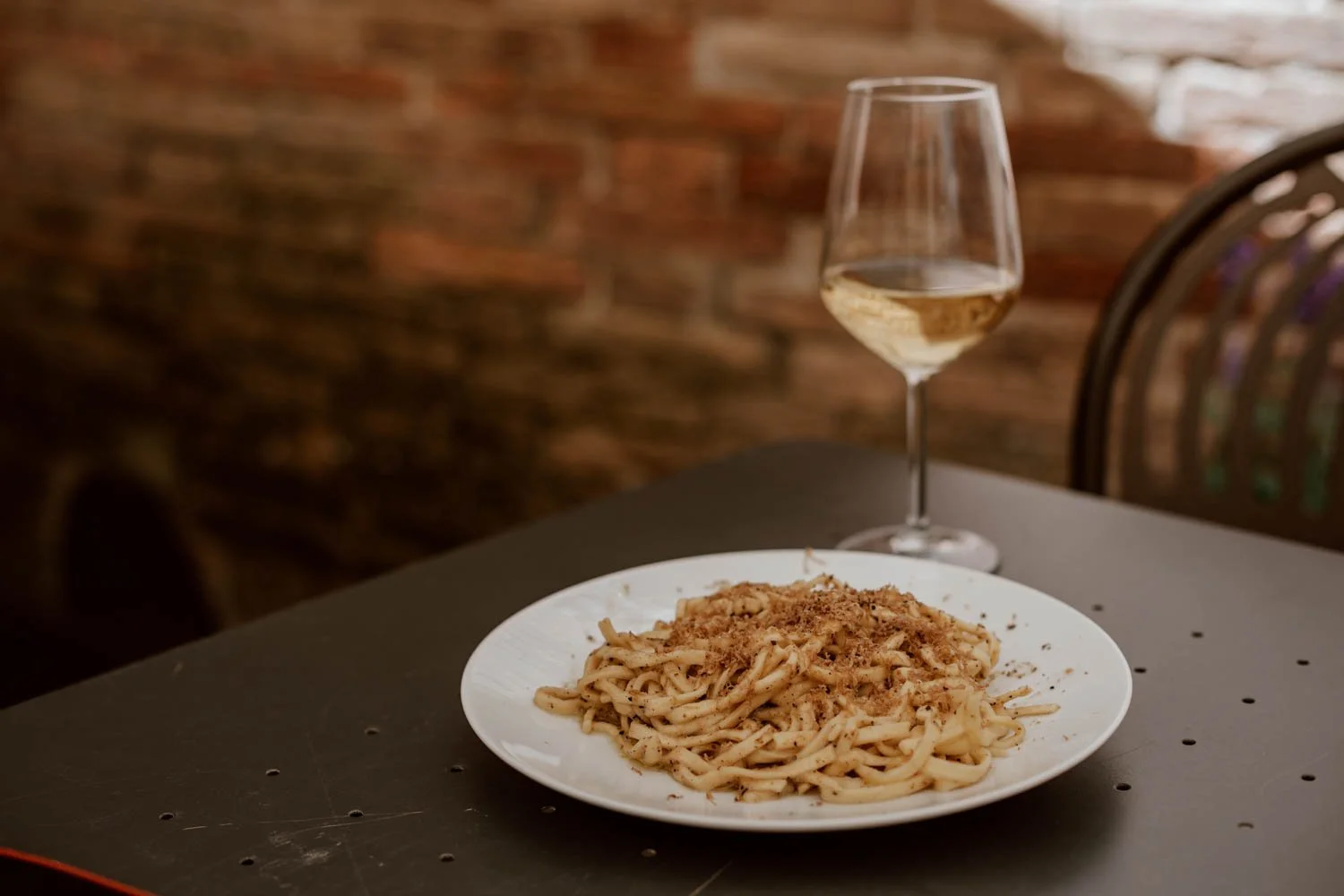
While the true hunting grounds lie in the hills beyond, Perugia’s menus celebrate the region’s obsession year-round, with shavings of black truffle over strangozzi, stirred through sauces passed down from generation-to-generation, and even in scrambled eggs. In autumn, the city’s markets brim with fresh finds, and this is one of the easiest places for travellers to taste Umbria’s most intoxicating ingredient without having to go deep into the countryside.
Almost every restaurant has at least one truffle dish on the menu - throughout the year - with a few that specialise in it. The Umbrian palate is typically quite meat-heavy, but vegetarians will be delighted to know that an Umbrian classic tends to be vegetarian. Strangozzi al tartufo nero is based around the regional hand-rolled strangozzi pasta made only from flour and water - no eggs - typically cut into thick, square-edged strands, and tossed in olive oil, garlic, and shavings of local black truffle.
Yes, you shall order that.
Do note two things though: 1. the quality varies dramatically when you’re visiting out of truffle season; and 2. if you haven’t had a big bowl of truffle pasta before, then beware that it fills you up quick and leaves you feeling like a gout-ridden medieval king.
Below, we’ve shared the places we enjoyed eating out in Perugia, as well as some that caught our eye or came recommended:
· Osteria a Priori · We really enjoyed our lunch here, and it’s a good option to introduce yourself to various Umbrian dishes and wines.
· Ristorante Al Tartufo · Just steps from the Cathedral, this was our Airbnb host’s main recommendation
· La Fame · We’ve already mentioned this quirky but serious restaurant run by a chess-playing artist with a hand in the kitchen.
· Verace · Really good pizza and a laid-back atmosphere, nuff said. Another option in the main square that was always busy with locals whenever we passed is Piazza Piccinino
Lo Moglie Ubriaca · We had a pre-dinner selection of delicous small plates at this charming wine bar, washed down with a couple of glasses of local wine recommended by the knowledgeable and friendly owner.
Fontanella da Ginetto · We didn’t make it here but a follower who lived in Perugia told us that it was her very favourite restaurant in the city. It’s just one local man cooking everything so arrive expecting there to be quite a wait.
Trattoria Piazza Ansidei · Traditional, unfussy, home-cooking in a rustic setting with a menu that changes daily.
La Pecora Nera · This polpette spot is a good shout if you’re looking for a quick lunch or easy dinner.
For proper good gelato, we personally recommend the following:
La Gelateria · A big hit with us on the walk home after dinner
Il Gelato di Mastro Cianuri · You won’t be disappointed with this popular place in Piazza Giacomo Matteotti
Lick · Modern gelato spot in steel tins with unique flavours-lovely walk down from centre or after the Rocca gate


Go Underground in Rocca Paolina
For centuries, what we now call Italy was a patchwork of independent city-states, republics, and kingdoms - each with its own rulers, armies, and ambitions.
As a Papal State, independently-minded Perugia enjoyed a degree of autonomy, with one of its privileges being an exemption from one of the Vatican's most important levies: the salt tax.
An essential, expensive product at the time, the Pope effectively had a monopoly and the the tax was source of revenue.
When these exemptions were suddenly removed, the Perugians rebelled and declared independence. The revolt was swiftly crushed by the Pope Paul III's troops and, to assert physical and symbolic control over the city, construction started swiftly of his Rocca Paolina fortress.
It was a response that was, one could say, a bit salty.
To rub salt into the wound (sorry), the construction of the Pope’s revenge required the destruction of a significant area of Perugia called Rione delle Due Torri, which included a number of those medieval towers we mentioned earlier, noble family homes, churches, and even remnants of ancient Etruscan and Roman structures.
It was arguably the greatest single transformation to the city in a millennium.
Unsurprisingly, Rocca Paolina instantly became a symbol of oppression, and when Perugia became part of the newly created unified Kingdom of Italy in 1861, one of the first acts was to demolish the detested Papal fortress.
What remains today is an empty shadow city of sorts: a network of underground passageways, huge vaults, and dimly lit cellars that incorporate the older medieval buildings, walls, arches, towers, and streets. Most bizarrely, its primary function these days is as a shortcut for commuters and students heading from one part of the city to another, with escalators even incorporated in places.
As a visitor experience though, our feelings were mixed.
We struggled to get our heads around what we were looking at, whilst the exhibitions, explainers, and spaces were perhaps not utilised to their fullest. Admittedly, we made the rookie error of walking the route in reverse, so all the signs were in reverse - but even allowing for that, the potential didn’t feel fully realised.
That said, whilst you should absolutely visit the remains of Rocca Paolina, just be aware that it may not hold your attention for as long as you expect.

Where + When | Find Rocca Paolina here on Google Maps - it’s free entry for all.
Learn from our mistake and enter where we exited at Porta Marzia, the huge gate where it’s clearest to understand the fortress on top of the city. It’s open from 7am to 8pm and you can walk or take the escalators down there - find it here on Google Maps.
You can also enter Rocca Paolina via the escalators at Piazza Partigiani and Piazza Italia - note the escalators operate from 6.15am-2am.
It’s refreshingly cool down there by the way, so a good option to stop by during the peak heat of the afternoon.
Read | What links the pope and unsalted bread in Perugia? This Atlas Obscura article is a really good read.
Top Tip // To gain a better understanding of Perugia’s underground secrets, it’s a good idea to join a highly-rated walking tour like this one.


Do A Day Trip from Perugia
We like to travel slow at Along Dusty Roads, but some may say there’s ‘slow’, and there’s a ‘sloth-like’
Although we arrived in Perugia with intentions to travel over to the pilgrimage town and famous church of Assisi, we decided we’d rather commit that extra day to the city itself (saving Assisi or a future Umbria road trip).
However, if your pace is a bit quicker, you’ve got a rental car with you, or you would prefer to use Perugia as a base to slowly uncover more of Umbria, these are the side trips that should be on your list:
· Assisi | Famous as the birthplace of St. Francis, this hill town draws pilgrims and visitors to its medieval streets, sweeping views, and the remarkable Basilica di San Francesco. Known for its peaceful, contemplative atmosphere and well-preserved historic core.
However, despite being just eleven miles away, it’s still a two to three-hour roundtrip with public transport from Perugia.
This super popular experience combines a guided tour of Perugia and Assisi with transport between the two.
· Montefalco | Known as the 'Balcony of Umbria”’ for its panoramic views, Montefalco is famous for its rich Sagrantino red wine and charming medieval streets. If you want to get better acquainted with he native grapes and wines of Umbria, this is probably a good place to start!
Alternatively, consider this winery visit & tasting or joining the small-group Umbria Wine Lovers tour.
Lago Trasimeno | Italy’s fourth-largest lake, under-the-radar Lago Trasimeno offers tranquil waters, scenic cycling routes, and quaint lakeside villages perfect for a peaceful day trip from Perugia.
· Spello | A little medieval town we’ve already bookmarked for our road trip, it’s very photogenic and famous for its flower-lined streets. It’s just 30 minutes away by train and a stop on the Olive Path Trail - those looking for an experience should take a look at this highly-rated e-bike tour which includes Spello, lunch, and wine!

How Long & Where To Stay in Perugia
So, how long do you need in Perugia? | We think a three-night stay is great, which could include one day trip (or not). However, we could have quite happily have stayed a few days longer.
Old town vs. New town | Staying up in historic centre of Perugia is going to provide the most atmospheric and enjoyable experience. If you’re thinking of staying in the modern area because it’s easier to arrive with a rental car, just note that you will still spend most of your time up in the old town.
Don’t forget the festivals | Visits coinciding with the Umbria Jazz festival (July) and the Eurochocolate festival (October) will see increased prices and less availablilty.
We’ve done the hard work and hand-picked a selection of the very best places to stay in Perugia, with something to suit every travel style and budget.
Hotels in Perugia
Sina Brufani | A grand old palazzo perched on Piazza Italia, Sina Brufani blends19th-century elegance with intimate charm: think parquet floors, velvet sofas, and a spa tucked into medieval vaults. From its rooftop terrace and glass-floored pool, you’ll get sweeping views of Perugia’s hills and underground history beneath your feet.
Hotel Priori Secret Garden | If contemporary styling is something you look for in a place to stay, be sure to take a look at this hotel. Its rooftop bar makes it a super popular choice!
The Bank | A sleek former bank turned boutique hideaway on Corso Vannucci, just steps from Perugia Cathedral and Rocca Paolina, this hotel fuses bold design with historic bones, with marble floors, modern art, and deeply comfortable beds.
Times Suites | A collection of gorgeous rooms that beautifully blend sumptuous modern design with period features. It’s a self check-in/out situation but it does have very convenient private parking nearby.
Hotel Fortuna | A warm, old‑world stay just steps from Corso Vannucci, this mid-range hotel blends vaulted frescoed rooms, a library, and a rooftop terrace with views spilling over Perugia’s rooftops. Guests rave about the staff, hearty buffet breakfast, and the cosy reading nook hidden behind medieval arches.
If hotel facilities are less of a concern to you, and it’s more about a good location, a comfortable room and good ratings - at an affordable price point - then you should take a look at Hotel Iris, Hotel S. Ercolano, Hotel Morlacchi, Hotel Umbria, or B&B Uva Fragola.
If you’d prefer to have access to the city but stay within the hills, there are a number of beautiful countryside retreats within a short distance of Perugia Castello di Monterone is our top pick.


Airbnbs in Perugia
Eco-living Luxury Design Apartment | This is where we stayed, and honestly we loved it! Located in a quiet part of the historical centre, it is spacious, beautifully designed, has a fantastic kitchen, is full of light and even has a small balcony with views over the rooftops and out to the Umbrian hills beyond.
Prestige and Comfort | A two-bedroom apartment decorated in a colourful contemporary style, it’s got excellent reviews and even a home office setup (ideal if you’re combining work and pleasure).
La Casa dei Pellari | This smartly designed studio is special for two reasons: one, there’s an actual Etruscan well within the property (hidden beneath a glass floor), and two it has a charming little, vine-covered garden area ideally situated to enjoy drinks or dinner with a wonderful view over the historic centre. Also available on Booking.com
If a garden sounds like a fabulous idea but the above isn’t available, take a look at Etruscan Flat instead.
Imperial Suite | For a uniquely historic and opulent experiecne, consider a stay in the exquisite apartment located within Palazzo della Staffa. High vaulted ceilings adorned with 400 year old frescoes are the star of the show, but the entire two bedrrom property is wonderful, decorated with both antiques and modern amenities.
If you’re looking for a property that won’t break the bank (even in peak season), this one-bedroom apartment is our top pick. Light, bright and cosy, it’s furnished in a modern style offering everything a couple needs for a stay in Perugia. Amazingly at this price point, it also has a large panoramic terrace!
Alternatively, this one-bed and this two-bedroom apartment are also cheaper than the Perugia average.
Tu Casa | This sloping attic roof apartment just screams cosiness - we could totally envision it for an off-season visit. Recently renovated with original materials, it has been tastefully furnished like a home rather than a holiday apartment.
The Vannucci Triple Lancet Window | Be right in the heart of it with views over the main piazza and the cathedral. Period features abound within this one-bed apartment but it’s been given a stylish uplift - it even has a piano for the musically-inclined amongst you.
There aren’t many three-bedroom properties in the historic centre, but Caporali 23 is a good option if you’re looking for a little more space.
Other properties that caught our eye include: Alba di Perugia, Casa di Gaia, The Happy Terrace (mainly for the, well, huge rooftop terrace), Music Home, Central Apartment, and Al Duomo. A follower also recommend this property.

How To Get Around Perugia
Perugia has a unique layout of historic layers, steep cobblestone streets, and sloping alleyways, but a very modern, ingenious way to navigate them.
A series of escalators, lifts, and even a monorail (yes, Simpsons fans - a genuine, bona fide, electrified Monorail!) link the old town up on the hill and the new town below, meaning that getting around it is quite different to most cities.
It caused us a fair bit of confusion for us, so it’s worth understanding how it works before you arrive - especially if you’re coming by train or on an Umbria road trip.
The Train Station to Perugia Centro Storico
Like Siena, Perugia’s train station is in the new town down the hill - here on Google Maps.
From there, your best bet is to walk a flat 200 metres to Fontivegge (maps), a public transport hub where you'll find buses and the entrance for the affordable monorail (they call it a Minimetrò, but we're sticking with this!)
Its futuristic little carriages hold around fifteen passengers at a time between the modern and the medieval, and departures are very very frequent, so don’t fret too much if you just miss one. There's plenty space for bags, and this offers the quickest, most direct connection to the historical centre without any wait times or queues.
It operates Monday to Saturday from 7am to 9.05pm (last ride), and 9am to 8.45pm on Sundays and holidays. That early closing time can catch visitors out, so take note.
You can easily buy their UP tickets from the machines at Fontivegge, and the main options are:
· a standard single for €1.50 (valid for 70 minutes)
· a pack of 10 for €12.90
· a tourist UP card for €5.40 (valid for 24 hours)
The final stop uphill is Pincetto (maps), and from there you're just a couple minutes walk from the action.
Note that the nearest monorail station to your accommodation in the historic centre may still be downhill (or indeed uphill), necessitating a 5-10 minute drag of your suitcase across cobblestones and up steep side streets to your accommodation.
We did this for our fantastic Airbnb, and whilst it'll be perfectly possible for some streets and travellers, it may not be fun or straightforward with others - check Google Maps or ask your accommodation in advance of arrival.
For context, we only needed to take the monorail twice - once when arriving by train and once when leaving.
For more information, visit the Minimetrò website
Can you walk up from the train station? | Absolutely, but we highly recommend not doing so if you've got heavy or multiple suitcases. Though not as far as it seems, it's quite steep, some along a twisting busy road, and several streets ain't ideal for wheels or pedestrians. Instead, your best bet is to take the monorail or find a taxi to drop you off as close to your accommodation as possible.
Travel Tip // Remember to validate your ticket on entry and exit, and single tickets can't reused for 20 minutes after exit. You will encounter people outside the stations asking for your used tickets, sometimes quite aggressively.


The Escalators in Perugia
Perugia also has a network of covered public escalators built into the old city walls and medieval vaults. They were installed in the 1980s to help people navigate the steep, layered geography without having to climb endless hills and steps.
They’re free, open daily, and a great shortcut between the old and new towns - at times you literally travel through the vaulted remains of the Rocca Paolina!
The connections and access aren't always terribly obvious - and Google Maps doesn't always highlight them - but if you see 'scala mobile centro historico' you're in the right place.
We often used this one on Via Luigi Masi, whilst this one on Piazza Italia is just opposite the bus station, and one of the main thoroughfares, conveniently taking you out next to the Giardini Carducci. Note that the escalators aren’t open 24 hours, but usually from 6.15am to around 1.45am for the main ones.
Once you’re in the historic centre, the ups and the downs along and through cobblestone passageways thankfully aren’t as dramatic a gradient, with many involving stairs or shortcuts between the levels. It’s an immensely walkable city for travellers, with the centre and sights being quite compact, Some people may require a few more rest stops along the way, but most places of interest are just 15-20 minutes walk from each othe.
There are free bicycles for 30 minutes, but we didn’t fancy it.

Parking & Road Trips
In comparison to many other old Italian towns and cities we've visited, Perugia has more parking options in and around the historic centre. However, many of the streets are subject to the dreaded ZTL (Zona Traffico Limitato), so you should 100% contact your accommodation in advance to confirm if it’s possible.
Personally, we wouldn't bother driving up and through the tight streets of the historic centre unless we were 100% certain that we had a space and that we were allowed to drive through to it.
For day trippers with a car and those want a stress-free life, the easiest option is undoubtedly going to be parking in one of the various car parks in the ‘new town’ and just walking or taking the mini metro / escalators up. A couple of good options include:
Piazza Partigiani - this large paid two-level car park is easy to access and very convenient for heading up to the historic centre by escalator or monorail. Prices are also reasonable .
Parcheggio Sant’Antonio - close to the Etruscan arch, it’s good for walking to the historic centre, but reviews often mention how tight the spaces and exit are, so it’s probably not a good choice for larger vehicles.
This article details a few more options, but do let us know in the comments if you find a more convenient or cheaper alternative for parking in Perugia!
If you insist on driving into the centre, note that several streets are incredibly narrow and involve going through an even narrower archway / porta - it won’t be for the fainthearted and you may wish to put your mirrors in first (another reason why smaller cars are the best for most Italian road trips).
Read / We always look + book our cars via Rentalcars and AutoEurope, and it’s a good idea to compare both to get the best deal for your dates. For more advice to save you stress and cash, then check our Essential Car Rental Tips for Travellers.