How To Spend A Day in Tirana
A likely start and end point for Albania itineraries, you’ll almost certainly have a night or two in the country’s capital. In this guide you’ll find our recommendations for the best things to do in Tirana.

If anywhere in Albania encapsulates the country’s stark transformation over the past three decades, it’s the Blloku district in Tirana.
Once a gated enclave reserved for Communist leadership under Enver Hoxha, it’s now alive with cafés, restaurants, and a nightlife hub of the capital. The dictator’s 1970s-era house still stands, guarded behind chains and a large garden. As it decays, the modern version of hyper-capitalist Tirana soars skyward, metamorphosing through concrete, glass, and steel.
Tirana itself doesn’t fit the mold some might expect. Rather than a cityscape defined by grey, brutalist Soviet architecture, it's very much a work in progress. There’s a startling amount of development everywhere, with towers of luxury flats and avant-garde office blocks competing with each other to shade over the hills and reshape the skyline. It’s becoming known as every ambitious architect's favourite playground in Europe - replacing Rotterdam - with bold and controversial projects welcomed.
Darker forces also underpin this construction boom, but transformation is unmistakably part of the story.
Despite these rapid changes, most visitors to the capital of Albania will still primarily be focussed on that 20th-century past, and this tension between what the city is quickly trying to become and what it was until quite recently can feel quite disorienting, and perhaps explains our lack of immediate connection.
Or maybe it's because we saved Tirana until the end of our two-week Albania road trip - and the jolt of the growling city after the coast, the mountains, and the historic towns was too jarring. For many of you however, Tirana will be the natural first stop after landing at the city's international airport, so impressions may vary.
Based solely on our own experience, we’d recommend two days in Tirana to get a sense of the place at a slow pace. However, if you'd rather save time for the coast or countryside in your itinerary, a well-planned 24 hours is going to let you see the main sights of the compact centre and soak up the atmosphere on foot.
So, to help you plan, we're going to focus on how you should spend most of that day in Tirana.

The Tirana Essentials
Visit / The House of Leaves
Enjoy / The new Skanderbeg Square
Go / Underground at Bunk Art 1 + 2
Climb / The Pyramid of Tirana
Ride / The Datji Ekspres cable car
Shop / The Old Bazaar
Indulge / In truly excellent pizza at Pizzarte
Stay / We stayed at Hotel Stela Center (primarily for the private parking) which was fine but some potentially better alternatives are Hotel Boutique Vila 135, Syncron Centre Skyline, Rooftop Tirana and Vatër Apartments
Backpackers / Will love Vanilla Sky Boutique Hostel
Best Things To Do in Tirana
The House of Leaves
If you’re only going to visit one museum in Albania, make it this one.
Set in an otherwise unassuming building draped in leaves and creepers, it's one of the best museums we've ever visited in terms of thoughtfulness, curation, and ability to connect the chilling realities of a dark, knotted moment in history with visitors.
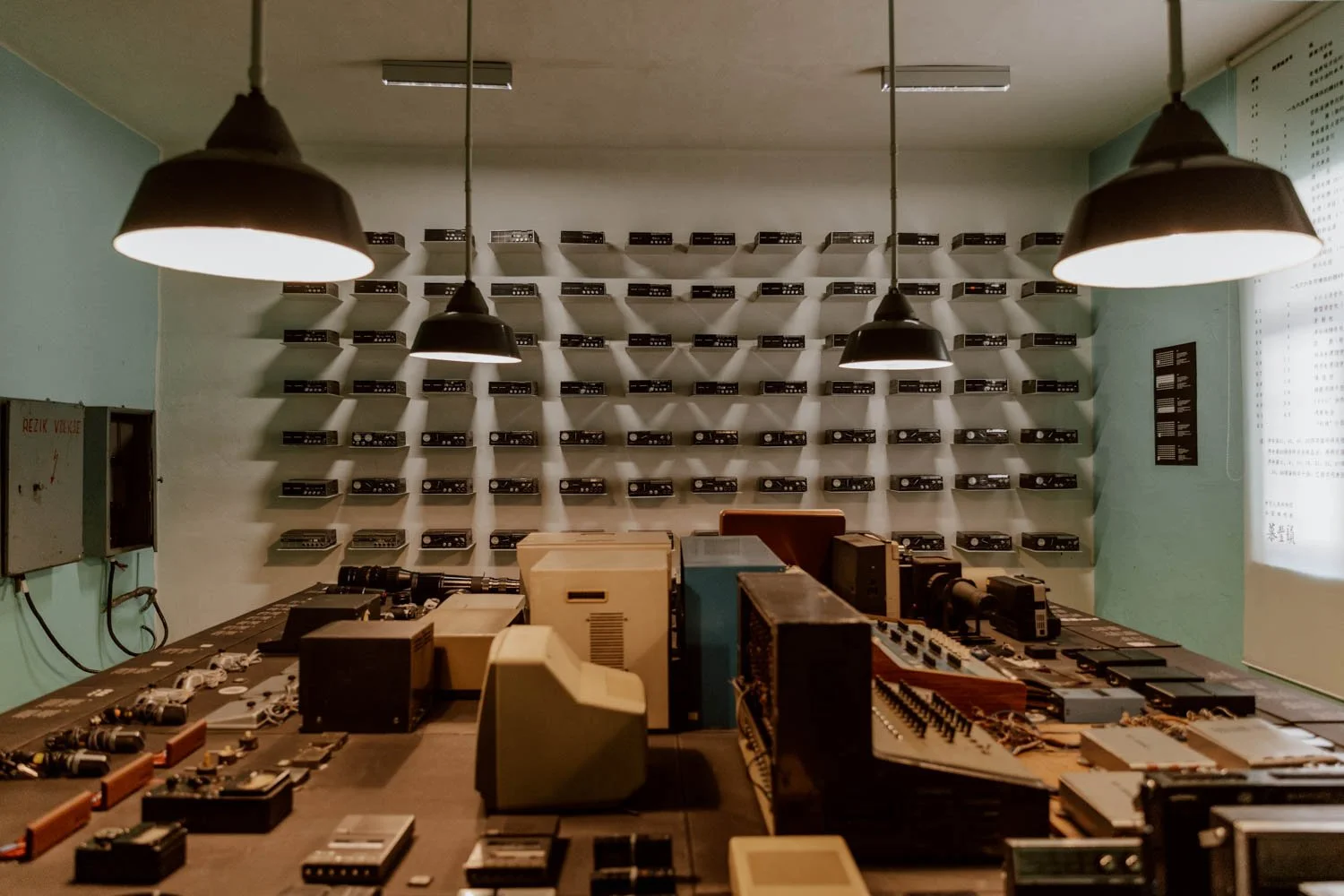
This was once the secret headquarters of the Sigurimi, Albania’s feared secret police, but rumours long swirled about what actually took place inside. It transpired that this was the ever-present eyes and ears of the regime's surveillance and security apparatus, with wiretapping, spying, and intimidation on an incredible scale.
The museum’s design feels like a film set in parts. You’ll walk through rooms layered with multimedia exhibits, films, thoughtful artistic installations, and original equipment used to bug citizens and enemies both real and perceived. In one room, you can watch foreign-facing films and news reports from the era, whilst in another there's the actual surveillance footage of a tenacious female black market trader embroiled with several diplomat's wives.
Within the very same walls of the buggers, surrounded by many original items, the experience is by turns mesmeric, voyeuristic, and chilling.
Where + When | You can find the House of Leaves Museum here on Google Maps
It's open every day from 9am - 7pm, and we recommend setting aside about two hours for fully absorbing the exhibits. Note that the displays follow a set, signed route across the two floors.
Cost | Entrance is 700 lek (€7). When we visited, the museum accepted cash and Albanian lek only, so come prepared.
Know | Don’t rush the final room, where private booths with headsets play synchronised victim testimonies and stories on screens. It’s a very moving conclusion, underlining how there was no neat resolution or apologies for many, with suspicion and fear lingering even after the dissolution of the Sigurimi in 1991.


The New Tirana Cathedral
When one emerges from the literal and metaphorical darkness of The House of Leaves, the golden doors of this Cathedral seem to shine even brighter.
Under Enver Hoxha’s communist regime, Albania declared itself the world’s first atheist state in 1967. All religious institutions were closed, religious practices banned, and many clergy imprisoned or executed. Most churches and mosques were demolished or repurposed into gyms or social centres.
To this day, Albania remains the only modern country to have constitutionally outlawed all religion.
Therefore, standing in the capital in front of a modern, architecturally bold cathedral such as this hits a strikingly different note to anywhere else in Europe. Officially opened in 2012, it's one of the largest Eastern Orthodox churches in the Balkans, built to replace the original cathedral destroyed under Hoxha.
As well as appreciating its design from the outside, it's definitely worth taking a moment to go inside to admire the light-filled cupola, the iconostasis, and the stunning painted idols.
Where + When | Open every day from 10am - 9.30pm, but visiting hours will be affected by religious services and ceremonies. Find it here on Google Maps.
Know | Modest dress is expected inside: cover shoulders and backs, remove hats, and give priority, respect, and privacy to any worshippers.
Travel Tip // A visit to the 'Site of Witness and Memory' in Shkodër offers the most powerful place to learn of the human consequences of the anti-religion policy.

Skanderbeg Square
Albania’s largest and most important public space, covering some 40,000 square metres, Skanderbeg Square is dripping with symbolism.
Originally conceived as an urban regeneration project by Italian fascist occupiers in the 1930s, it is named after Albania’s national hero - Skanderbeg - who resisted the Ottoman Empire for 25 years; the country fell under their rule following his death.
In 1968, marking five hundred years since he died, the regime unveiled a large statue of Skanderbeg on horseback.
This statue still proudly stands on the square's southern edge but, on a cold February morning in 1991, thousands of Albanians gathered here to bring down an equally imposing statue of Enver Hoxha - one of the Albania’s defining historic moments and the symbolic end of 'Europe's last dictatorship'.
Whilst Skanderbeg Square has reflected and outlasted two ideologies, the vast square you'll walk along bears little resemblance to its 20th-century version.
Edi Rama - the then-Mayor of Tirana and current Prime Minister of Albania - commissioned a bold redesign to pedestrianise the area and give it an overtly 'European' identity. This was in keeping with Rama’s overarching goal for the transformation of Tirana through buildings and urban projects, as well as nod to the new ideologies that will likely define the country's next chapter.
Wholly financed by state funding from the very non-European Kuwait, the final result in 2017 was a massive, open and disorienting esplanade. The weird slope you'll feel underfoot is actually deliberate: the square rises at a 2.5% gradient toward a central peak, allowing water from the fountains to wash over the colourful paving slabs and drain away.
The most interesting part of the redesign however is that all those stone slabs are sourced from different regions across Albania. Intended as a symbol of national unity, it also explains why you'll sometimes see groups of people seeking out particular stones from their district and taking photos with them!
Where | You can find Skanderbeg Square here on Google Maps - if you’re in Tirana on a longer visit, it’s good idea to spend time during the day and the early evening.
You’ll also find several of the capital’s most important buildings around the square, including the National Opera, Bank of Albania, and several government ministries. Next to the Clock Tower, you'll also find the small Et’hem Bej Mosque. Dating back to the late 18th century, it's one of few religious buildings to survive Albania’s atheist period, reopening in 1991. It's still an active place of worship, but visitors are permitted inside at certain times to view the frescoes for a small donation.
Know | If you take the hourly shuttle bus from Tirana Airport, you’ll be dropped off just next to the square. Find all details and costs in this post: How To Get From Tirana Airport to the City Centre


The National History Museum
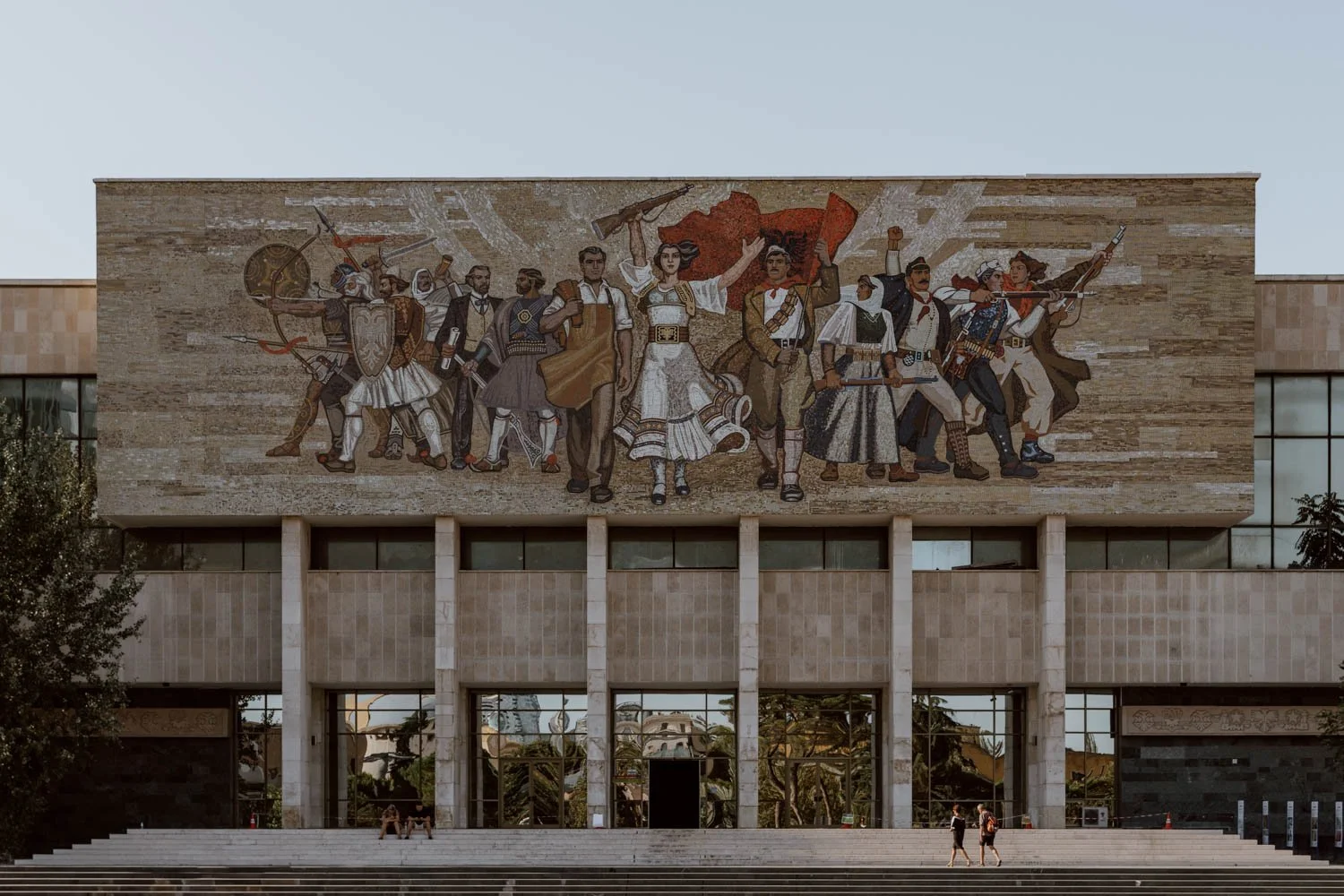
Another important building bordering Skanderbeg Square is the National History Museum (Google Maps)
Its façade is dominated by the large mosaic called 'The Albanians', a truly fantastic example of Socialist art. It depicts a range of historical figures - from Illyrian warriors and Skanderbeg himself to communist partisans - and represents the country's near-constant fight for independence in the face of occupation. After 1990, some communist-era symbols were removed from the mosaic, such as the red star and the red book.
Inside, the museum covers Albania’s history from antiquity through the Ottoman period and into the communist era. While it provides a comprehensive overview across its eight sections, those looking for a deeper dive into the Cold War years might prefer the more focused experiences offered by the House of Leaves or Bunk’Art museums.
Important | The National History Museum is currently undergoing a complete renovation, and is closed until 2028. Do let us know in the comments when it opens up so we can update the article for other travellers!
Go Underground at Bunk'Art
In your previous research, you’ll likely already have heard about the tunnels, bunkers, and pillboxes found all over Albania.
As we explain further in 23 Things To Know Before You Visit Albania, thousands were constructed from the 1950s to 1990s in a (not entirely mis-placed) frenzy of paranoia about invasions and coup attempts from enemies east and west. Most now lie empty and abandoned, fossils of a previous century’s concerns.
In Tirana however, two have been transformed into popular museums.
Bunk’Art 1 is on the outskirts, whilst Bunk’Art 2 is located in the heart of the city, housed within a former Cold War-era nuclear bunker reserved for the Ministry of Internal Affairs.
It also focuses on the activities of the Sigurimi, as well as the gendarmerie and other aspects of the state’s security apparatus, so there is a bit of overlap with House of Leaves. Set over 24 rooms, we felt the first section about pre-Second World War police forces was quite dry and lacking context, with the second and third areas being much more engaging and impactful, particularly The Monster of Art sculpture, the personal histories, and the videos on 'work camps’.
However, despite the popularity, we honestly felt tBunk’Art 2was a missed opportunity. The name / branding doesn’t really match the curation and experience, and we had (perhaps foolishly) expected there to be more ‘art’ from or about the period housed within the bunker, rather than a series of small rooms about the police forces and regime.
The claustrophobic layout of the bunker itself, with its narrow corridors and stark concrete walls, does add to the experience though - but we felt House of Leaves was the more compelling of the two.


Where + When | The entrance to the bunker is easy to spot in the bright pinks of Bujar Lako Square, a short walk from Skanderbeg. Find it here on Google Maps.
Bunk’Art 2 is open every day from 9.30am - 6pm (until 8pm Fri - Sun). For the best experience, we suggest turning up early due to the space becoming quite cramped when busy. This can make the flow very slow and unenjoyable, and also makes it difficult to linger on lengthier descriptions or displays. We visited at about 10am and, when passing by several times later in the afternoon, there were queues out the door and back onto the street; given the layout down there, this really would not be the best option for many travellers.
You’ll need around 60 - 90 minutes, depending on how in depth you wish to go on all the explanations and videos. We do also have to mention that English translations are quite poor, sometimes becoming quite impenetrable even for native speakers who think they’re pretty smart (hello!), so may not be great if it’s your second language. There is an audioguide though, so do consider that.
Tickets | Standard entry is 700 lek for adults, cash only. We think euros are also accepted, but do let us know in the comments.
Alternative | Bunk’Art 1 is the much larger, original site on the outskirts of the city. Set within a five-floor underground nuclear shelter built for Hoxha and Albania’s elite, we’re told it offers a broader look at Albania’s 20th-century history, from the monarchy of King Zog to Hoxha’s dictatorship. Bunk’ Art2 is one most tourists chose due to its ease of location, and we ‘ummed and ahhhed’ about whether to prioritise visiting both during our stay (we didn’t due to lack of time). However, Cold War enthusiasts with time will almost certainly want to make the trip out, and a combined ticket covers both museums and is valid for three days.

Climb The Pyramid of Tirana
Bold, unconventional buildings - and using architecture to shape a narrative - are not actually a new phenomenon in Tirana.
The most striking communist-era example is the erstwhile Hoxha Pyramid, a sloping, 21 metre-high white-concrete monument built in 1988 to honour dictator Enver Hoxha. Designed in part by his daughter and her husband, this pyramid - as much a pharaoh’s tomb as a tribute - was the most expensive building ever constructed in Albania, but closed barely three years after its opening after the state’s collapse.
Over the following decades the Pyramid cycled through uses - conference centre, TV studio, NATO base - before sliding into disrepair. Graffiti, cracked tiles, and teenagers using the slopes as giant slides turned it into both an urban playground and controversial reminder of the past.
For years the city argued over its fate. Some wanted it demolished, others demanded it be preserved as a reminder of the past. Protests in 2010 saved it from the wrecking ball, and eventually a different solution emerged that tied so well into the overarching vision for the capital: architectural reinvention.
Today, Hoxha’s Pyramid has been repurposed as a tech and community hub for modern city life with start-ups, classrooms, cafés, extended staircases on the sides, and open-air terraces. You can find out more about the good and bad of the design in these two excellent articles:
· Pyramid of Tirana – from tyrant’s monument to joyful symbol of modern Albania
· Reclaiming the Pyramid of Tirana: MVRDV Transforms Albania’s Most Controversial Monument
Where + When | It’s free to visit and enter the new Pyramid and surrounding public space - find it here on Google Maps. You should make a point of climbing up one of the various staircases to enjoy the panoramic views from the top; they aren’t quite as dramatic as we’d anticipated, but does let you see the Dajti Mountains to the east. Afterward, swing by Komiteti Bar for a drink or food (maps)


The Tirana Cable Car
Speaking of those mountains, those with more time than us should definitely consider heading a few miles east of the centre to ride the Dajti Ekspres cable car.
Opened in 2005, it was designed to make Mount Dajti and its national park far more accessible, replacing a long, winding drive with a quick, scenic lift. The cable car itself has become a popular attraction thanks to its panoramic views as the cabins glide 4.5 km from the base station on the eastern edge of the city up to the summit of Mount Dajti. The 1,000 meter ascent takes around 15-20 minutes.
At the top, the cable car deposits you into Dajti National Park, where you’ll find walking trails, picnic areas, restaurants, and a small hotel.
Unfortunately, we simply couldn’t fit it into our plans but it’s definitely one of the main things to do in Tirana.
To get there, most travellers take a 20-minute bus from Skanderbeg Square to the base station. The Dajti Ekspres runs 9am - 6.30pm Monday to Friday and until 7pm on weekends, but note that it’s closed on Tuesdays. For current ticket prices and more information, check the official website.
Due to their location on the eastern outskirts, the Datji Express is usually paired with B’unk Art 1.

The New Old Bazaar
Just east of Skanderbeg Square, Pazari I Ri - literally the “New Bazaar,” though most visitors know it as the Old Bazaar - is one of Tirana’s main market areas.
A significant renovation between in 2018 transformed the stalls and general area, but it very much retains the sense of a traditional open-air market with cafés, restaurants, and shops.
The central market hall sells fresh produce, cheeses, herbs, and spices, alongside a few stalls with raki, honey, and other Albanian specialities. Around it, the surrounding streets have been smartened up with brightly painted facades and plenty of outdoor seating, making it a pleasant spot to wander or stop for a coffee.
It’s quite small and not the sort of sprawling, chaotic market where you can lose yourself for hours, but it does give a flavour of daily life in Tirana and is a good place to browse, pick up souvenirs, taste local foods, and people-watch.


Where + When | You can find Pazari I Ri here on Google Maps, and most stalls operate daily from around 7am until 9pm (but mornings are your best bet).
We actually stayed in this area, and the atmosphere for evening drinks over the trendier, more popular Blokku - but that could just have been the vibe on those two evenings!. If you’re hungry, there are a bunch of no-frills traditional restaurants, but Pizzarte is also a good shout for something different (maps).
Travel Tip // Back in the early 2000s, the then-Mayor encouraged a campaign of painting colourfully over grey buildings, and that kicked off one of Tirana’s first and most visible first steps in urban renewal. By 2018, Mural Fest Tirana turned this into something more deliberate, inviting artists to brighten up neighbourhoods like Blloku, Komuna e Parisit, and the busy stretch of Myslym Shyri.
As you wander around the city on foot, make sure to look up and out for some of the small and large-scale pieces on the side of apartment blocks! This website has an excellent detailed map if you’d prefer to seek them out.