San Andres Island, Colombia | 18 Things To Know Before You Visit
18 super useful things to know before visiting Caribbean island of San Andres, Colombia
Updated October 2024

If you're planning your route through Colombia right now, and pondering whether San Andres island is good for your budget or a worthwhile addition to your itinerary, then this post will hopefully give you the answers and advice you're looking for.
On our first trip to Colombia, we simply couldn't afford San Andres. However, as that was part of a much longer, almost flight-free two year adventure through Latin America, we had plenty other things to occupy us and give us that hit of vitamin sea.
Fast forward a few of years to our most recent visit to South America, and we were both really keen to visit the small, beautiful Caribbean island which is much closer to Nicaragua than Colombia. After finding cheap last-minute flights, we were fortunate enough to spend five nights here in total (plus three on neighbouring Providencia).
In this article, we’ll share practical advice and tips to help you make your decision, plan your own trip, avoid a few common mistakes, and have the best experience possible. Fom entry taxes to the best time to visit, how to get around, the dispute with Nicaragua, whether to speak English or Spanish, and the reason why you need to head south for the Caribbean island vibes you likely want - these are 15 essential things to know before you visit San Andres, Colombia.


It’s Pretty Far From Colombia
480 miles in fact, and much closer to Central than South America.
Due to foundations built on colonial power plays in the Caribbean, slavery, and a longstanding unresolved maritime dispute, things are more complicated for this little holiday island than you may necessarily think.
Colombia and Nicaragua have been in disagreement about San Andres, and the waters which surround it, for well over a century. A 1928 treaty was eventually annulled and reneged upon in 1980, and Nicaragua has continued to protest that the Caribbean waters should belong to them.
Tensions flared dramatically in 2012 following a ruling by the International Court of Justice. It determined that the three-island archipelago (composed of San Andres, Providencia, and Santa Catalina) would remain Colombian, but that “most of the sea around it would become Nicaragua’s economic zone”.
Colombia has however steadfastly refused to accept the judgement which effectively transferred over 75,000 square kilometres of resource-rich sea to Nicaragua, and the dispute continues.
This article by The Economist gives a good overview of the ruling and the issues.
So, what does all this mean for your trip? Probably not very much - any confrontation between the two countries is very very unlikely - but it does explain why an island much closer to Nicaragua and Central America, is in fact part of Colombia!
How To Get To San Andres
Multiple cheap and direct flights to San Andres depart daily from every major Colombian city and are the only means of accessing the island for most travellers.
There’s also a few weekly flights from Panama, but no others from Central America.
Unfortunately, there are also no passenger boats running from the Colombian mainland to San Andres, nor from Nicaragua.
Flight times to San Andres Airport (aka Gustavo Rojas Pinilla International Airport) are:
· 1h 30 mins from Cartagena
· 1h 50 mins from Medellin
· 2 hours from Calí
· 2h 20 mins from Bogota
Airlines include Avianca, LatAm Airlines, wingo, and Copa, and prices generally range from 250,000 COP to 500,000 COP ($60-$125 USD) per person one-way. As San Andres is a popular weekend and vacation destination for Colombians, the airlines are quite competitive with good deals often available outside of the peak tourism periods and last-minute.
However, we recommend not just assuming the cheapest up-front fare is the best to go for, as checked-in luggage is usually charged in addition and allowances / prices vary quite a lot between the companies.
Weight and size restrictions tend to be strictly enforced. When we were planning our own trip, it became apparent that the budget airlines (such as Wingo) are renowned for making a little cash off of unorganised travellers, so it’s super important that you ensure you check-in online, print out / download your boarding pass and really pay attention to your luggage allowance and weights.
If you really want to cut down on costs, then consider leaving your main backpack at your hostel on the mainland!
Flying on Fridays, weekends, and around the Christmas and Easter holidays (which Colombians take very seriously), will mean significantly increased prices and limited last-minute availability.
Check flight prices and availability on Skyscanner, as well as on the airline websites for the full picture before booking. Travellers should have no issue booking and paying for flights on the airline websites with non-Colombian bank cards.
Travel Tip // We flew from Bogota to San Andres with Avianca, and then San Andres to Cartagena with Wingo. If you are planning on including San Andres in your Colombia itinerary, then it’s a good idea to think about flying one-way from a city in the south / centre (like Bogota, Medellin, or Cali) and then flying the return leg to a city in the north (i.e Cartagena or Barranquilla), or vice-versa. Doing it this way will save you travel time and help you to cover more of Colombia at no extra cost and without a long bus journey!

The Best Time to Visit San Andres & When To Avoid
San Andres tends to receive pretty great weather all year round, with average temperatures 26-28°C / 79-82°F. We visited in February, during the December - May dry season months, and had perfect hot, sunny weather throughout.
However, dry season also coincides with the busiest two holiday periods for Colombians: Christmas and New Year, then Semana Santa (Easter). Personally, if you want to avoid peak crowds and prices, you should avoid visiting San Andres during those key vacation dates.
Rainy season is from June to November, but supposedly that often only entails a few hours of rain each day. October and November are the wettest months though and best avoided. However, the biggest risk in June to November is actually hurricane season - 2020’s Hurricane Iota devastated Colombia’s three Caribbean islands.
You Have To Pay The San Andres Entry Tax
Everyone has to pay a visitor tax of 124,000 COP (£22 / $28) - this fee is correct as of October 2024.
The visitor tax is also known as the San Andres Tourist Card (tarjeta de turismo) - a small piece of paper that you fill in by hand - and you can only purchase and pay for it at the airports before you travel.
Before our trip, we were a little confused by the information available online as it seems like every airline and airport has a slightly different process or practice. Some require you to check-in first then buy the card, others require sight of the purchased card before they allow you to check in, and others only allow you to buy it at the boarding gate!
Therefore, we wanted to share our own experience of paying the San Andres visitor tax in Bogota airport to make things as clear as possible for you.
Once we had checked in with Avianca and passed security, we made our way to the boarding gate. Everything was a little disorganised, but they made an announcement about paying for tourists cards in Spanish, and we joined the newly formed queue on one side of the two desks. The queue went down very slowly and, as we got closer to the flight departure time, people turning up who had missed the previous muffled announcements about the cards assumed that we were all queuing to board, and so would skip ahead to the front of the line in a panic to ask where to pay the entry tax! As we inched to the front of the queue, this process repeated itself about a dozen times.
Anyway, we were able to pay for the visitor tax without any issues by bank card and received a receipt and our two tourist cards. These have to be kept safe until you’re back on the mainland, and they’ll be checked when you leave the island - do not lose them!
For your own trip, our advice is to ask when checking-in to your flight about where and when you can buy the tourism card, and hopefully you’ll receive a definitive answer! We also highly recommend that you are carrying plenty pesos with you in case the card machine isn't available on that day or with your airline - there are lots of accounts of airlines only accepting cash payments!
Also, try to get to the boarding gate desk in good time to avoid a panic or confusion. Whatever happens, do NOT get on that plane without having paid and received your San Andres tourist card!
Let us know your own airport experience in the comments!
You Need Return Flights Too
Proof of a return flight is also mandatory for non-Colombian San Andres visitors.
We and several others were called up to the boarding desk to show our return tickets (probably because they were booked with a different airline), and this is a common requirement.
For the avoidance of doubt, you will not be allowed to fly to San Andres unless you have a return flight booked and can show evidence of this as proof of departure at the airport.
This won’t be an issue for most who are just doing a short round-trip, but is definitely something to be aware of if you’re hoping to have an open-ended amount of time on the island or over on nearby Providencia.


Colombians Absolutely Bloody Love It
For Colombians, San Andres offers a way to visit a holiday island in the Caribbean Sea via a relatively affordable flight and without any visa, money, or language concerns, because it's still Colombia (no matter what a Nicaraguan tells you).
It’s therefore understandable that they love it and it’s become an incredibly popular all-inclusive holiday and long weekend break destination for groups of families and friends.
Can you imagine if there was an island in the Mediterranean that Brits could go to without having to speak a foreign language, worry about visas (thanks Brexit) and eat egg, chips and drinks cups of tea in the sunshine?
Yeah, San Andres is basically that, but for Colombians. With the addition of golf carts.
The whole island is even a duty-free zone, which tempts even more in search of bargains on clothes, booze, perfume and electronics at the large shopping centres all over town.
So, whilst all of us may fawn over Tayrona National Park, this is where the locals really want to go for a holiday.
It Isn’t Paradise Undiscovered…
Such popularity is the main reason why some travellers are surprised by the atmosphere and set-up on San Andres.
They’re perhaps expecting a low-key and rustic Caribbean island where backpackers dominate, like Nicaragua’s Corn Islands, Utila in Honduras, and the neighbouring Providencia.
Instead, on the busier parts of this little tropical island, they find a bit more of a resort-style atmosphere primarily geared around domestic tourism, with traffic, petrol fumes, lots of urban development, and a whole bunch of Colombian tourists with neon swimwear and selfie sticks.
…But It Still Has Great Beaches & Swimming
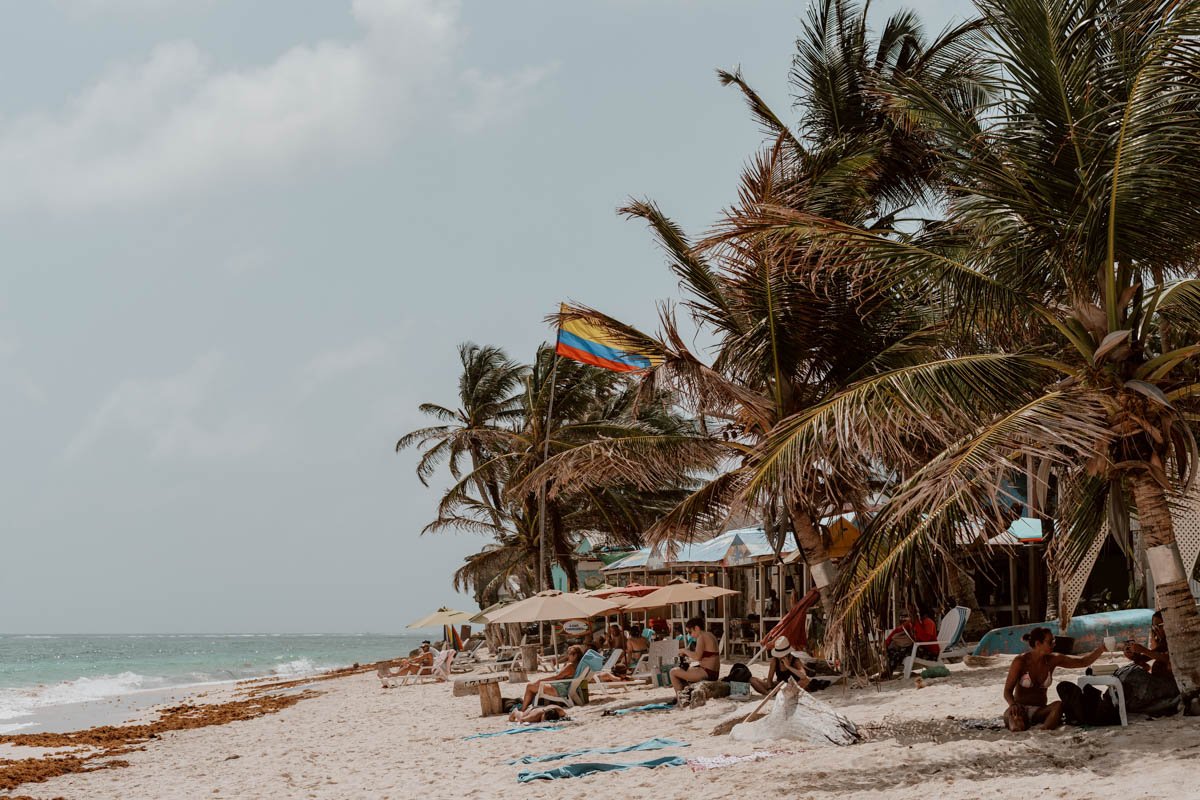
There are however wonderful white sand beaches, secluded bays, swimming spots, and traveller hangouts in San Andres where it does look and feel like a little tropical island in the Caribbean - you just have to get out of the centre and find them!
The pick of the beaches are on the east of the island, whilst its best swimming and snorkelling are clustered on the western side.
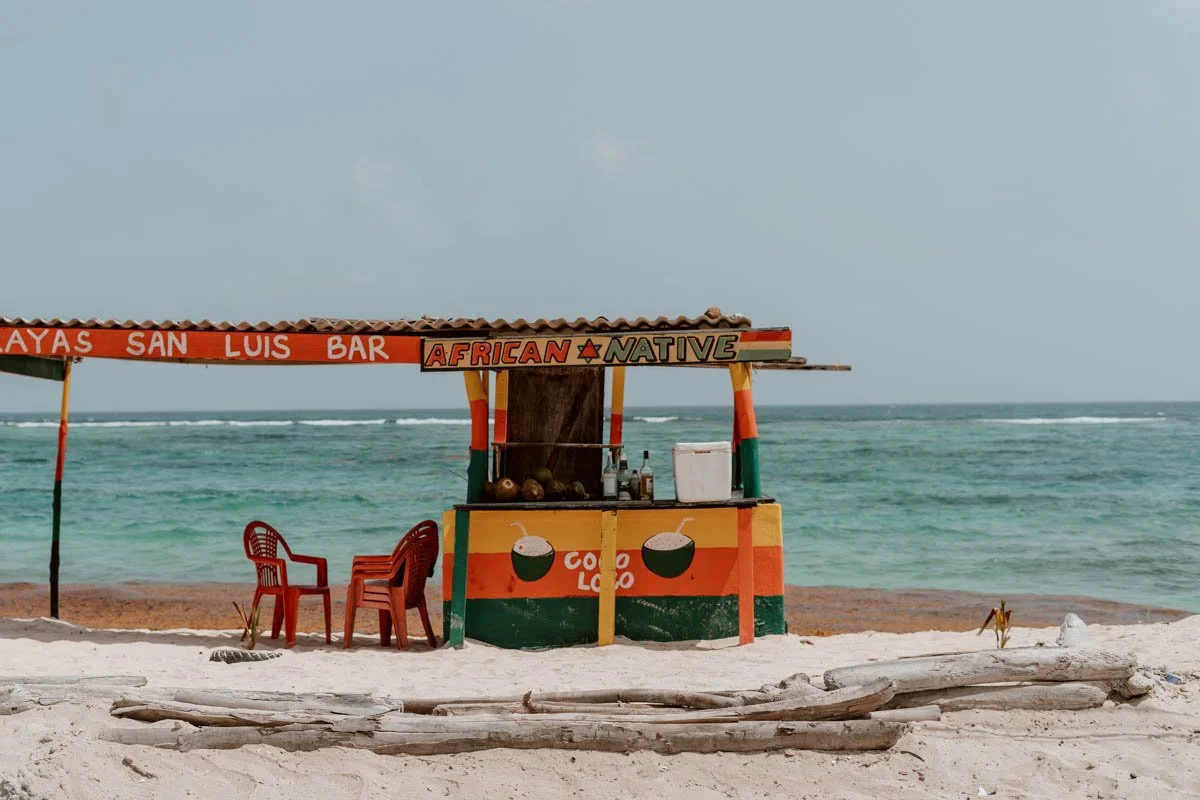
If you only have a couple of days, we’d recommend Cocoplum Beach and Playa San Luis, whilst a few hours drinking and swimming at the Reggae Roots bar is always going to mean a good time.
You can read more about our favourite beaches and places in our main guide to the best things to do in San Andres.
Leave The North
This is why your experience of San Andres - the island - really depends upon you getting out of San Andres - the town on the north of the island. That’s where the majority of the population, hotels, restaurants, airport, and shopping centres are found. Whilst it’s a sensible choice for accommodation, if you exclusively hang out there then you’re missing out on what makes San Andres special.
Indeed, many travellers we've spoken to, and misinformed blogs we read before visiting, completely wrote off San Andres based on what they saw on that first afternoon between the airport and when they took the boat out to Providencia the following morning.
And we TOTALLY get that. If you only base yourself in San Andres town and its two pretty but often crowded white sand beaches, you’ll have a very different, more negative experience than others who venture south.
Indeed, if we hadn't taken a full day with a scooter to explore the rest of the island outside the surprisingly built-up, polluted, and congested town, then we would have left with the very same impressions.
So, whilst some of the best accommodation on the island is there, make sure you leave the north most days by bus, bike, or boat.
Spanish > English
Many people arrive on San Andres assuming that English is widely spoken, as is the case on other Caribbean islands, due to the influences of British colonialism and the slave trade.
The Afro-Caribbean Raizal people of San Andres were long the majority on the San Andres archipelago, speaking English and / or San Andrés-Providencia Creole. However, increased migration to and from the Colombian mainland, as well as an accompanying spike in tourism, has changed demographics and linguistic patterns in the last decade.
On the island, we spoke Spanish primarily and it definitely felt like the dominant language, whilst over in lesser-visited Providencia, we spoke English with almost everyone.
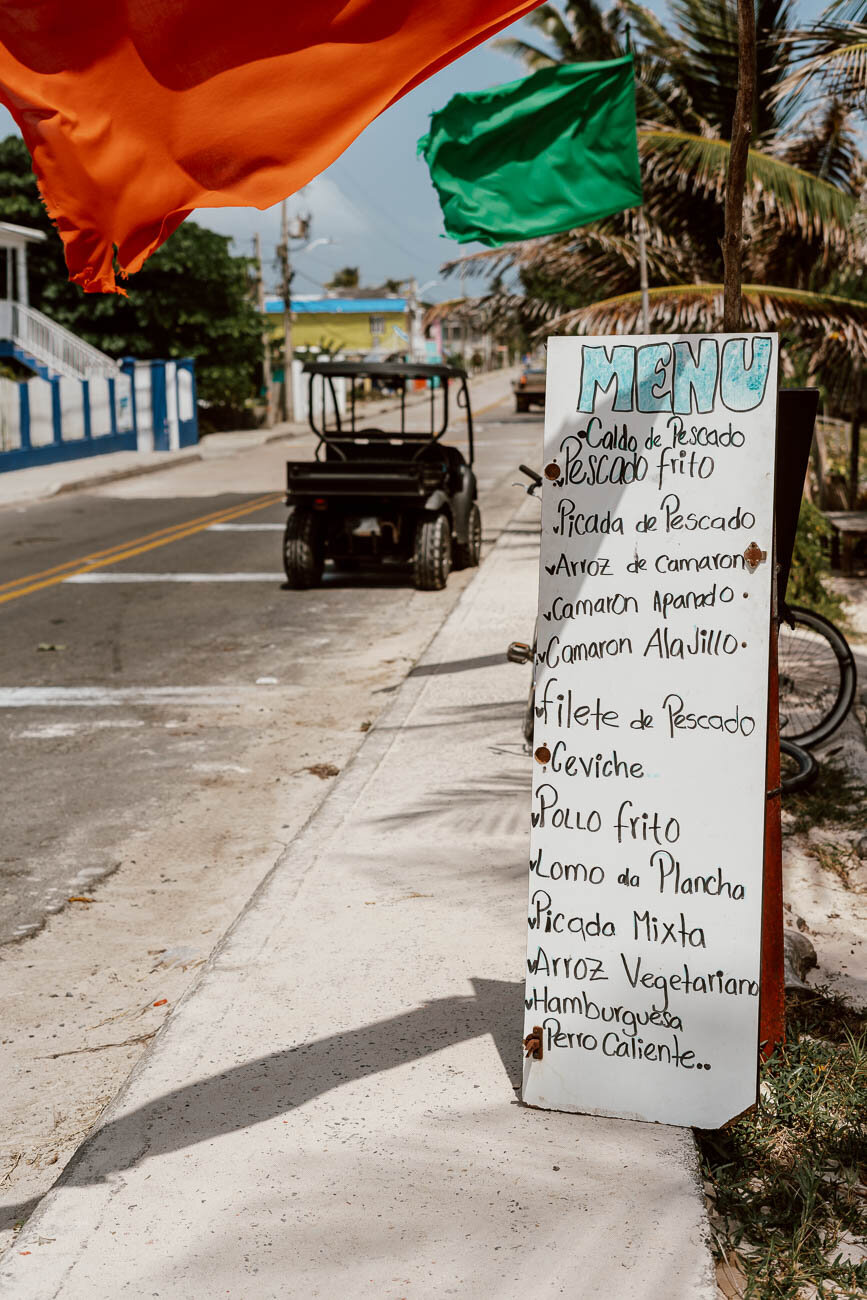
You’ll still have opportunities to speak English and various menus and signs are also in English, but expect to go between the two languages depending on the person you’re speaking with.
There’s Only One Road
San Andres is really small.
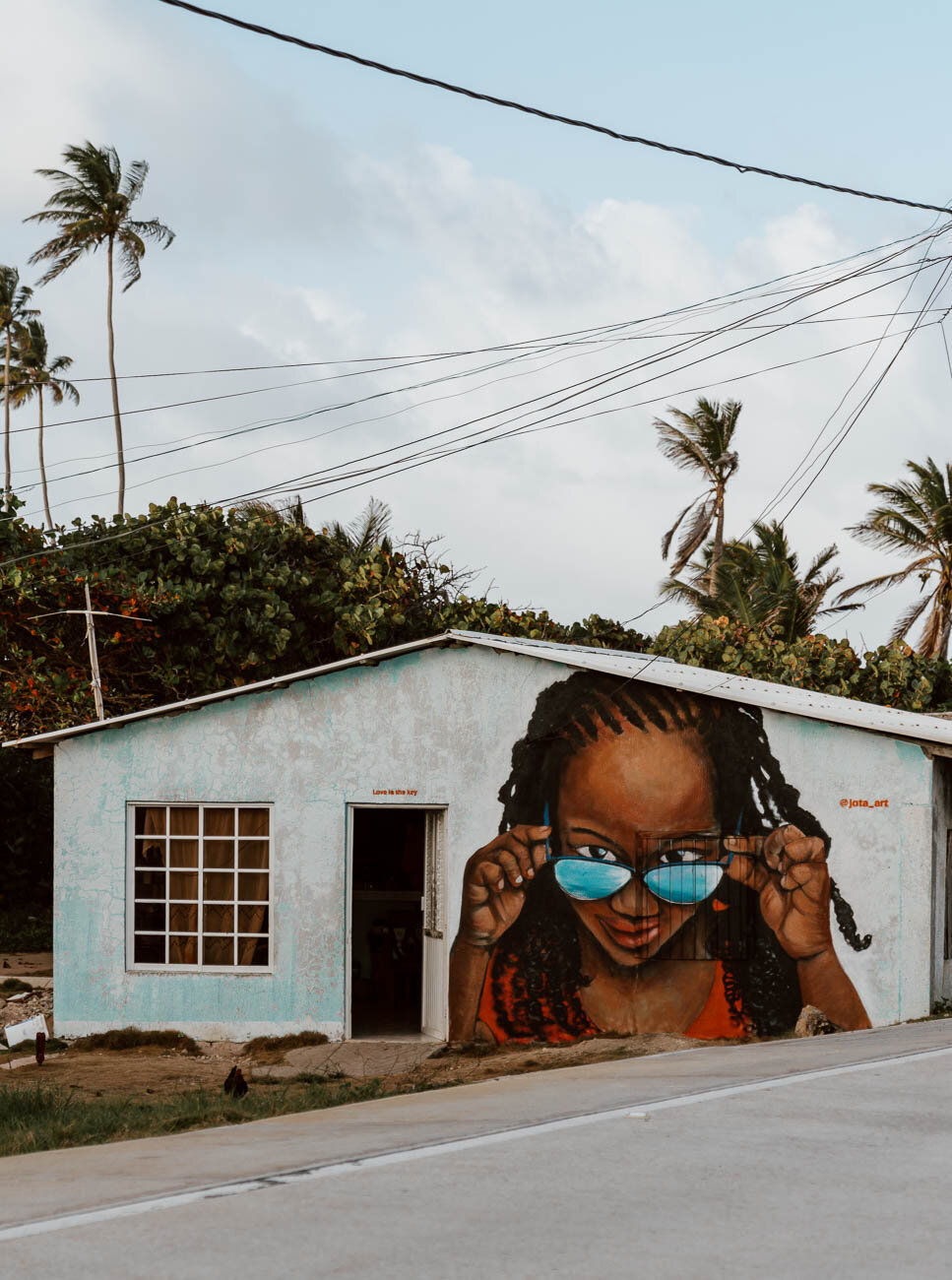
At just 10 square miles (26 square km), it doesn’t take long to explore independently, and it’s made even simpler by the fact that there’s just a single 19-mile road that goes round the island in a loop.
The most popular way to get around is with a rented golf cart. These hold 4 or 6 people and some of them are like little pimped-out mini Batmobiles - they’re really popular with Colombian couples and groups. You can rent them all over the city centre from various companies, with prices starting at 130,000 COP per day.
We opted to rent a scooter instead for 70,000 COP. Much more fun - just check that you’re covered by your travel insurance and know the risks before you head out.
Alternatively, there is a very regular public bus which circumnavigates the island. It will bring you into and out of the town centre, plus directly to some of the best beaches in San Andres. Just hop on and hop off - but be aware that it can get really packed at certain times of day, so if you want to get on at a popular beach, you may have to wait for a few to pass.
Tickets cost 2,600 COP, and correct change is always preferred.
There are also taxis in San Andres, and they’re the best option for getting to / from the airport (though it is possible to walk if your accommodation is nearby). Bear in mind that they are more expensive than elsewhere in Colombia and any price should be discussed before you agree on the journey. From the airport to our guesthouse in Almendras, we paid 15,000 COP, which seemed to be the standard price from the airport to most places in the town, but we believe this is likely closer to 20,000 COP now.
Read our guide to the best things to do in San Andres for more advice on renting vehicles on the island.
It’s More Expensive Than Mainland Colombia
If you've come from south or central Colombia, then elements of San Andres will definitely feel pricey.
The basic seafood lunches we had out cost 25,000 - 30,000 COP and our private room was 190,000 COP night - very much at the thick end of our budget at the time.
By comparison, excellent private doubles in hostels in the Coffee Triangle and Bogota were in the 70,000 - 95,000 COP range.
However, if you've come from the much more expensive northern Caribbean coastline of Colombia (i.e. Cartagena or Palomino) then prices here actually won't come as too much of a shock.
So, whilst San Andres is more expensive than elsewhere in Colombia for some things - particularly accommodation - it is not an entirely unaffordable destination for budget travellers or backpackers if you do it right and make a point to avoid the peak vacation periods.
We strongly recommend travellers have a good look at what their overall costs are likely going to be for a trip to San Andres & Providencia (including flights + the tourist entry card) before they finalise their itinerary - focussing particularly on accommodation costs.
The good news is that there are a few hostels in San Andres with fairly priced dorms and private rooms; the only problem is that they sell out fast! A couple to check out are Blue Almond Hostel and Karibbik-Haus-Hostel.
For various other day-to-day costs, like beers and groceries, San Andres is little more expensive than the mainland but not too much to be concerned about. You can absolutely still have a great time here on a bit of a budget, just make sure you get the big ticket items sorted and budgeted for in advance.
We’ve shared our personal recommendations on the best hostels, hotels, and Airbnb apartments this post: Where To Stay in San Andres
The Internet is pretty crappy
The internet is pretty bad across San Andres.
Of course, on an island like this one shouldn’t be glued to their phone, but it’s worth bearing in mind if you’re a digital nomad or someone who requires a decent connection. At high usage periods, it took as much as minutes or so to even open a new page - and that’s when you can actually get a connection!
We found that if we really, really needed to use the internet,we were much better giving up on the wifi and instead using the 3G/4G on our phones with a local Claro SIM card, which had a strong reception right across the island.
Cash & ATMs
As the internet coverage and reliabiltiy will improve each year, so will the number of busineses that accept card payments in San Andres. However, for the moment, cash is still the go-to for lots of the smaller businesses, tour companies, rentals, and restaurants.
There are now three or four ATMs in San Andres town, but we recommend bringing a decent amount of Colombian pesos with you from the mainland, alongside an emergency stash just in case.
And remember, that’s in addition to the cash you’ll need for the tourist card at the airport!
It’s The Gateway To Providencia
The only way to access the island of Providencia is by boat or plane from San Andres.
This logistical necessity is responsible for bringing some, but by no means all, non-Colombian travellers to San Andres in the first place. It also means the biggest question for some planning their trip to San Andres is whether they should leave it straight away and continue onward to Providencia.
As we mentioned earlier, we think San Andres has earned a little bit of a misunderstood reputation amongst South America backpackers. It may not be the island paradise we found on Providencia, but it's still a really accessible tropical island in the middle of the Caribbean with a few excellent beaches, several spots of absolutely perfect waters, and dependable sunshine.
But, you may be faced with the dilemma of whether your travel budget or itinerary can extend to spending meaningful time on both of these islands, or if you should only come to San Andres in order to go to Providencia.
So, to save you some of the trouble, we'll talk you through two of the key assumptions:
Providencia is so much better than San Andres | Not entirely wrong, because Providencia is has so little tourism or development in comparison, and is just uniquely special. However, that specialness unfortunately means San Andres is given a hard deal by virtue of an impossible comparison. Chocolate cake isn't as good as sticky toffee pudding, but give me chocolate cake when I want a dessert and I'll still be pretty damn happy.
Will you prefer Providencia to San Andres? Very likely yes, but that doesn’t mean you won’t enjoy a few days on San Andres!
Providencia is damn expensive to get to | We really stretched our budget to go to Providencia for just three nights, but we have absolutely no regrets. However, there's no doubt that those three nights were way more expensive to secure due to the pricey transport between the two islands - 378,000 COP per person for the boat journey there and back - and some backpacker budgets simply will not be able to stretch to include the Providencia flight or the boat. This supply/demand ratio helps to keep Providencia so special, therefore we would never complain about it, but the reality is that some budgets just won’t be able to make it happen.
And so, if you want a few nights affordable instead on a Caribbean island, San Andres will become the only (and best) option.
At the end of the day, the choice really is yours and yours alone. Either way, you are going to be able to make it to a lovely Colombian island on your trip for a cheap, short flight, so there’s nothing to be despondent about either way!
Plan | Visiting both San Andres and Providencia, then read our Providencia guide for inspiration and ideas, and our How To Get from San Andres to Providencia post for full details on transport options between the two islands.


How Many Days Do You Need in San Andres?
A tough question.
Arrive here outside of peak season with your expectations in the right place, a nice place to stay, money in your pocket, and a good group of people to hang out with, and staying three or four days on San Andres would be great.
We’d suggest three full days is the minimum amount to make the journey from/to mainland Colombia worthwhile, whilst five to seven days will likely be too much for most given the size of the island and what there is to do there.
However, if you’re planning to pair it with Providencia and your travel style leans more to that island, then you’re absolutely going to prefer giving yourself more time over there: we don’t think you should just arrive, spend one night on San Andres, and leave the next morning though.
So, if you’re going to visit both islands, we suggest spending two full days to enjoy most of the highlights of San Andres.
You Can’t Drink The Water
Unfortunately the tap water is not suitable for consumption on San Andres.
We write this not as hyper-paranoid travellers who will never drink from the tap anywhere, but as people who have travelled in Latin America for three years and have regularly used tap water as our main water source.
However, in San Andres all the tap water comes from desalinisation stations or well reservoirs, and every bathroom and accommodation has signs up saying that it isn’t safe to consume. Locals don’t do it, and neither should you.
Obviously, this is a real pain as it means that everyone’s consumption of single-use plastic goes through the roof - which causes a bunch of additional issues on a small island. To cut down on unnecessary plastic as much as possible, we recommend that you stock up on the really large bottles of drinking water from the supermarket and use these to fill up your own water bottle to take out for the day.
Top Tip // All travellers should try to minimise their plastic usage and footprint. We travelled in South America with a Water-to-Go travel filter water bottle which provided safe drinking water in 99% of locations, and it’s one of the best ways to cut down.
You can get 15% off on their website using the code ADR15, or buy one on Amazon.
This article has more advice and tips on how to travel with less plastic
But You Can Drink Lots of Coco Locos
The signature cocktail in San Andrés is a potent, tropical drink typically served inside a fresh coconut.
A blend of rum, vodka, tequila, coconut water, lime, and a sometime splash of grenadine, it gets the job done and acts as the ideal accompaniment to your sunbathing spot on the white sand under a palm tree.
Whilst we don’t suggest relying on them to stay hydrated or replace tap water - and you should avoid them on driving days - you should absolutely enjoy a few of them on the island.