How to Visit the Doge's Palace in Venice - And Where to Buy Tickets
You simply can’t visit Venice without exploring the spectacular Doge’s Palace.
In this guide you’ll find everything you need to know to plan your visit, including how to get tickets (even if they’re sold out).

To get a better perspective of how wealthy and powerful the Venetian Republic was for so long, a morning or afternoon exploring the Doge's Palace (Palazzo Ducale) is essential.
Roughly translated as ‘the Duke’, the Doge was essentially the elected leader of Venice and, from 810 AD, this building adorned in pastel pink diamond tiles and perfect porticoes overlooking the water was the seat of government and justice.
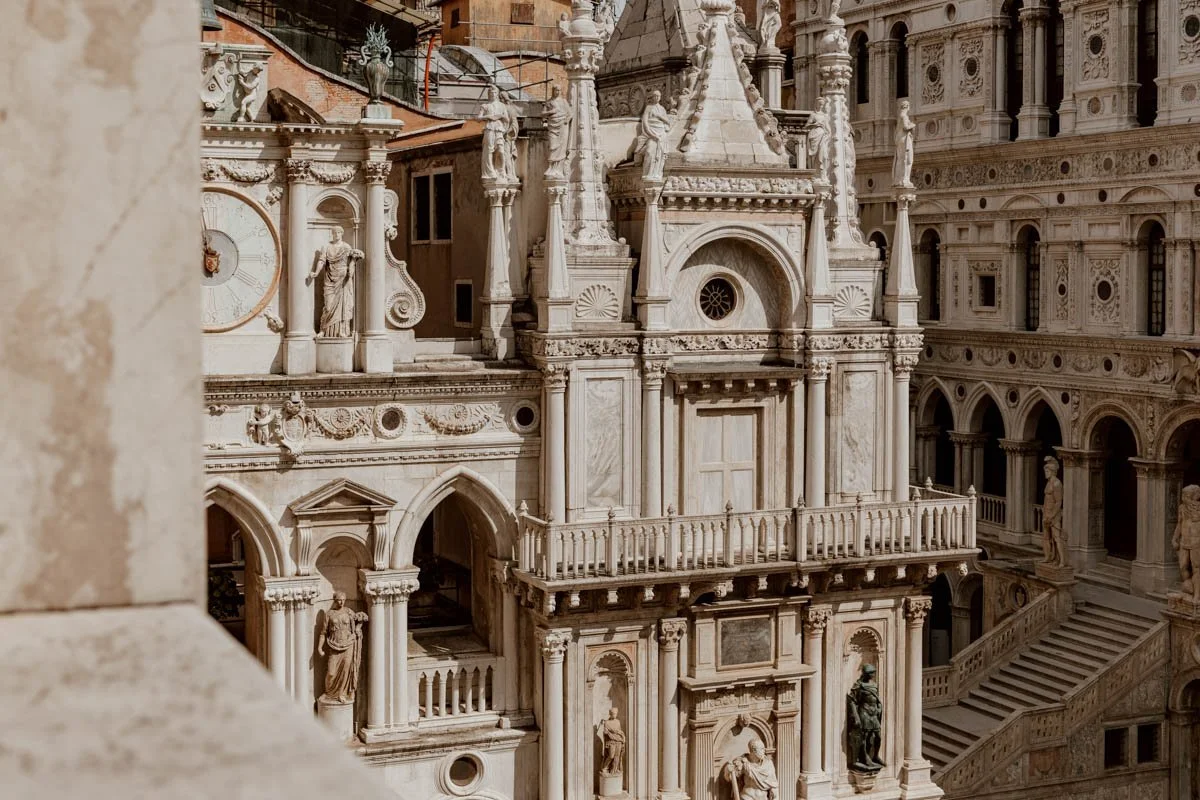
Today, it’s one of the Floating City’s most popular sites, filled to the brim with incredible art work, architecture splendour, rich symbolic decoration, historical curiosities, and an excellent view from the Bridge of Sighs.
In this short explainer post, we’ve shared the key information you need to plan your visit to the Doge’s Palace in Venice - with tips on what to see, how long you need, how to avoid the lengthy queues, and working out the convoluted ticketing system.


How To Get To Doge’s Palace, Venice
You can find the Doge's Palace in Piazza San Marco (maps), just steps away from the Venetian Lagoon and overlooking the famous Grand Canal.
There are a few options to reach the palace: the Vaporetto water bus, on foot or by gondola:
Vaporetto | Take lines 1, 2, 4.1, 5.1, or 5.2 and get off at San Zaccaria (maps), from which it’s just a short walk to the palace.
A single ticket for the Vaporetto is €7 and is valid for 75 minutes, but if you plan to use the water bus regularly, it’s worth buying a 24 or 48 hour pass which starts from €45.
Walk | Venice is incredibly walkable and that’s often the only way to get around, and it’s easy to reach Piazza San Marco on foot from your accommodation or elsewhere in the city. Additionally, the palace is well signposted which is very useful for those moments when Google Maps freaks out as is common on the narrow streets of Venice!
Gondola | You can also take a private gondola ride for a romantic and classic trip along the canals, but this is a rather decadent option to just go from A to B! Instead, it’s better to save your gondola road for a longer trip or experience!
We recommend taking a look at our tips for taking a gondola ride in Venice first.
Doge’s Palace Tickets & Opening Hours
Due to the popularity and length of wait time for those who try to buy a ticket on the day, we highly recommend purchasing your tickets for the Palazzo Ducale online in advance.
Tickets | There is no standalone ticket for the Doge’s Palace, with the two available options requiring the purchase of a combined ticket.
The cheapest is the €25 St Mark’s Square Museums ticket, also referred to as the ‘Musei di Piazza San Marco - Palazzo Ducale’ ticket. This includes entry to the Doge’s Palace, the Museu Correr, and the Marciana Library. However, you need to buy it more than 30 days before your visit date to get that price, otherwise it increases to €30.
For various concessions, including over 65s and students, prices drop to €13/15.
With this non-refundable ticket, you have to select both the date + entry time slot for the Doge’s Palace when purchasing it, so it’s best for planners and those who already know their dates.
The second option is the Museum Pass ticket. This includes your Doge's Palace ticket, as well as entry to three other museums within St Mark's Square - the Museo Correr, Museo Archeologico Nazionale and the Monumental Rooms of the Biblioteca Nazionale Marciana - and several others dotted around the city.
It’s €40 for adults (€22 concessions), and the ticket is valid for 6 months from your purchase date, with a single entry to each museum included.
Skip the Queue | This is one of the most-visited places in Venice and Italy, and there are queues out the door throughout the day for unreserved tickets; you should not just turn up and hope to buy your ticket at the door.
If you want to save yourself a lot of time, then purchasing the skip-the-line reserved entry ticket for the dedicated entrance is a very good idea - buy it here.
You can also buy fastback tickets here, and not that the three St Mark’s Square museums are also included in the cost.
Alternatively, consider this popular skip-the-line guided tour
Opening Times | The Palace is open every day from 9am to 7pm, with the last entrance at 6pm. During the summer season opening hours are extended until 11pm with the last entrance at 10pm on Fridays and Saturdays only.
We'd advise at least two hours for a suitably paced visit, but add an extra one or two if you truly want to savour some of the masterpieces or plan to add on the prisons and armoury.
As ever, visiting earlier in the morning or toward the end of the afternoon is likely to give you the best experience with fewer large crowds.
Know Before You Go // Bulky bags and rucksacks are not permitted, but can be checked in to the Left Luggage Office free of charge. Beachwear or 'skimpy' clothing is not permitted either.
The palace itself is wheelchair accessible but the prisons and armoury are unfortunately off limits due to accessibility issues.


Doge’s Palace Tours
If you would prefer the knowledge and stories of a guide to navigate the rooms, art, and history, then there are a range of highly-rated group and private tours available.
Joining one of these is also a reliable last-minute option if you’ve just found out that there aren’t tickets left for your dates.
Doge's Palace Guided Tour | A two hour small-group experience to see the main highlights, which offers both morning and afternoon times.
The Hidden Treasures & Terraces | This takes you to lesser known areas of the palace, focussing on details and rooms that may be missed on other tours. The price also includes a tour of the prisons and armoury, as well as your skip-the-line ticket.
Private Doge’s Palace Tour | A great option for those wishing to have plenty of opportunity to ask questions and really get to know the background of the Palace and nearby sights during their time in Venice.
St. Mark's Basilica & Doge's Palace | This highly-rated small group tour combines two of Venice’s most notable sights across three hours, with pre-reserved entry tickets for both, as well as your guide.
You can also turn this into a day trip that includes a small tour of Venice from a gondola and lunch - find out about that option here book this option here.
There is also a Secret Itineraries tour (we didn't do it), which brings you to hidden parts of the Palace including Casanova's Cell and a Torture Chamber; it requires advance booking due to limited times - find out more here.
Things To See In The Doge’s Palace
Given the architecture, rich symbolic decoration, historical significance, and sheer number of masterpieces painted on canvas and ceilings inside, we think this place is unmissable for any first-time visitor, and one of the best things to do in Venice.
However, there are far too many rooms and chambers, levels and paintings of note to mention them all in this post, but we want to draw your attention to several of our personal favourites which are unmissable and worth more of your time as you make your way through the Palace:
Golden Staircase (Scala d’Oro) | Elaborately finished in Roman-style decoration and so-called for its 24-carat gold ceiling, the Scala d'Oro is arguably one of the most opulent staircases in the world.
The intricate details and showcase of wealth is however no accident, as this is the staircase used to welcome important guests to the Palace; the Doge was keen to highlight the power and riches of Venice before entering negotiations on trade.
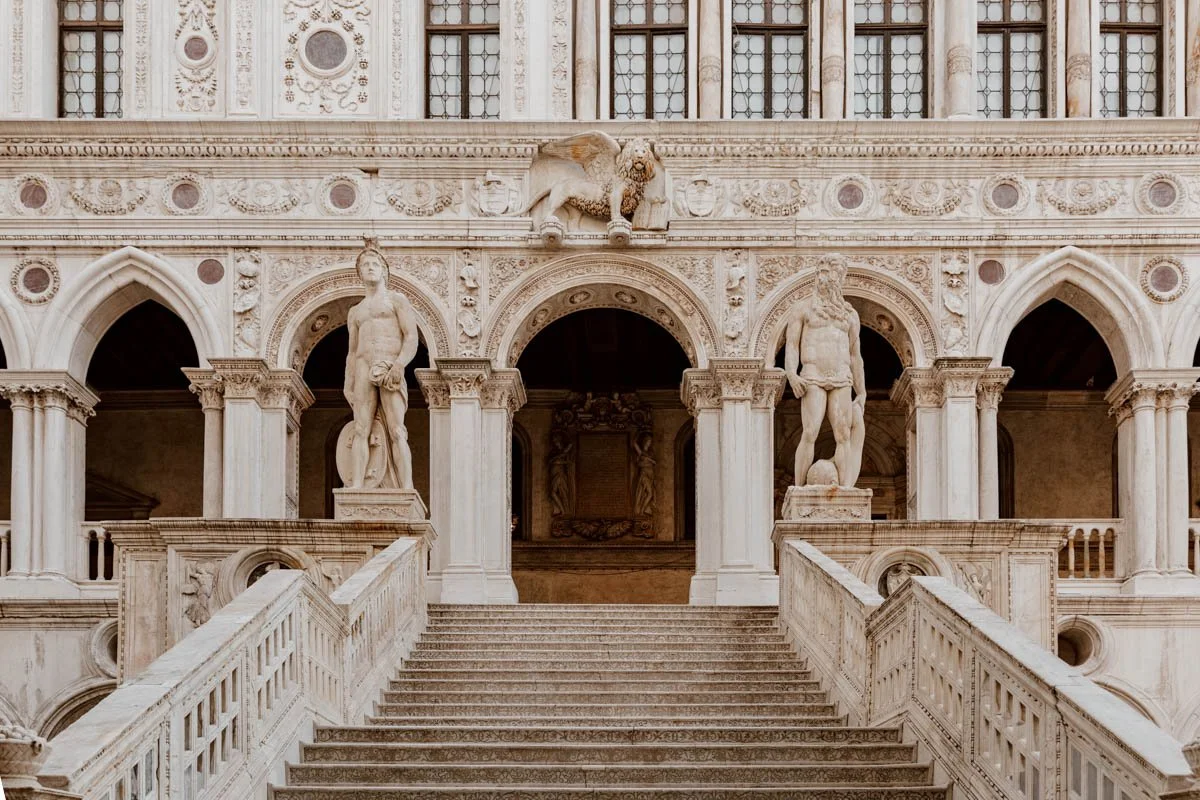
The Giant's Staircase | Although the Trump-ian ceremonial Golden Staircase dripping in 24-carat gold gets more attention, we found this timeless marble beauty absolutely mesmerising (pedant alert though, it isn't totally symmetrical with the windows behind). Set within the courtyard opposite the Foscari Arch, the Scala dei Giganti and its colossal statues of Mars and Neptune, could easily be missed if you simply made a beeline for the upper floor - please do not miss this perfect example of Venetian Renaissance design where a newly elected Doge would be crowned.


Palace Armoury | With over 2,000 immaculately preserved pieces across four rooms, this offers an insight into quite how many brutal and innovative ways there were to kill or torture a person in the 14th - 17th centuries.
Senate Chamber (Sala del Senato) | Hard to miss on the the second floor of the Palace, this grand room was one of those refurbished after the 1574 fire which affected much of the Palace.
The Chamber of the Scrutinio | The gigantic, dramatic paintings in this room, all of which depict important military victories, drew us in totally. Far from the staid, static, or heavily religious works which are ten-a-penny from the era, this feels like an explosion of colour and fury. The frenetic Battle of Lepanto by Vicentino was our personal favourite.
Il Paradiso & The Chamber of the Great Council | The last major work of Tintoretto - although technically his son did most of this one - this vast oil painting dominates the cavernous Sala del Maggior Consiglio (The Chamber of the Great Council). It includes around 500 figures in exquisite detail, and is flooded in religious symbolism interwoven with the Republic’s own hierarchies. You'd need an Art History degree, a Theology Degree, a lot of coffee, and several days to be able to fully appreciate and appraise it, but we lost ourselves in it for a good 10 minutes. Breathtaking.
The rest of the 53 metre x 25 metre room, where Council members would gather every Sunday with the Doge presiding and counsellors placed in double rows running the length of the entire room, ain't too shabby either.

The Prisons Cells | Hidden beneath the Doge’s Palace are the infamous cells, once home to some of the most notorious criminals and political prisoners in Italy (including the legendary Casanova and the revolutionary Garibaldi). The prison conditions were incredibly harsh and a tour of them shows the stark contrast between the incredible architecture of the palace above and the brutal simplicity of what lies below.
You can include a tour of the prisons with this guided tour of the palace.
The Bridge of Sighs | At least the second-most photographed bridge in Venice, you can only access and walk across the enclosed Bridge of Sighs from within the Doge's Palace. Built in 1614, its two corridors linked the Palace courts to the New Prisons. The name stems from the supposed sighs of the condemned prisoners who, on the last walk from the courtroom to their cell, were faced with one final beautiful view of Venice and freedom. When you visit, you'll cross over twice, and be sure to take your time - even if people are getting a bit impatient with you - to look out with no prospect of confinement awaiting you on either side.
Paper Gate (Porta della Carta) | This monumental entrance between the Doge’s Palace and St Mark's Basilica (once the entrance to the Palace itself) is a stunning example of Gothic architecture, but from where it derives its name is not entirely clear - perhaps it is the petitions that were handed into the council members as they made their way through the entrance or the scribe’s tables that were set up nearby, whilst others believe it is because the archive of state documents was located nearby.
You’ll now exit the Palace through this gate, so be sure to look up once you pass through the into St Mark’s Square to view the intricately sculpted winged lion resting its paw on an open book above the entrance.


Travel Better in Venice
13 Wonderful Things to Do in Venice
23 Things to Know Before You Visit Venice
How to Get From Marco Polo Airport to Venice
Where to Find the Best Views of Venice
How to Plan Your Venice Travel Budget
Burano | The Perfect Day Trip From Venice
Everything You Need to Know About Taking a Gondola Ride in Venice