The Best Things to Do in Kotor, Montenegro
It is impossible to write a travel guide to Kotor without first addressing the elephant in the room.
Or, in this case, the elephant in the marina.
Most days in summer, docked closer than you could possibly imagine, you’ll find a cruise ship so large that it dwarfs the citadel and dominates the view from its old walls. From these floating towns, an army of tourists disembarks en masse, flooding into the narrow cobbled streets that have borne the weight of Venetian rule, Ottoman raids, and centuries of Adriatic commerce.
On particularly busy days, three or four ships can arrive in Kotor, bringing 5,000-6,000 passengers with all the concomitant challenges this puts on a place: overwhelmed spaces, price gouging, traffic jams, hollowing out, and a loss of identity that even the fantastically preserved architecture struggles to overcome.
It’s apparently all happened quite quickly too: supposedly there were just two souvenir shops in 2013, and now there’s over a hundred.
In the Faustian bargain struck by whomever controls the port, the short-term gains are obvious - but the long-term costs for this old fortified city are even clearer.
Whilst one could make a point about how Kotor’s fate has always been shaped and determined by those who arrive from the Adriatic to trade or invade - and that this is just the modern spin in our globalised world - the truth is that it really deserves better.
We’re aren’t here just to moan about it though; not simply because there’s nothing duller than tourists complaining about other tourists, but because that wouldn’t really help you out for your upcoming trip!
Instead, we’re here to arm you for the battle.
After all, despite what mass, daily cruise ship tourism has done it to, nobody visiting Montenegro for the first time is going to bold enough cancel on Kotor.
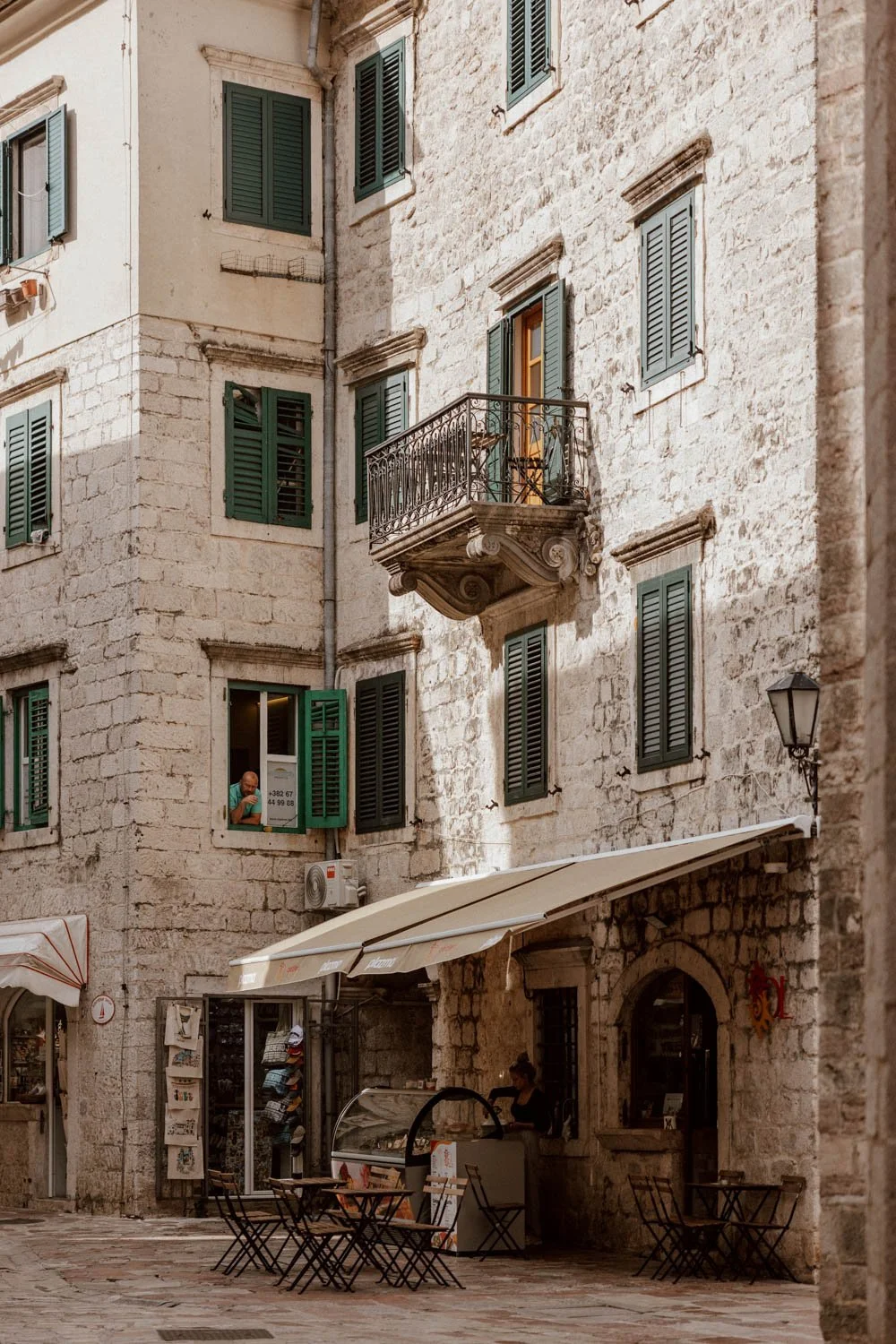
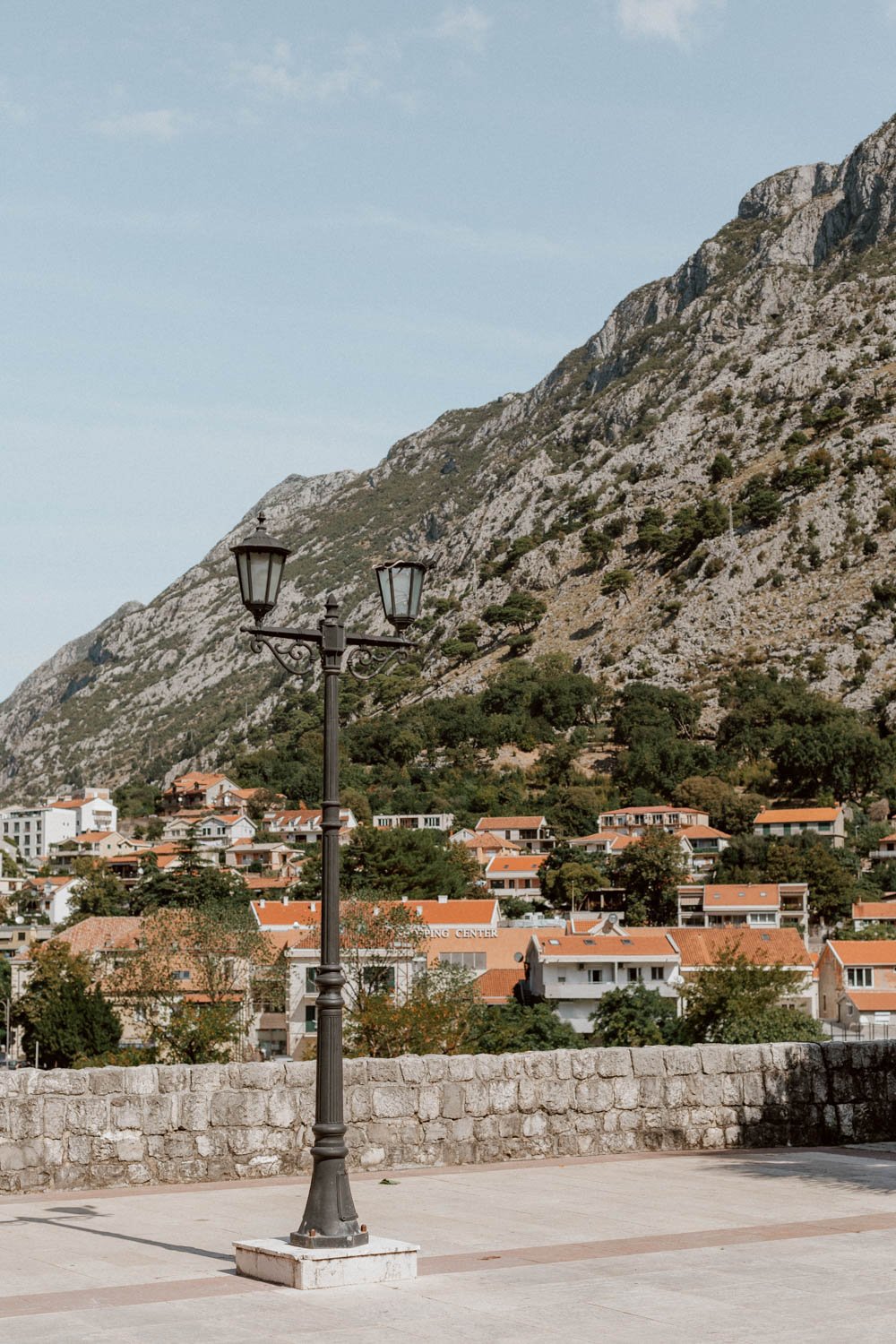
Nestled at the head of the Bay of Kotor - a standout destination in its own right - this was designated a UNESCO World Heritage Site in 1979 for its remarkably preserved medieval townscape, Venetian fortifications, and the harmonious blend of architecture and natural setting within the bay. Backed by steep green mountains, the setting is irresistible whilst the honey-grey jumble of streets and cobbles offers a labyrinth of stone and shadow that’s best explored slowly and without a map.
Oh, and there’s hundreds of beautiful pussycats just chilling out everywhere.
So, perhaps the real question to ask yourself isn’t really about what you’re going to do in Kotor, but rather how you’ll move through it given its rhythm now bends so much to the ships’ itineraries rather than its citizens.
Ultimately, depending on your travel style, this may mean staying in Kotor for a little less time than you expected, structuring your days a little differently, viewing it as a destination rather than a base, or choosing to prioritise a handful of experiences over fistful of frustration.
Finding the moments in between and away from the cruise ship crowds, and the unexpected glimpses that help you understand why this town has mattered for centuries. In other words, take a cue from the cue from its cats: find a quiet patch of sun, stay curious, and don’t let the crowds bother you.
In this guide, we’re going to share our favourites things to do in Kotor, as well as useful tips to avoid the worst of the crowds and the traffic, advice on where to stay and park, the day trips and the boat tours, plus one restaurant you need to avoid at all costs.
The Kotor Essentials
Walk / The city walls
Wander / The gates & streets of the old town
Do / A Bay of Kotor boat trip - this one is highly-rated
Hike / The Ladder of Kotor & Mount Locven National Park
Count / The cats of Kotor
Visit / Kotor Fortress
Book / This small-group walking tour
Drink / At Bandiera or Jazz Club Evergreen
Make / A day trip to Perast & Lady of the Rocks
Eat / At Konoba Scala Santa
Ride / The cable car & Alpine coaster
Stay / We loved our little attic apartment, but this one & this one are great alternatives in the old town. For hotels, step back in time at the Historic Boutique Hotel Cattaro or go budget-friendly at Step to Kotor Bay.
Backpackers who love to party should book Old Town Hostel (or Hostel Centrum if they don’t)
The Best Things To Do in Kotor
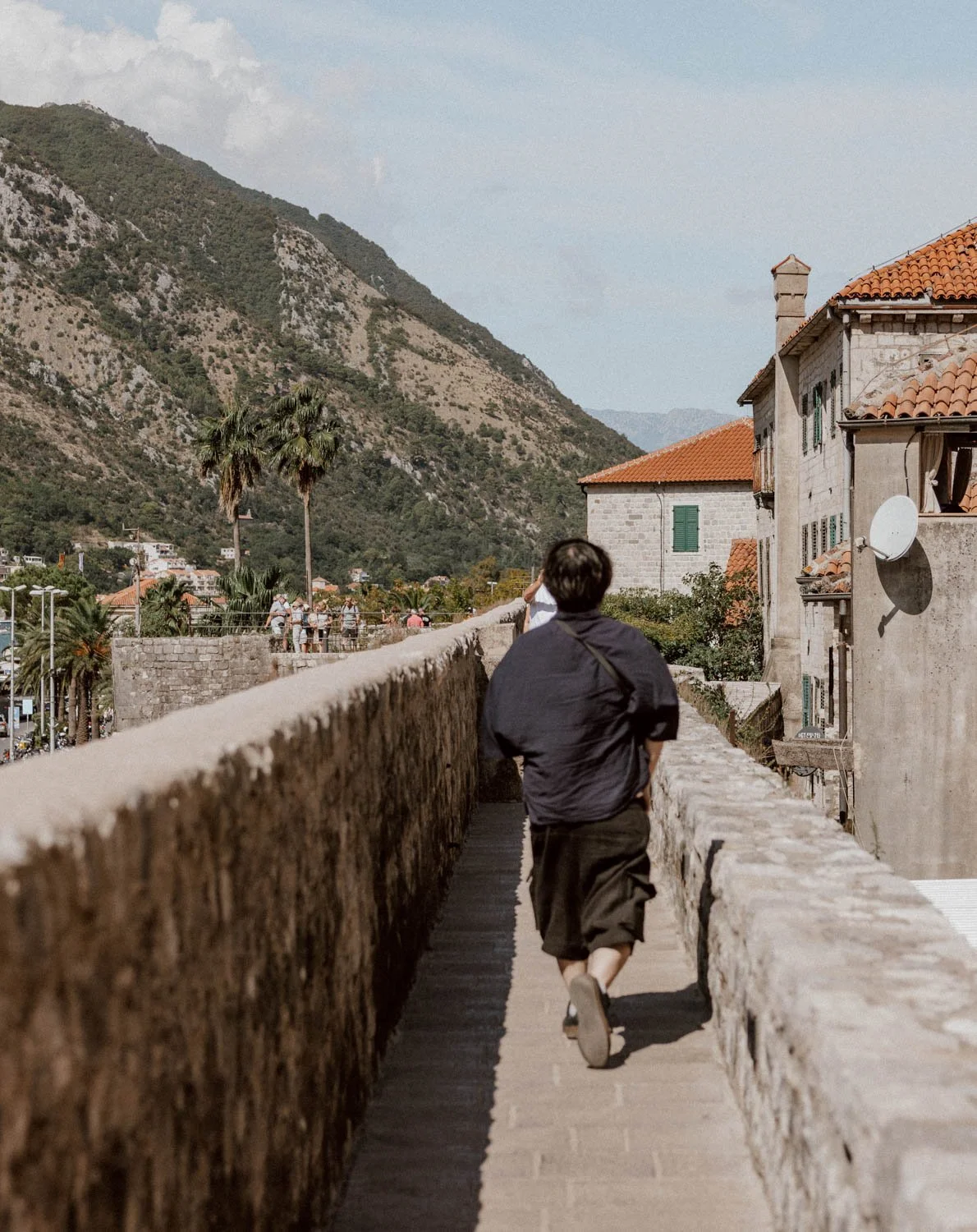
Walk The Walls of Kotor
Old Kotor has long been protected by a thick shield of stone.
Its three-mile-long ramparts have been rebuilt, reinforced, and expanded over the centuries - first under Byzantine rule in the 9th century, later strengthened by Serbian kings, and then perfected under Venetian occupation - and they allowed the town to withstand several sieges that others in the Bay of Kotor could not.
The most famous and consequential was in 1538, where Kotor defended itself against the legendary admiral Barbarossa (Red Beard). Acting on behalf of Suleiman the Magnificent and the Ottoman Empire, his fleet was part of a broader strategy to challenge Venetian control along the Adriatic, making strategically positioned Kotor a key battleground.
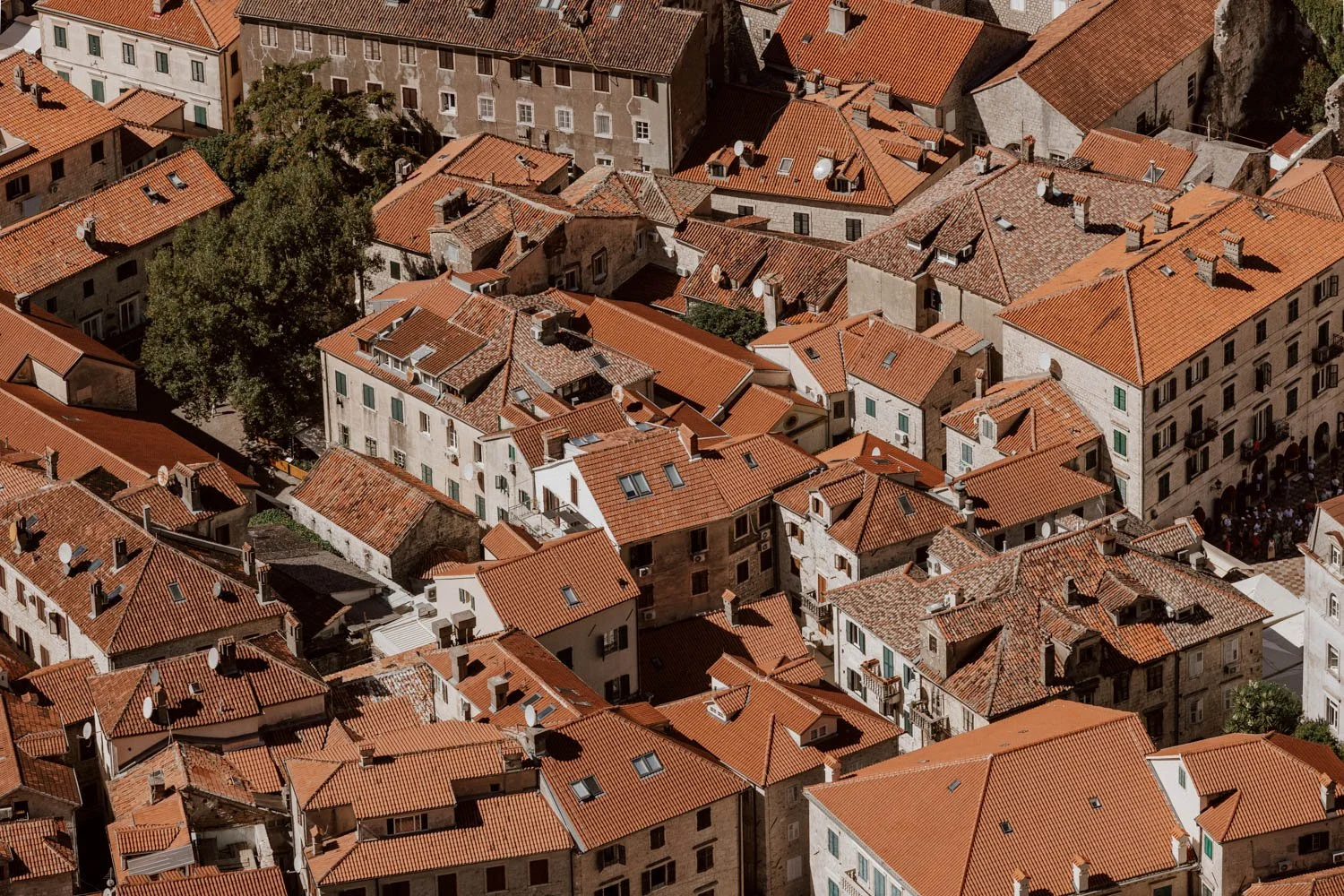
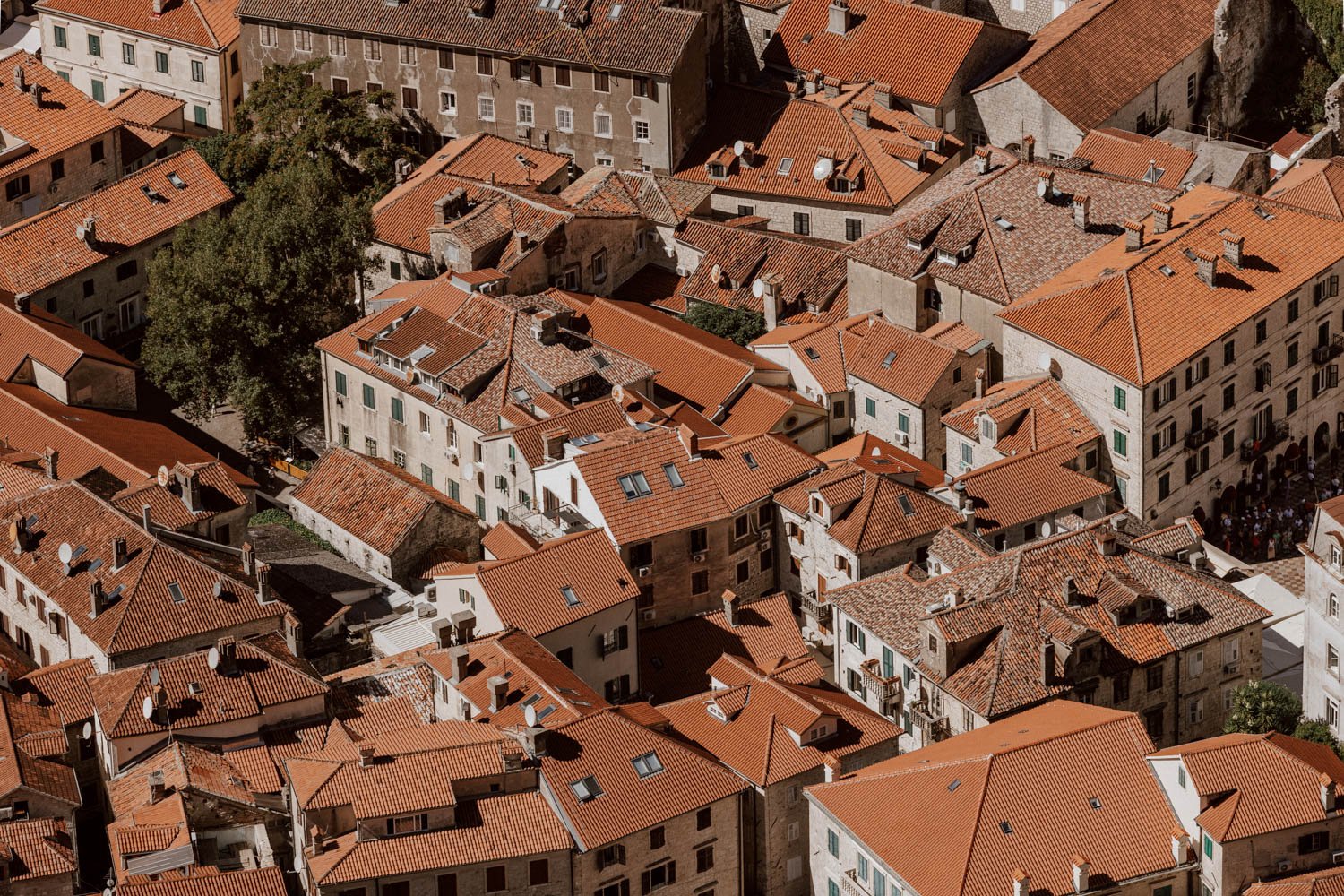
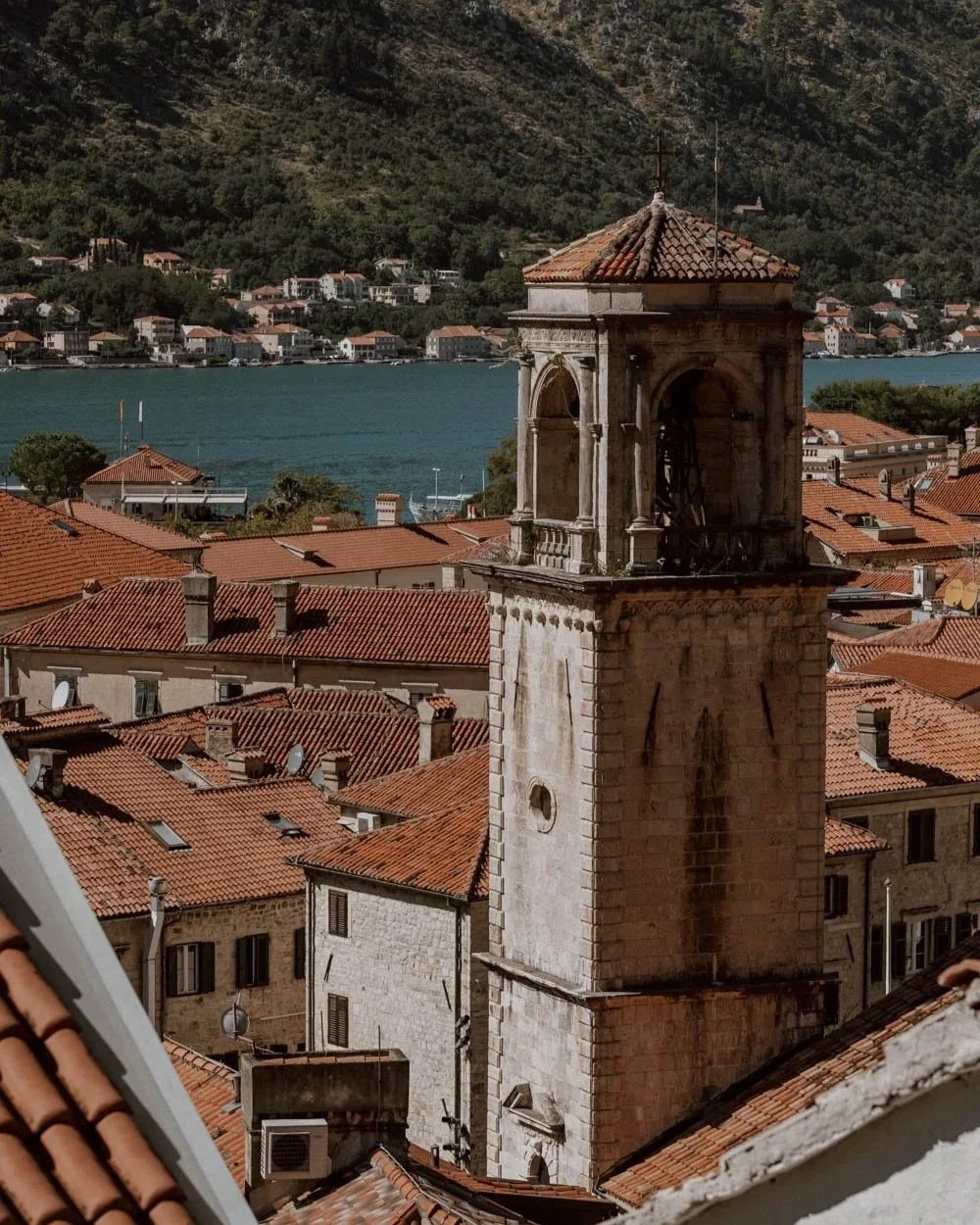
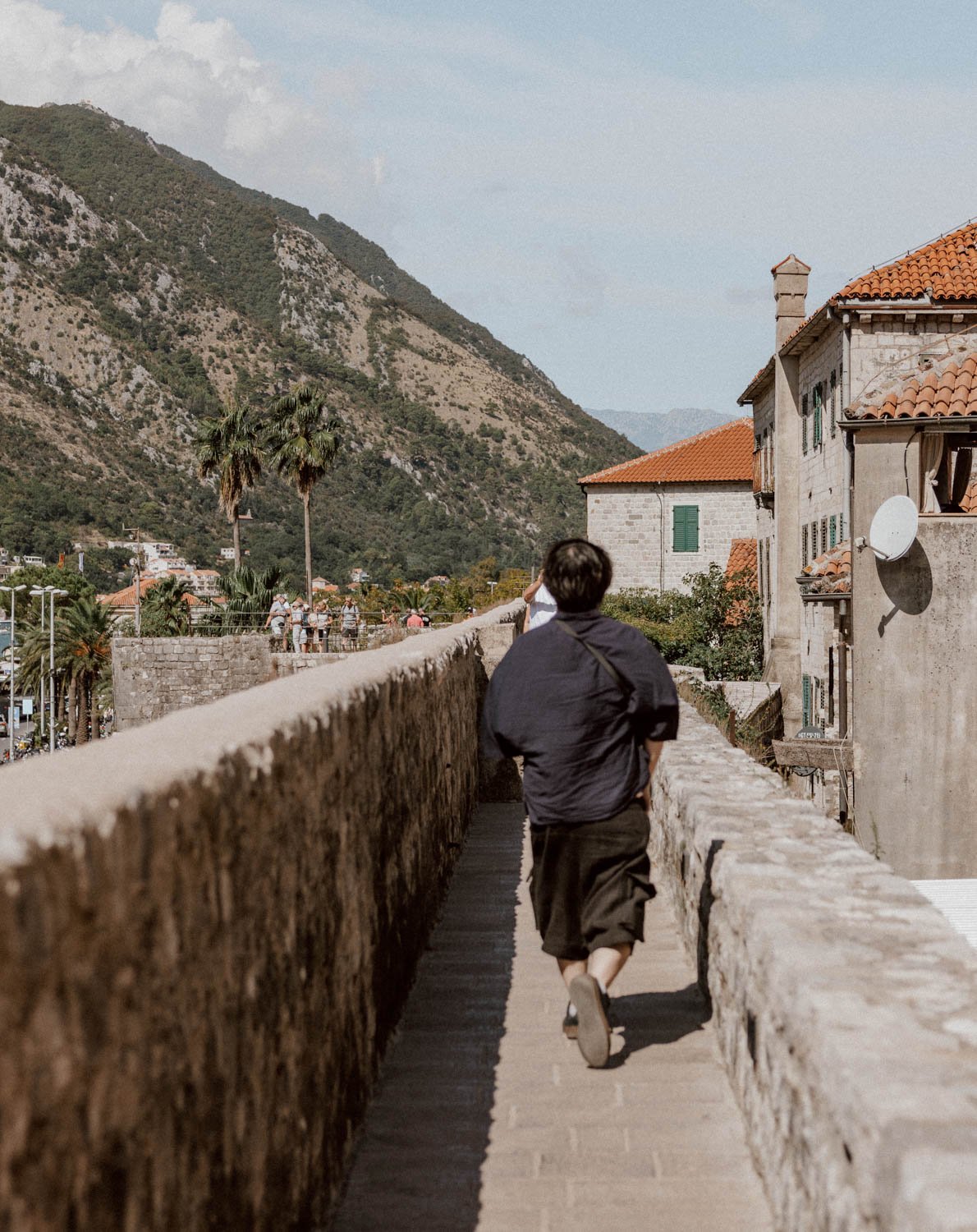
Visitors today can walk the same defensive line, the walls still drawing a clear and unwavering boundary between the fortified heart of the Old Town and the newer city that has steadily grown around it. Rather than one continuous circuit, the ramparts are made up of short elevated walkways and bastions that you can access from within the Old Town. From these vantage points, you get a better perspective on Kotor’s maze of marble lanes, its campaniles and terracotta roofs, the harbour beyond, and unexpected glimpses in between the cracks of time.
And yes, usually a blood big boat (that at least enables one to quite easily picture Kotor under siege!)
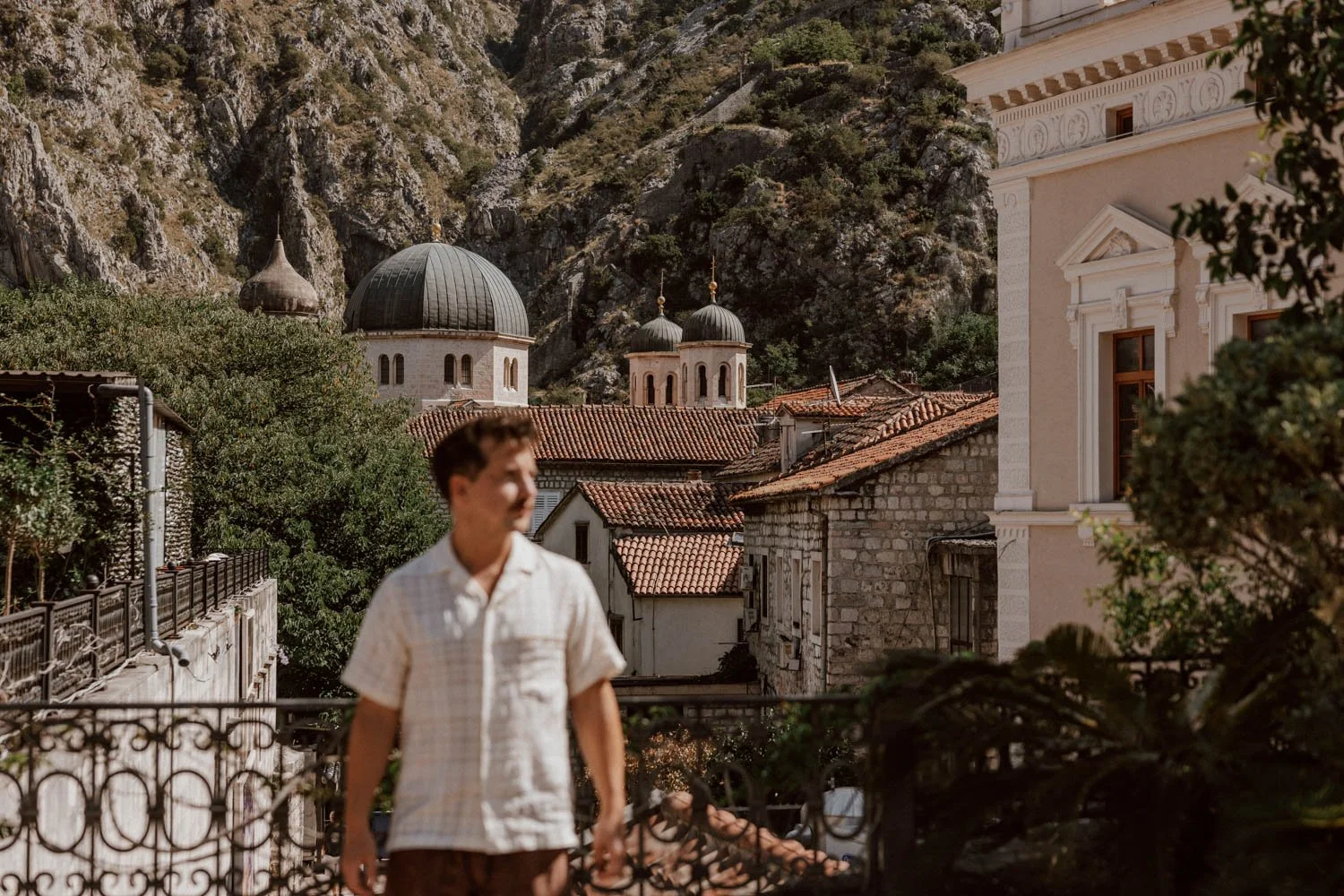
Where | There are several stairways to access the walls of Kotor, and it can be walked in either direction. However, we suggest heading to the water fountain in this square by the North Gate (here on Google Maps), go up the stairs in the corner to Bembo Bastion, then walk along this wider part to Kampana Tower, then Korner/Corner Bastion and finish up at the Fortress viewpoint (maps) then exit at the stairs before Gurdić Bastion.
Know | Walking around the fortifications of lower Kotor are often conflated with the more physically challenging fortress and the Ladder of Kotor - more on those later. This activity is going to be fine for any traveler that’s able to make it up and down the stairs, but you do have to watch your step at certain points (we saw one man take a hell of a tumble).
Travel Tip / This is an activity best done in the morning or in the late afternoon golden hour hue once the day trips have departed. Undertake it during the peak afternoon sunshine when there too many others going both ways on the skinny walkways and it won’t be terribly enjoyable.
Get Lost in The Honey-Grey Streets
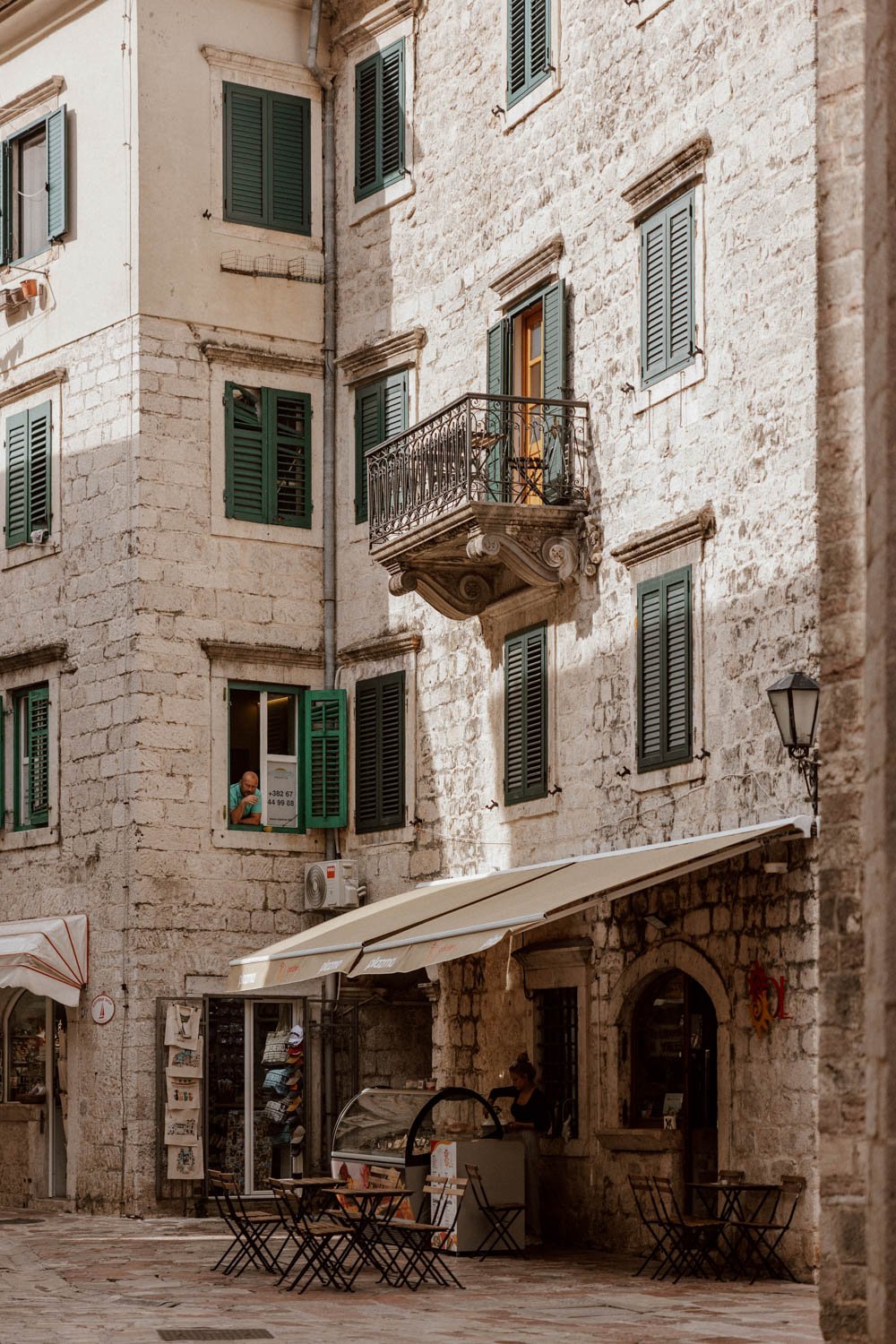
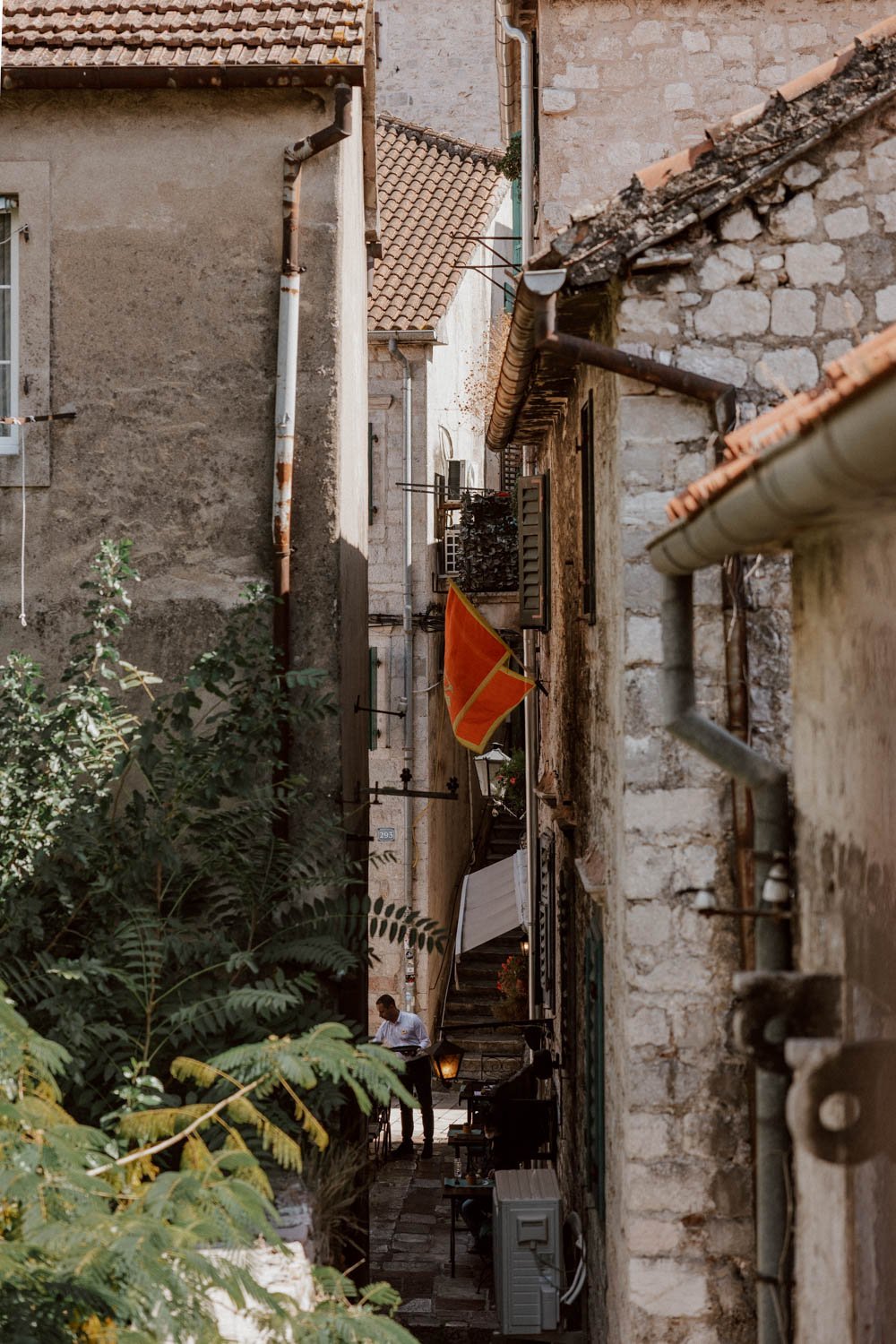
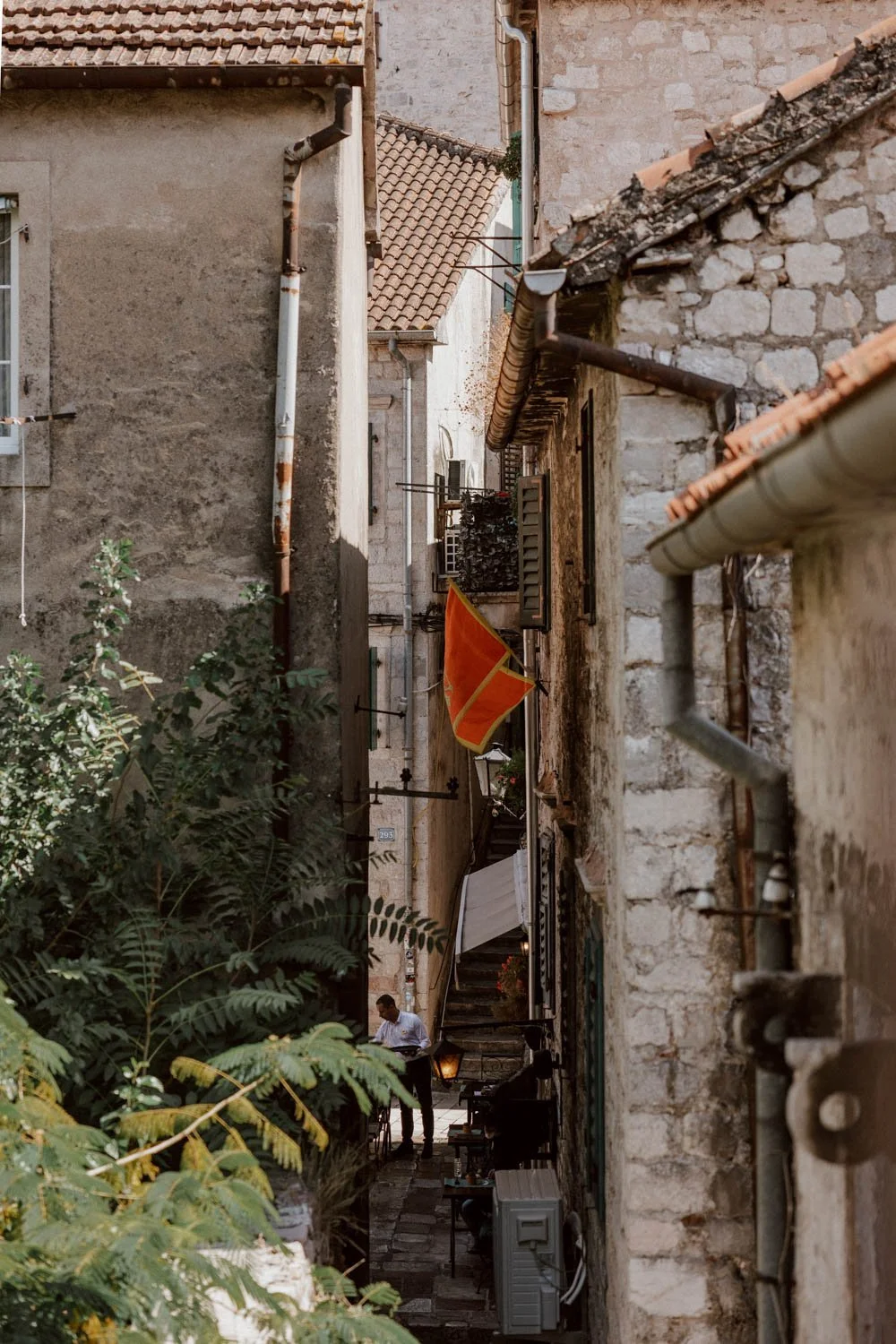
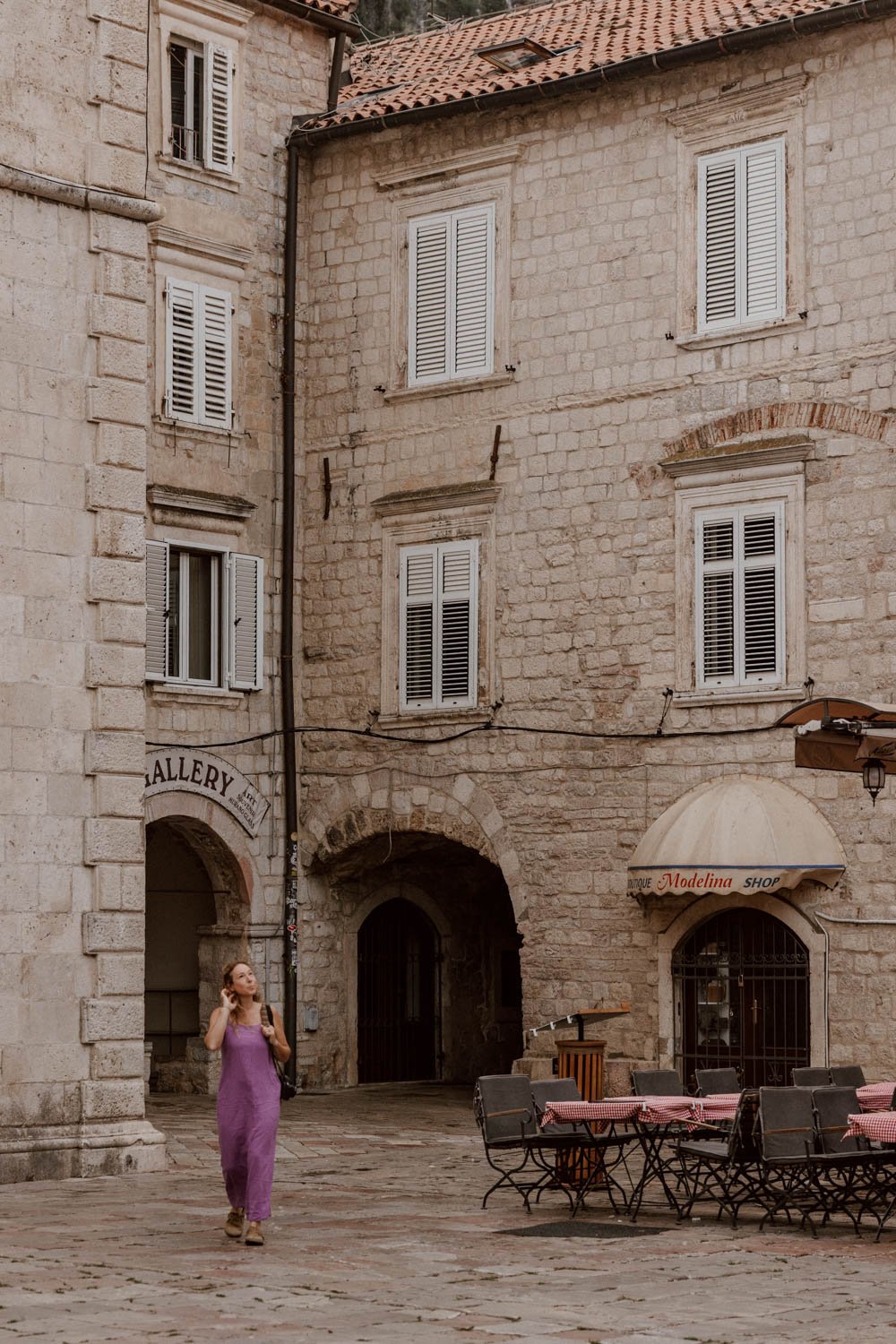
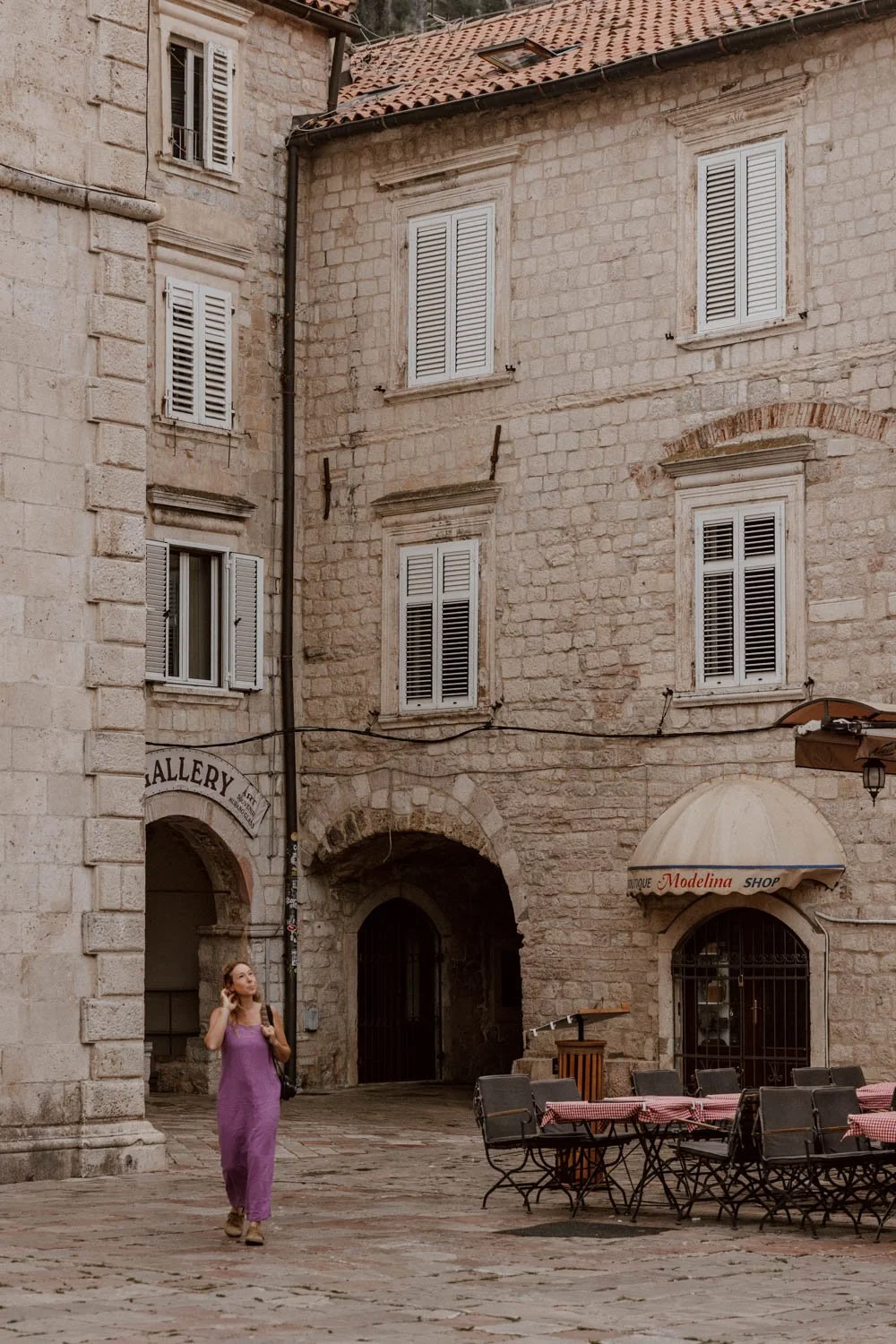
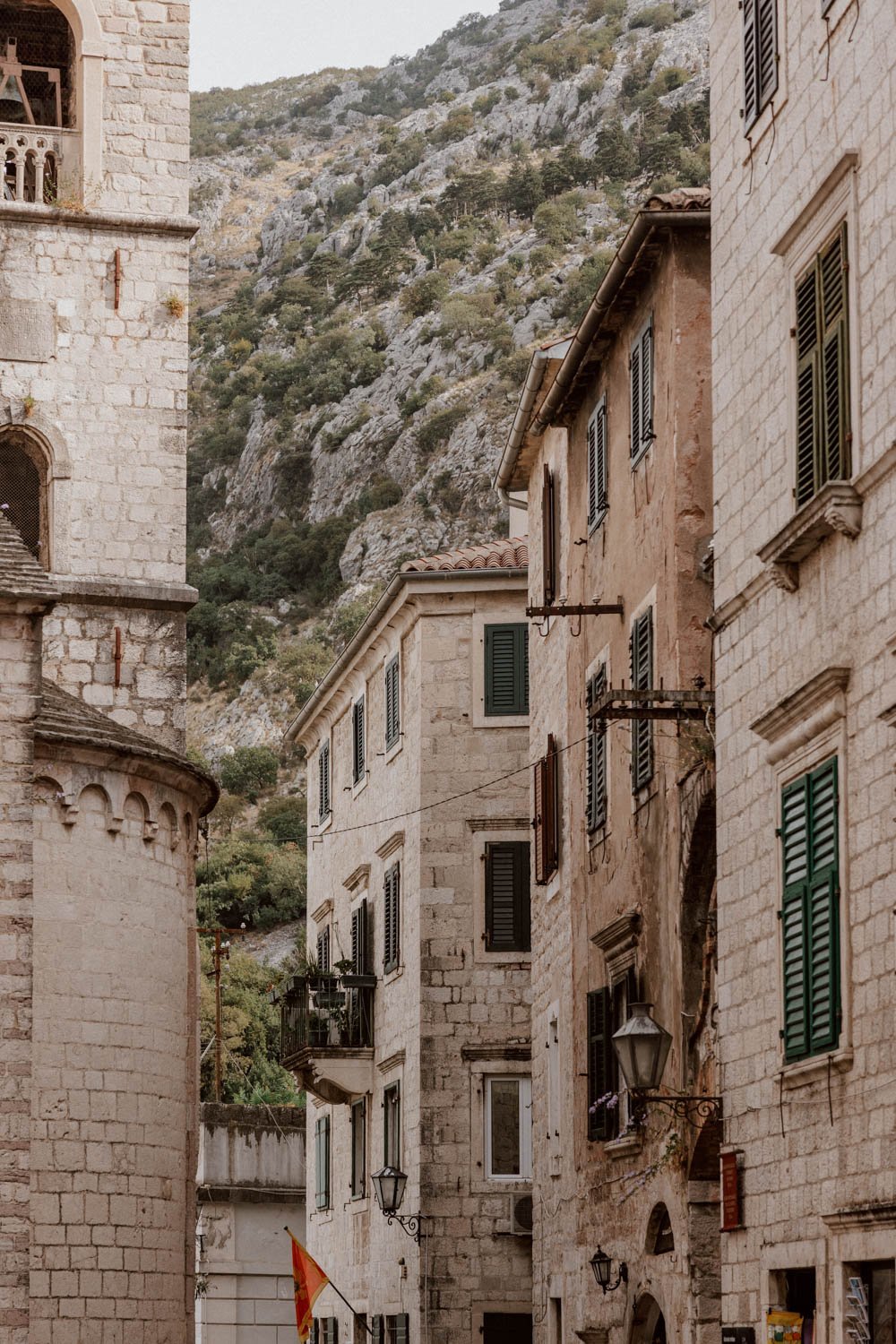
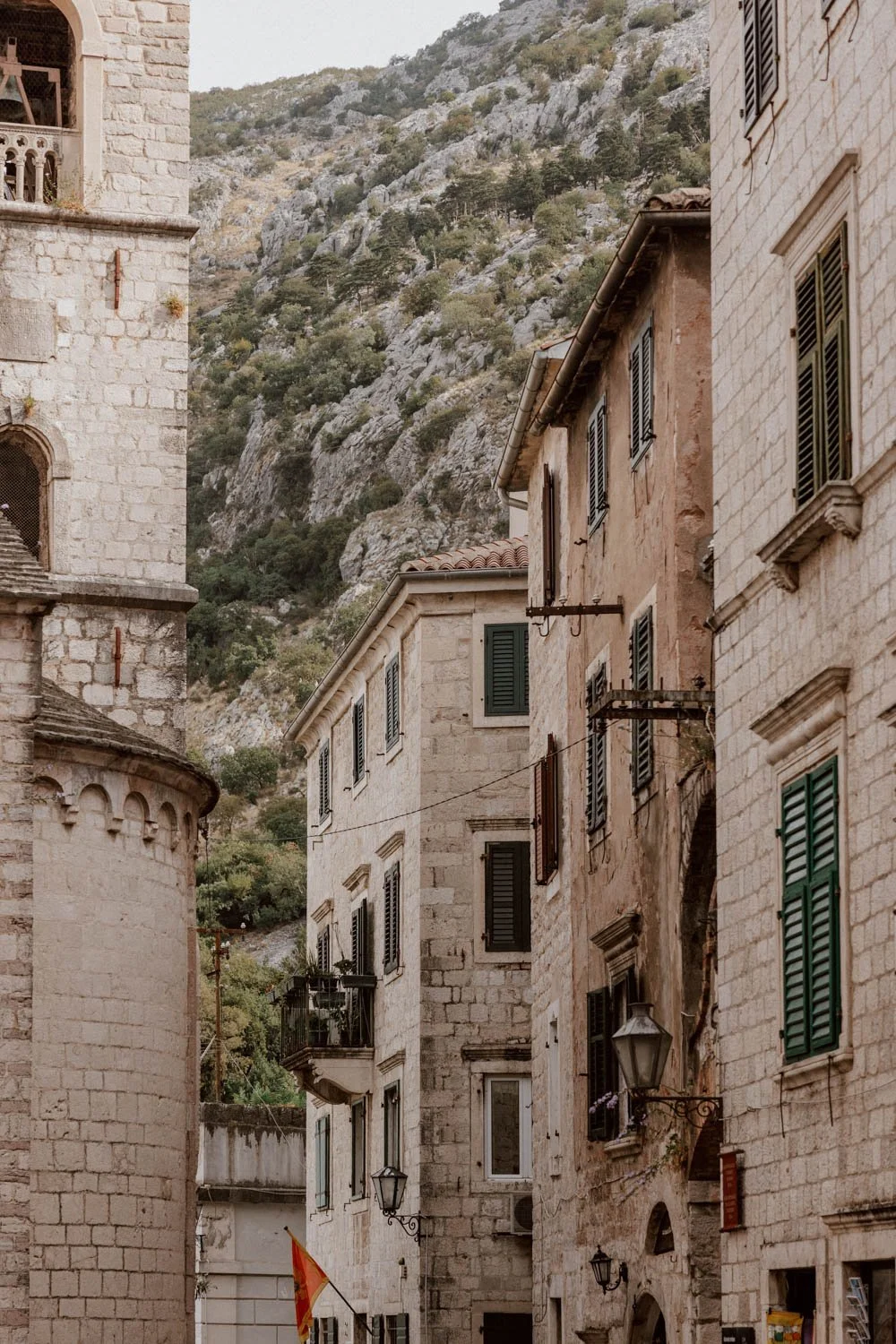
Enclosed within those thick stone walls, Kotor’s Old Town is a compact triangular knot of alleys, piazzas, and arches.
Supposedly, no street is the same width or length as any other.
You’ll enter through one of three main gates: the Sea / West Gate (the grand, main entrance from the waterfront), the North Gate (built to honour the successful defence of the 1539 Ottoman siege), or the South Gate (the oldest and quietest, leading toward the Gurdic River). This trio of gates are a good guide to shape your explorations, and you shouldn’t leave Kotor without having entered/exited them all once.
As with most European places that have been around this long, its churches, its squares, and its palaces form the focal points: the Cathedral of St Tryphon, with its twin towers and relics of the town’s patron saint (maps); the famous Clock Tower (maps); the church of Sveti Luka (maps), the only edifice in town which didn’t suffer significant damages during the devastating earthquake in 1979.
The Maritime Museum offers insights on the history of commerce and battles.
But, instead of seeking anything out specifically, the real pleasure lies in wandering and stumbling upon: accidentally retracing your steps, following your nose, and going in the direction that others aren’t. It really is quite small and, with your head down and a good pace, you could probably cover it all in less than a couple of hours, so it’s best to intersperse your wandering with spontaneous coffees and pastries, cocktails and chats, and going between the light and the shade.
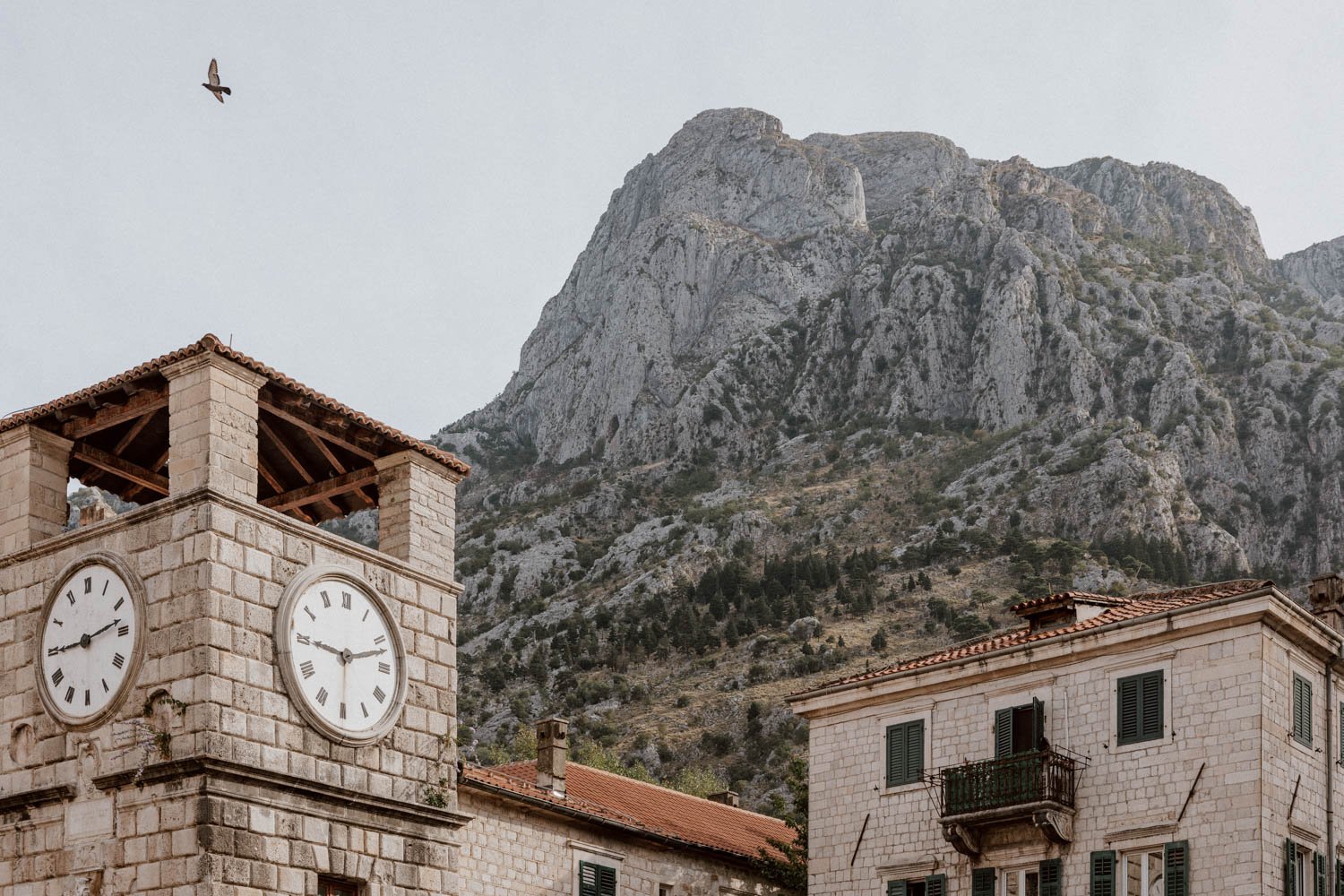
Now for the big caveat: there are times when the romantic version we’ve outlined above just won’t be possible or desirable due to the number of cruise shippers and day trippers. So, you really should try to start your flâneur-ing before 9am, and then give yourself another go after 5pm once it’s thinned out a little - in the early evening or closer to midnight can actually be the most magical time to feel transported to another era.
If you’d prefer to have the history and characters brought to life, then consider joining one of these very highly-rated guided walking tours:
Kotor Old Town Small-Group Walking Tour - also available to book here
Recco | Patisserie by Wine House is a cute, tiny cafe in a 12th century building next to the narrowest street in Kotor. It’s got decent coffee, pastries, and savoury bits for breakfast or brunch, but you may have to wait around or circle back a few times for a table - find it here on Google Maps
Know // The old town is a traffic-free pedestrian zone, but you’ll spot the occasional cart carrying in restaurant and shop supplies. Due to the number of tourists, you’ll see a few official signs up advising you to keep to the right to help with flow and suggesting not to linger for too long in narrow streets. Also, don’t wear swimwear or beach clothes, and make sure to dress + act appropriately within the cathedral and churches.
A Bay of Kotor Boat Trip
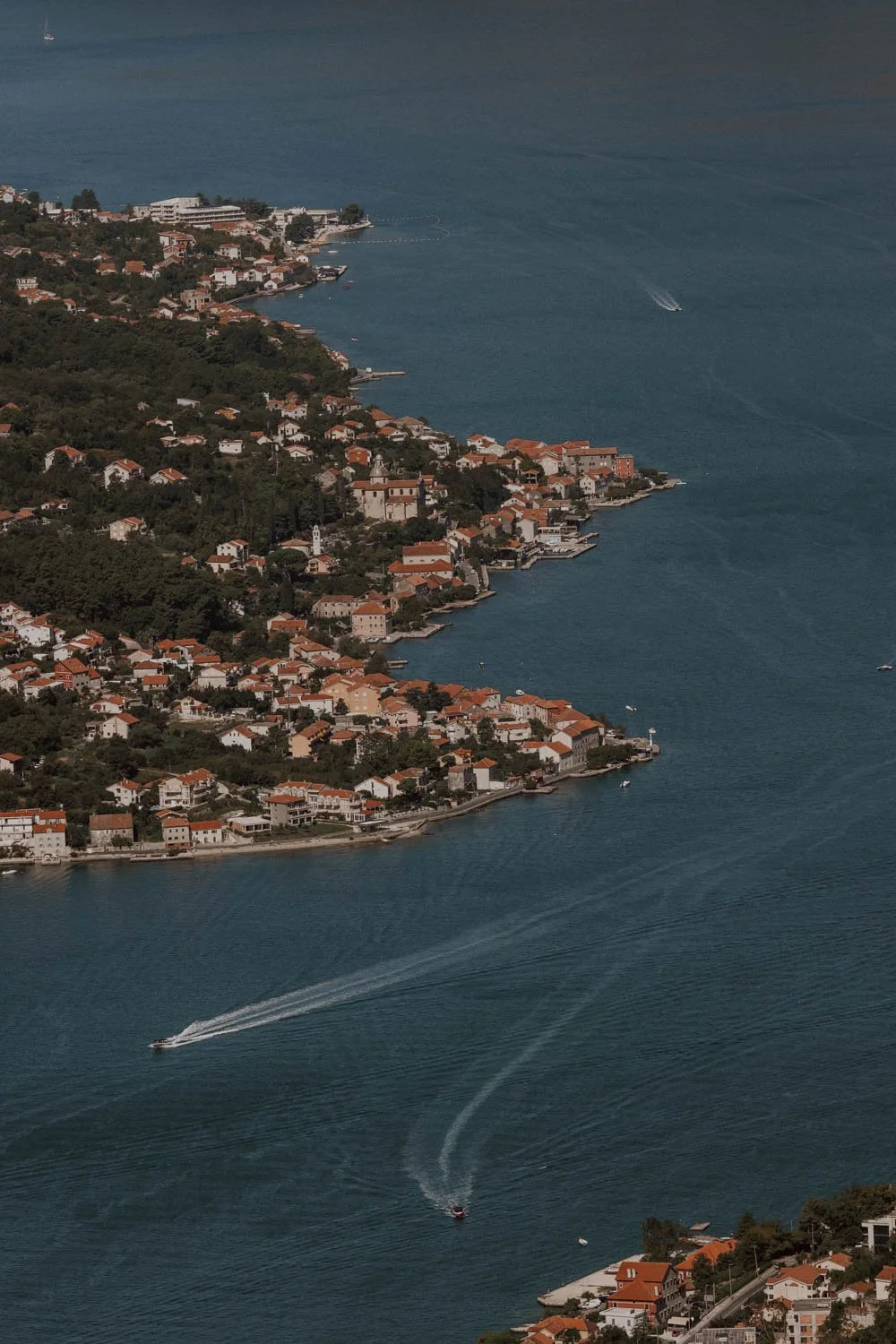
A common point of confusion when planning is thinking that the Bay of Kotor refers only to the waters upon which the town lies and looks out upon. However, the dramatic fjord-like inlet of the Adriatic Sea stretches many kilometres beyond, dotted with several charming towns, villages, and swimming spots.
Articles and guides don’t always make the distinction so, when people say they’re “going to Kotor”, they may actually (or also) mean the Bay or one of its other towns.
But, what is clear, is that the town of Kotor itself is an ideal base for exploring the bay by boat.
These are all done as tours, and can be as short as an hour or stretched out to a full day in the Bay, offering everything from panoramic views of Kotor and surrounding mountains to visits to charming villages like Perast. Most trips include stops at the remarkable islet of Our Lady of the Rocks or the Blue Cave, plus opportunities to swim in quiet coves. Sunsets boat trips are also popular.
You will find tour operators all over town - and be constantly asked if you’re interested in a boat tour as you wander around - but the most important thing is to keep in mind is that a boat trip is as essential for cruise ship passengers as walking the streets of Kotor; this can mean lots of very large tour boats as well big crowds at certain stops.
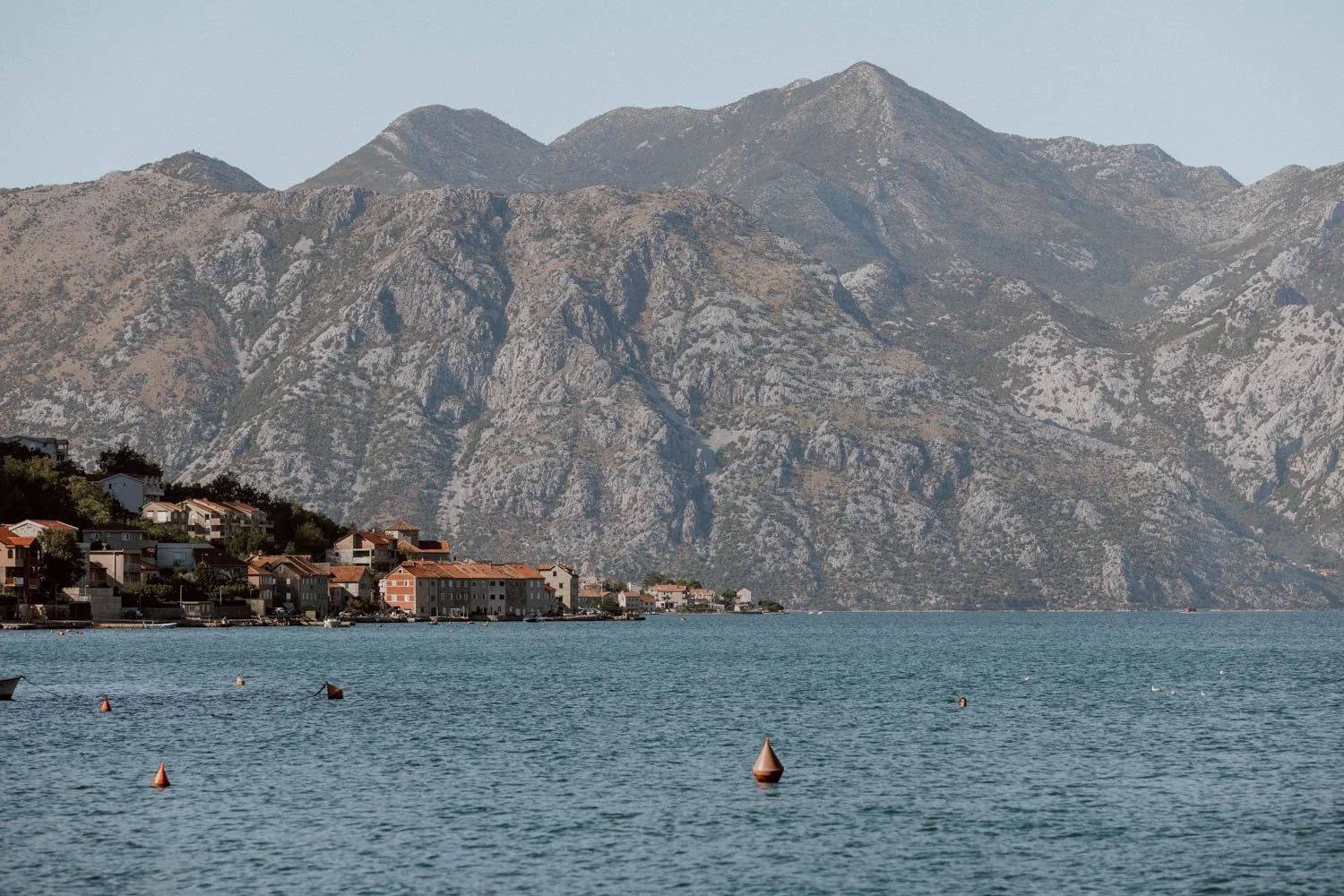
To get the most out of your experience, aim for a smaller, earlier tour, or consider a private boat if you’re travelling with family or a group.
We don’t have a personal recommendation, but the following are very highly-rated with excellent reviews:
· From Kotor: Blue Cave and Bay of Kotor Boat Tour
· Blue Cave and Our Lady of the Rocks Group Boat Tour
Travel Tip // For those of you who have more time in Montenegro, note that you may prefer to visit Perast and other places independently rather than on a boat trip from Kotor. Further, it’s also possible to do similar and distinct boat trips from other places in the Bay of Kotor, like Perast and Herceg Novi.


Climb The Ladder of Kotor
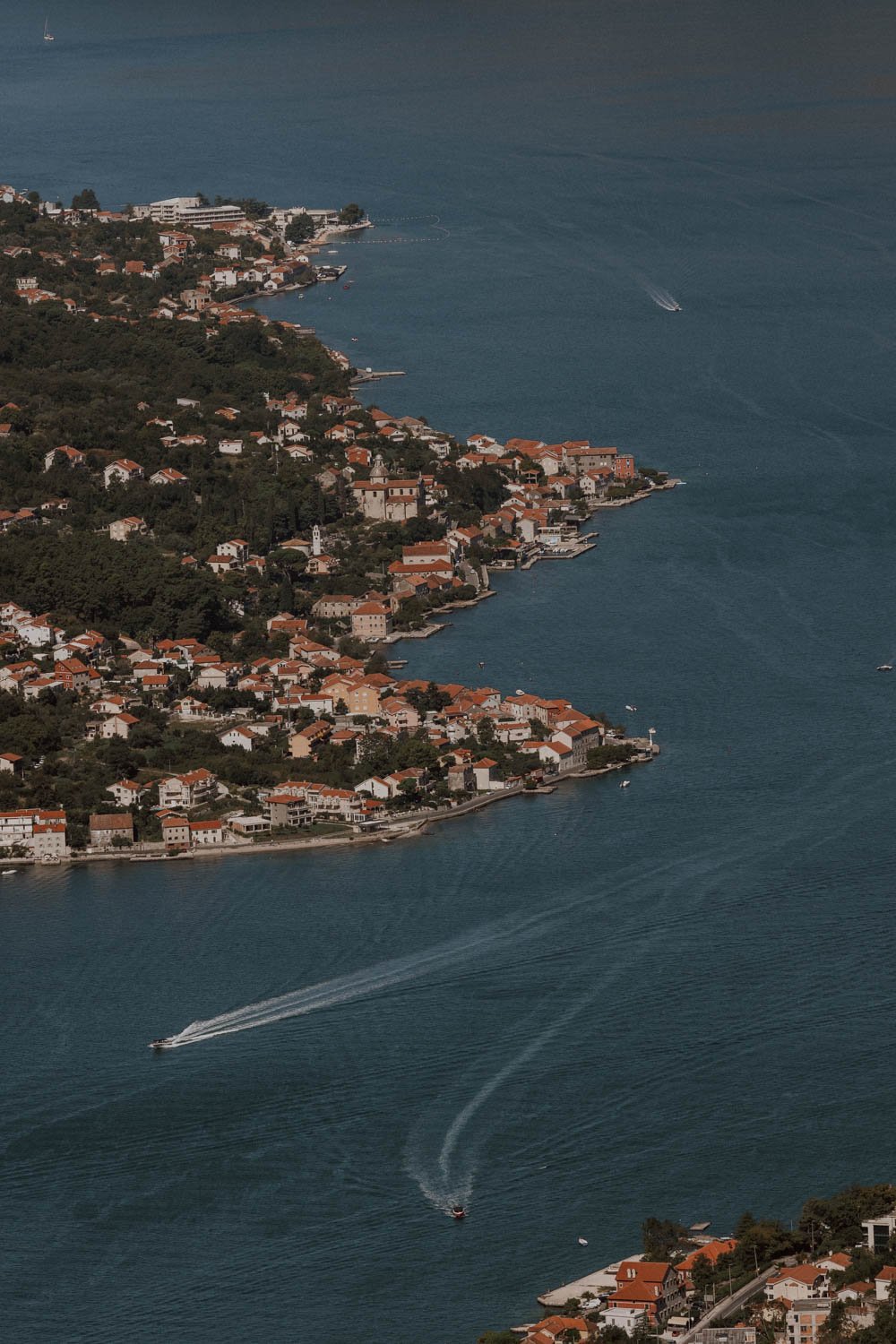
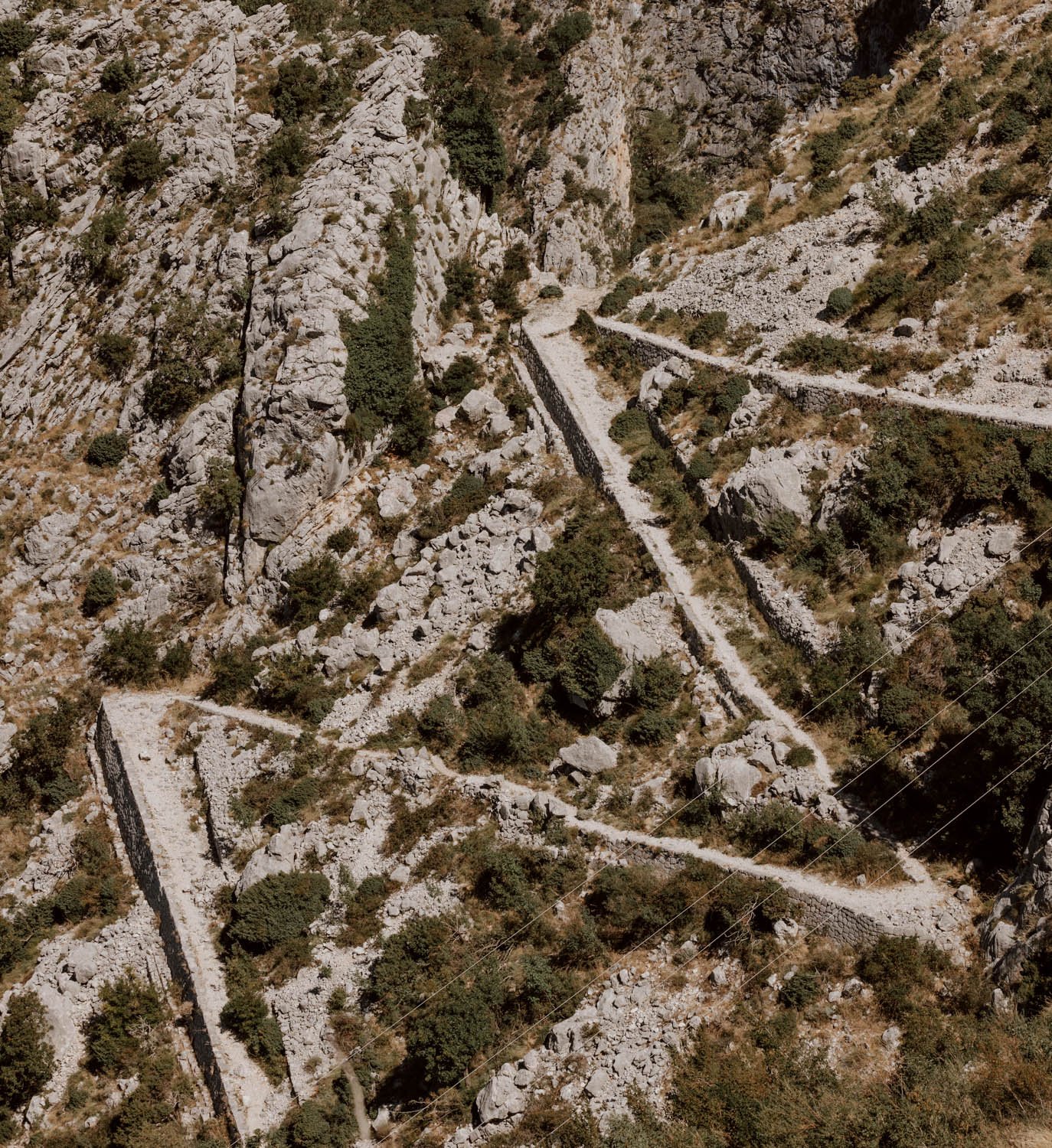
If you want to escape the crowds and gain a true sense of Kotor’s strategic brilliance and glorious setting , the Ladder of Kotor is hard to beat.
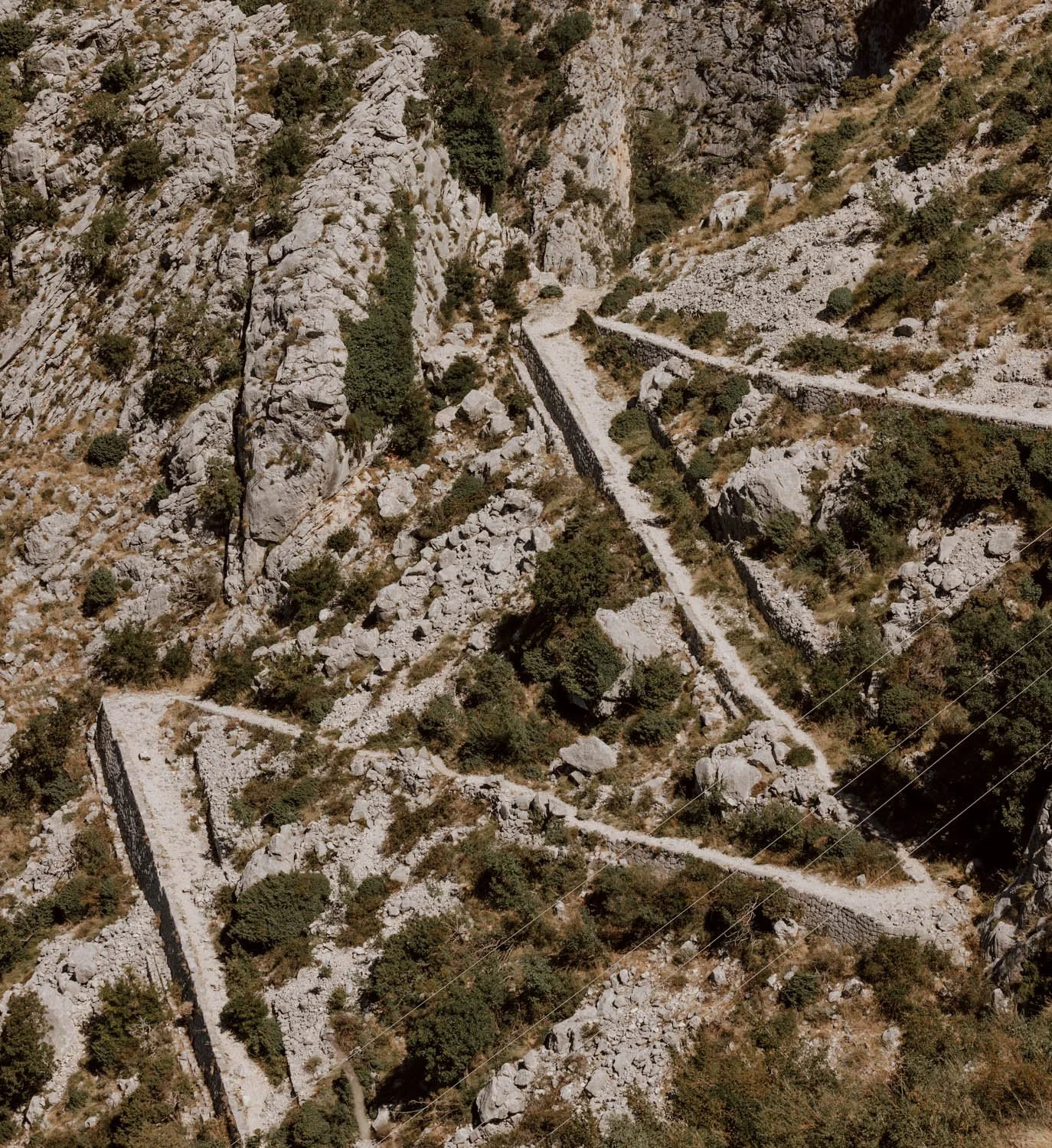
This 10km round trip walk begins just outside the town walls and climbs the mountainside via 70+ switchbacks. The path was formally built by the Austrian military, who had nabbed Kotor from the Venetians in 1797 and clung to it (bar a brief Napoleonic interlude) right up to 1918, and once the main artery linking Kotor with Njeguši and Cetinje.
Today, it offers a unique perspective over the old town and the modern town that’s spread far beyond it, the bay, and the surrounding mountains, rewarding every zigzag with spectacular views. It can also be combined with a visit to Kotor Fortress, which is definitely a good idea if you don’t want to sweat on steep steps two days in a row!

We hiked a lot in Montenegro and, depending on your level of fitness, would categorise this more as an enjoyable / challenging walk rather than a proper hike. That being said, good footwear is important, as well a morning start before the trail has the full glare of the sun on it.
You should absolutely also stop for a glass of pomegranate juice or local wine on the way down.
In recent years, a shorter, easier version of the Ladder has grown in popularity, leading some to think they’ve ‘done’ the Ladder when they’ve only completed a few rungs.
Whichever you choose, just be aware that there’s a way to do it for free and another way that will cost you €15!
Plan // We’ve shared absolutely everything you need to know for both the full Ladder of Kotor hike, the shorter alternative, your options for combining it with the fortress, and how to do it for free or €15 in this dedicated post: How To Climb The Ladder of Kotor.
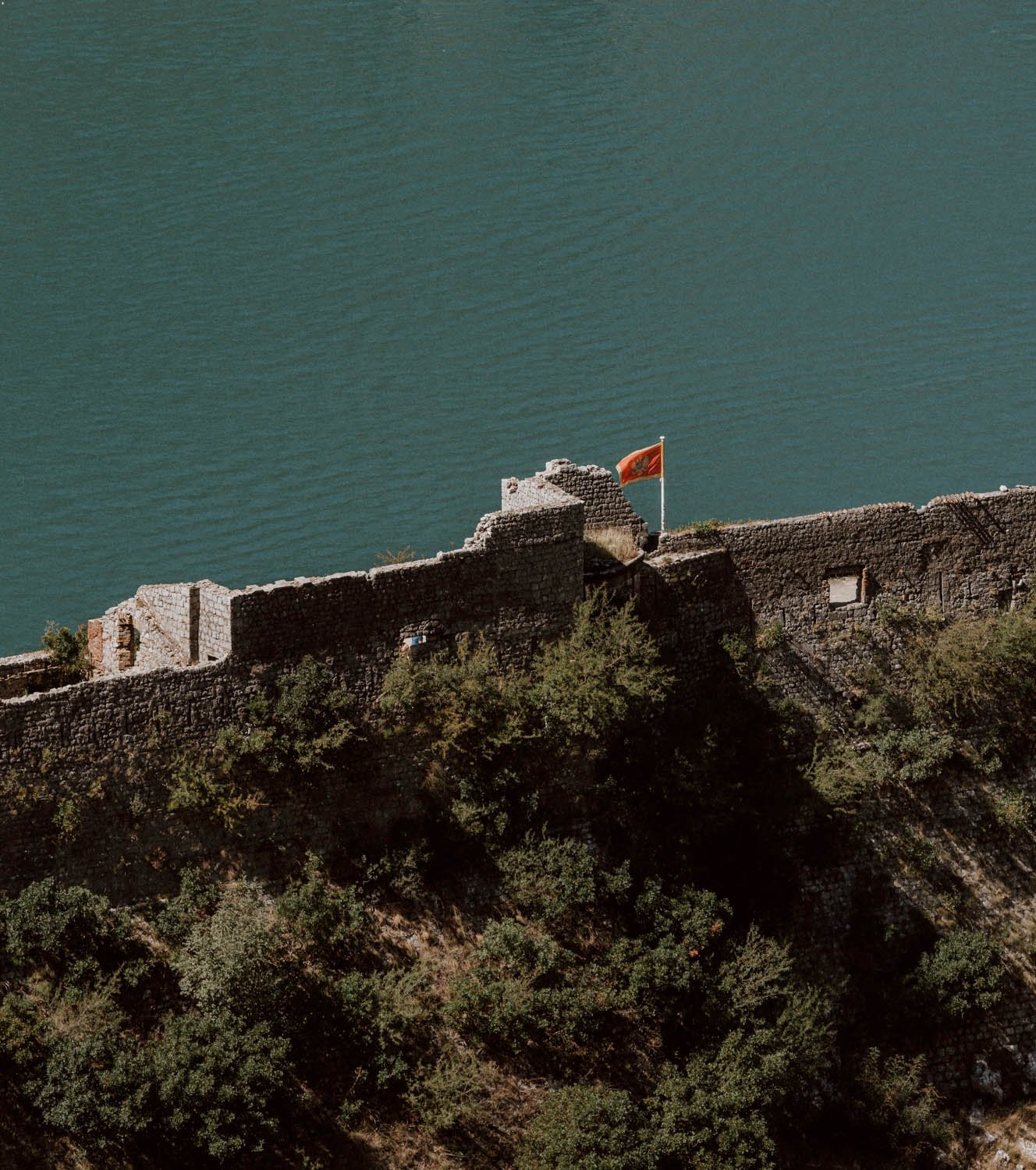
How To Avoid The Cruise Ships
Stay overnight rather than day-tripping. Although the cruise ships docking overnight means that passengers and tour groups are out and about much earlier than is standard, if you set the alarm early you’ll always have an hour or so of peaceful wandering.
Similarly in the evening, most cruisers are eating on the ship, so dining out is generally really enjoyable.
Visit in spring or autumn when cruise schedules thin out - there are none at all between November and April.
If you really want to travel in summer, check a cruise ship mapper for a full breakdown of exactly how many cruise ships will dock during your planned visit. This will allow you to prioritise time in Kotor on days when there’s one or two, not three or four
Base yourself outside the walls so you can join the crowds on your own terms. We stayed in this lovely little Airbnb just across the bay that was only a 15-minute walk to the old town, but gave us a much more chilled few days.
Want to go totally rogue? Head out to the surrounding hills and secret spots on this off-the-beaten-track jeep adventure
Count The Cats of Kotor*
They lounge on sun-warmed stones, curl up in church doorways, clean themselves upon cafe tabletops, and gaze out over the Adriatic as if they personally own the view (and, to be fair, they probably do). You’ll find them in the narrow alleys, on crumbling Venetian steps, and occasionally, rather regally, on restaurant chairs that you might have assumed were for people.
Kotor’s cats aren’t just strays, they’re part of the town’s identity and unofficial mascots. Theories abound about how they came to be so numerous: some say sailors brought them from afar to keep rats off ships; others that they simply multiplied in the labyrinthine streets and never felt the need to leave.
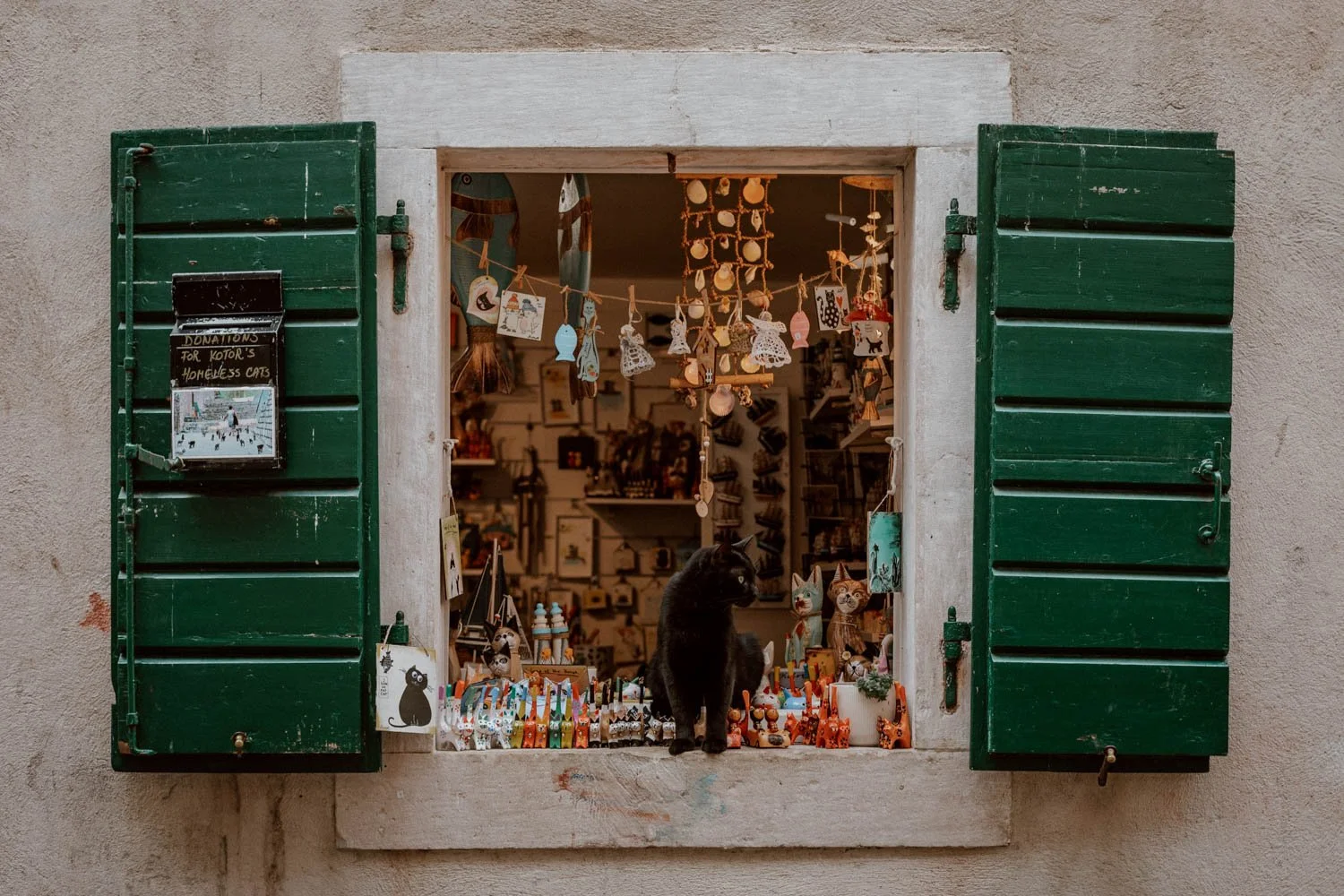
Today, they’ve achieved near-celebrity status. There’s even a Cat Museum (yes, really) devoted to feline art and memorabilia, and the many, many souvenir shops all peddle cat-themed trinkets (Danijela’s Shop is a good one)
But, in true feline fashion, will they ever pose for you or show you any appreciation? Of course not.
However, several were very accepting of fuss and scratches behind the ear, and may even be the highlight of your time in Kotor.
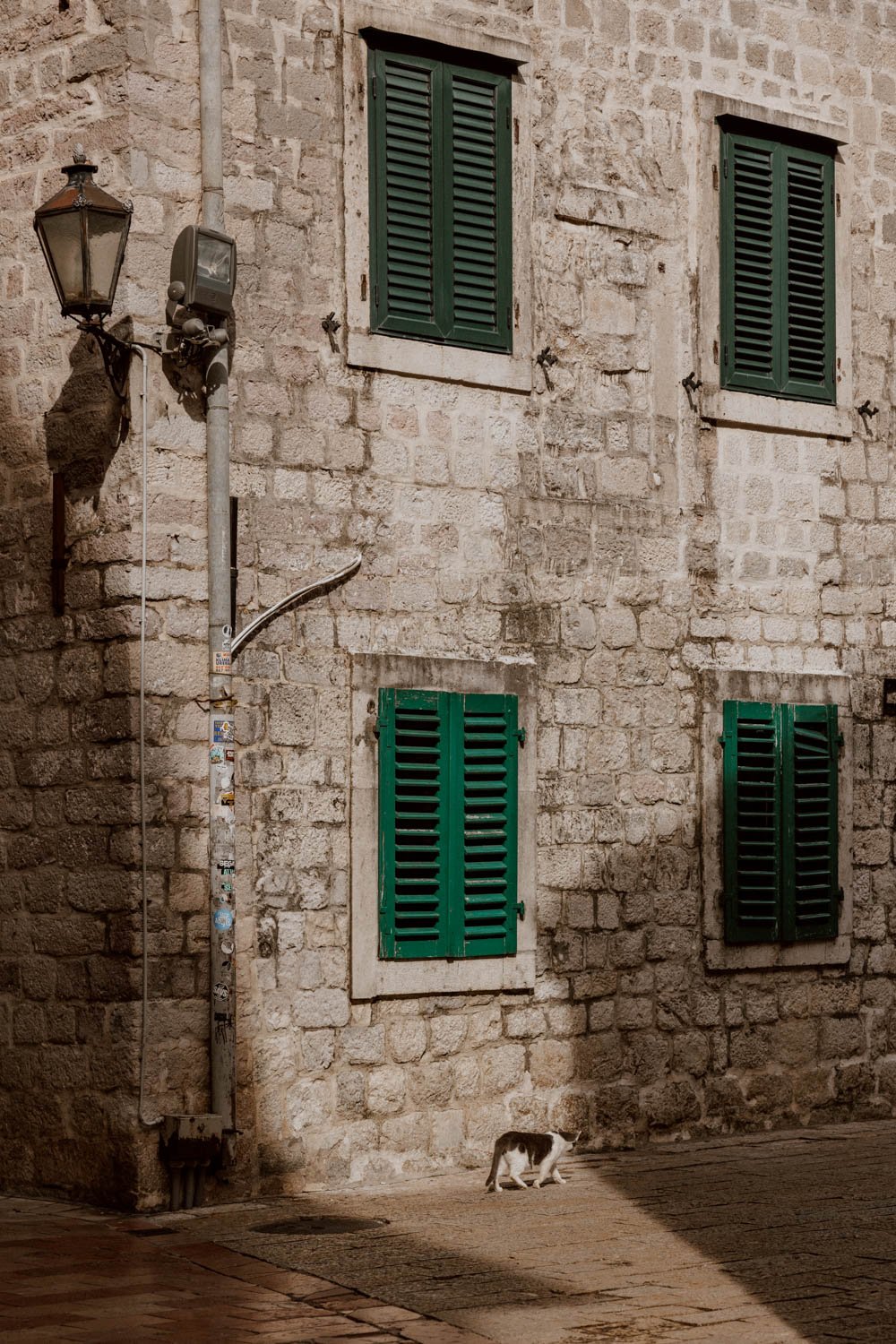
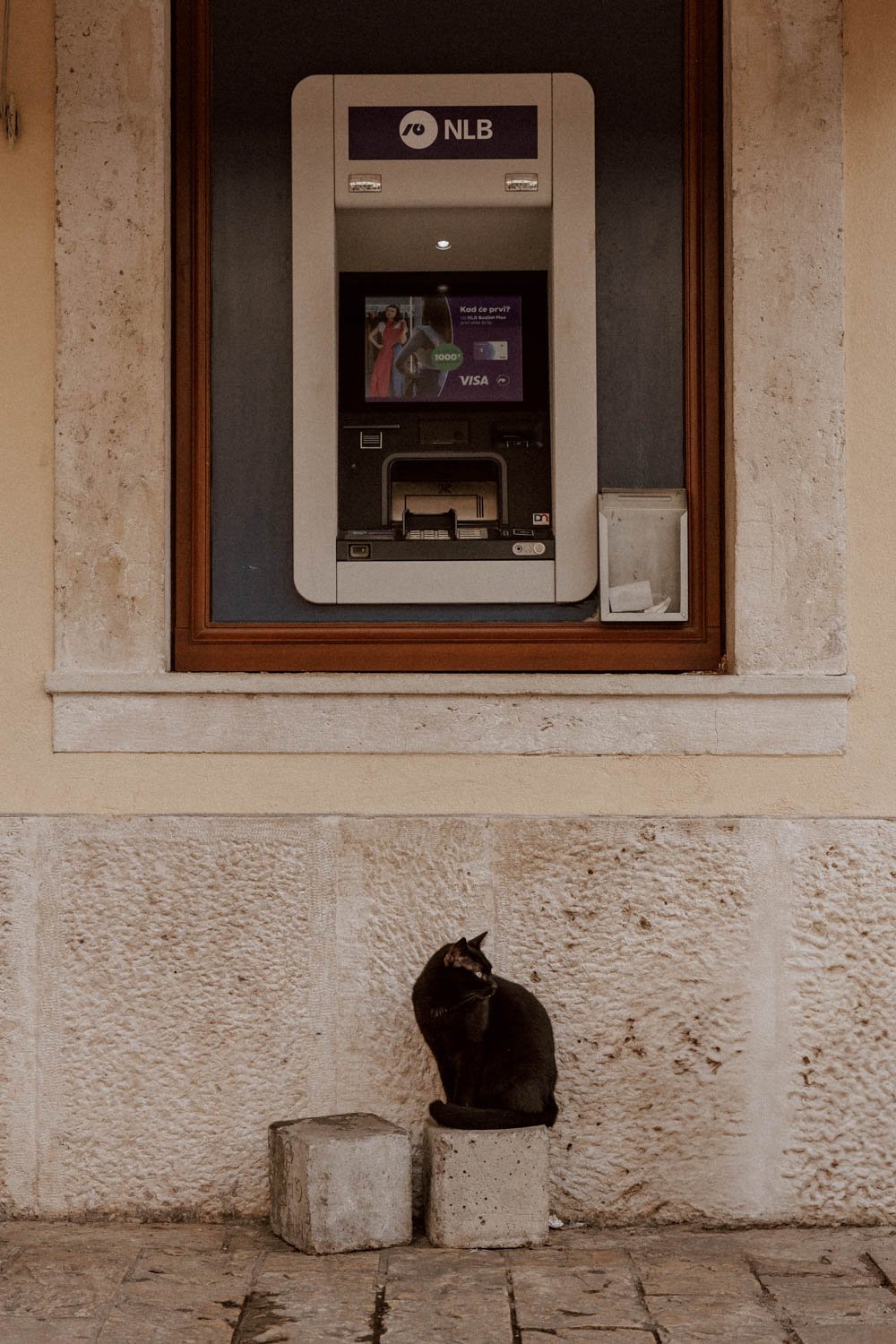
Where + When / It’s just €1 entry to the Cat Museum, which is small and won’t take you too long. They also feed and care for cats, so it’s a good organisation to support. Note that it’s only open from May 1st to October 31st - find it here on Google Maps.
The museum is set within Square of The Cinema (Pjaca od Kina), which is one of Kotor’s smaller, quieter squares that’s relatively tucked away from the main tourist flow. It’s got a beautiful centuries-old poplar tree there, supposedly planted here in 1667 after an earthquake, when the square was part of a monastery.
The cinema, alas, is no longer with us.
Oh, and keep an eye out for Stubs the cat.
*Apologies for that effort by the way. Surely calling it ‘CAT-OR’ would have been a better shout, and maybe this is why the Venetians called it Cattor!
Visit Kotor Fortress
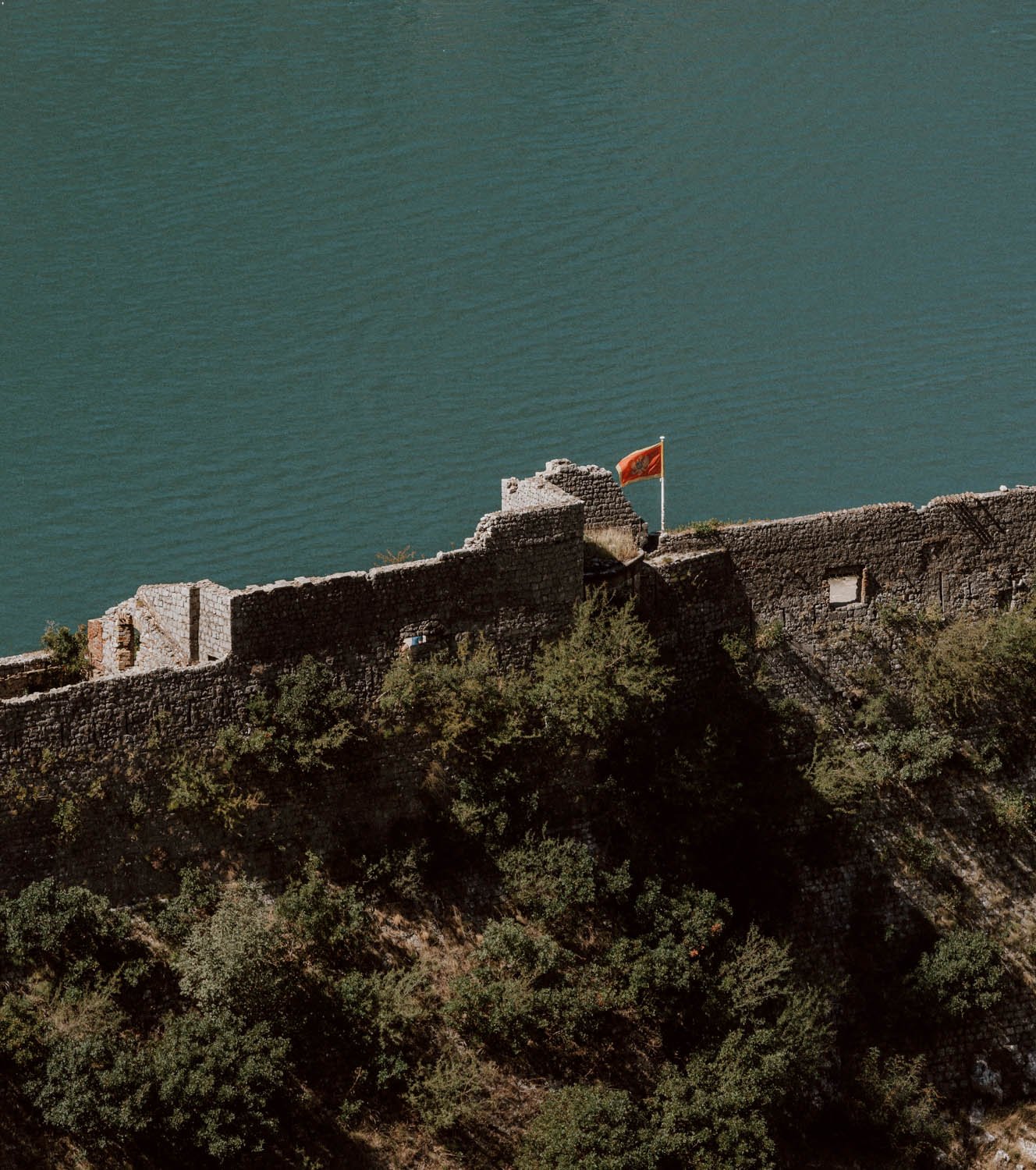
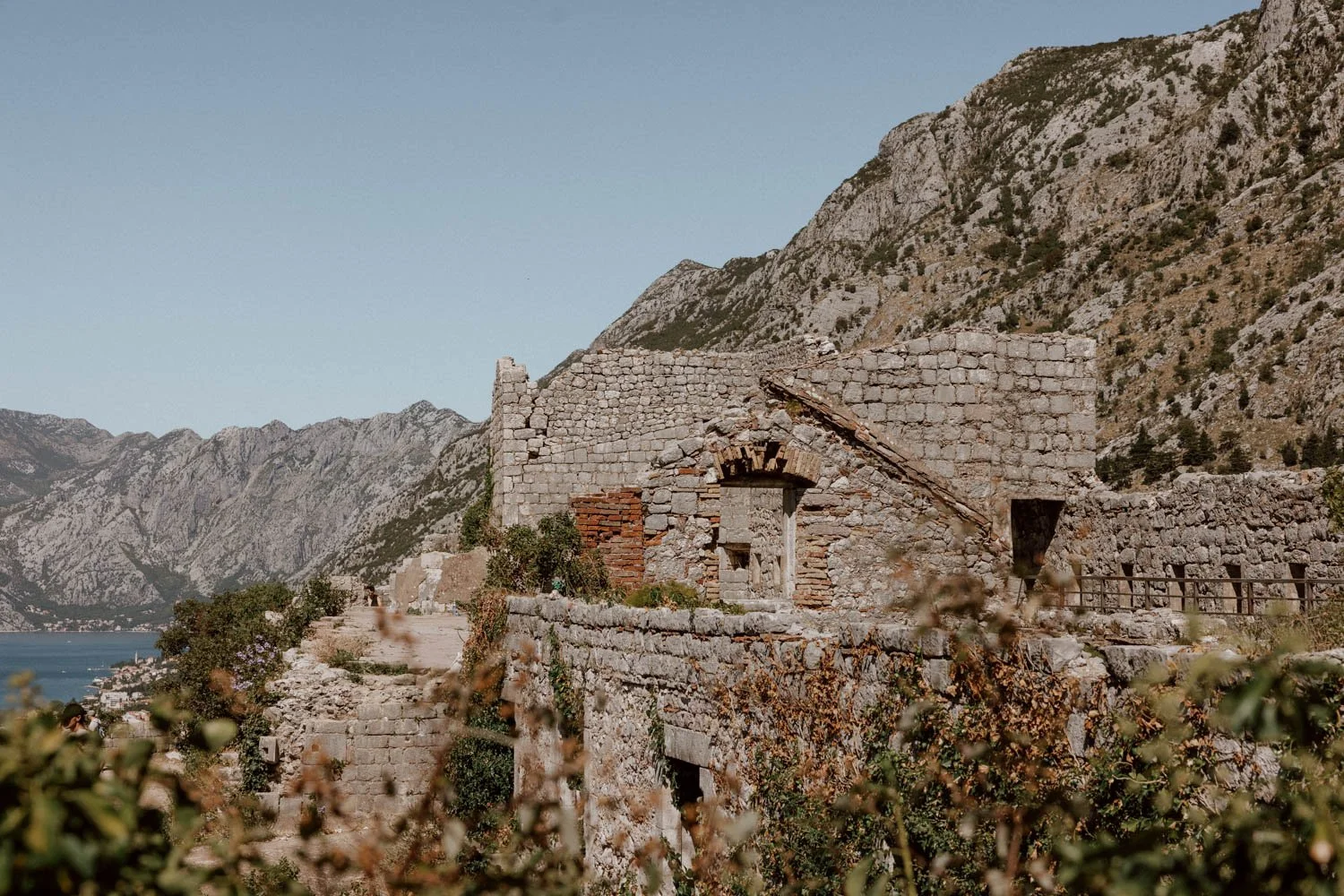
High above the terracotta rooftops, stitched into the limestone flank of the mountain, lie the ruins of Kotor’s fortress. A form of this has watched over and protected the town for over a thousand years, and is so embedded that from afar it looks almost organic: a stone ribcage growing and twisting into and out of the rock itself.
As with the town walls, most of those who have ruled here played their part in the creation of the fortress, but most of what you see today dates from the Venetian occupation, between the 15th and 18th centuries, when Kotor was known as Cattaro and served as a vital outpost of the Republic’s maritime defences.
The Venetians strengthened and expanded the medieval walls, turning the town into a true fortress city and an impregnable link in their chain of Adriatic strongholds.
Over the centuries, the fortifications were battered by earthquakes, sieges, and the ambitions of foreign powers - from Barbarossa’s fleet to the Austrians who inherited the bay after Napoleon’s collapse.
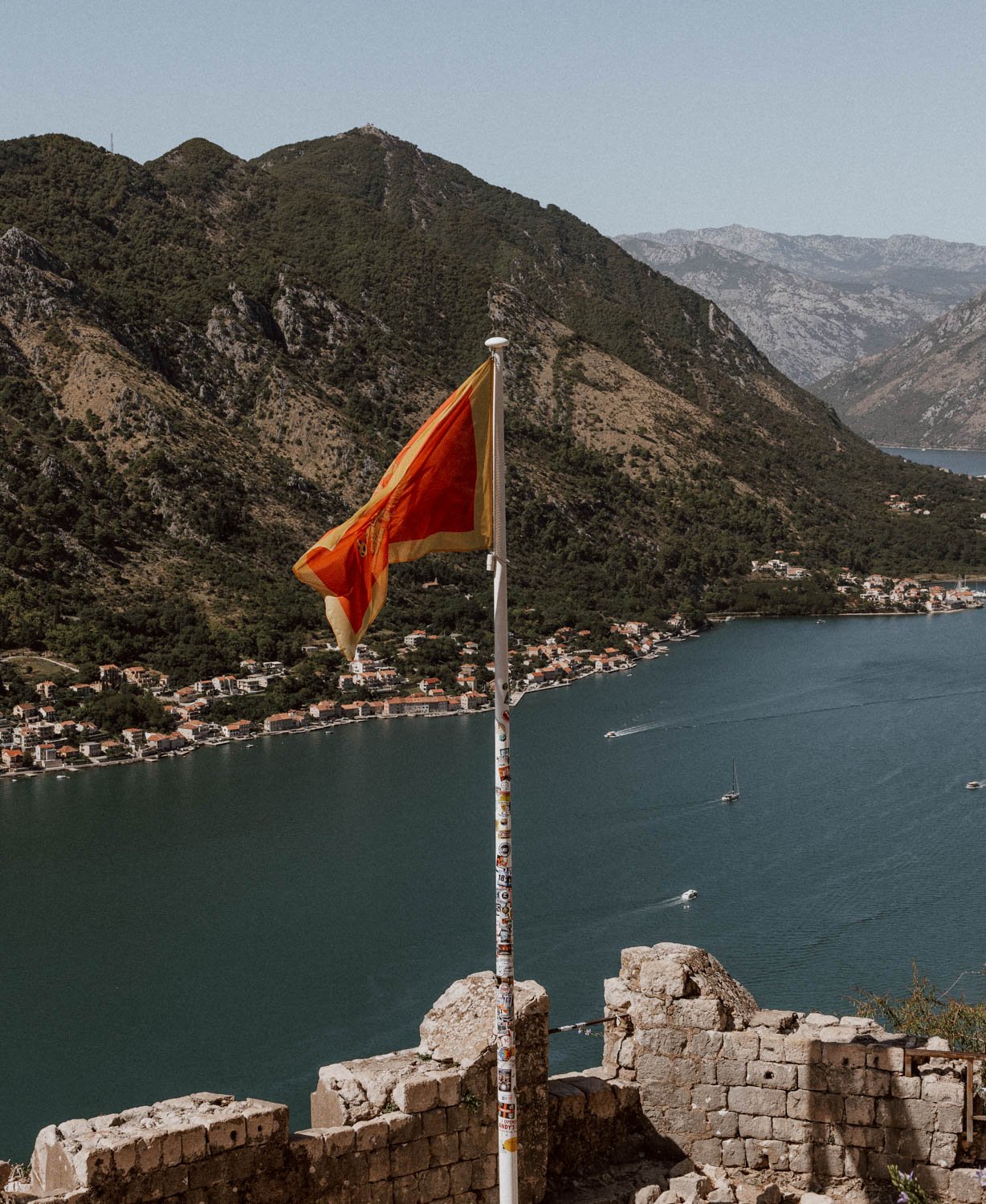
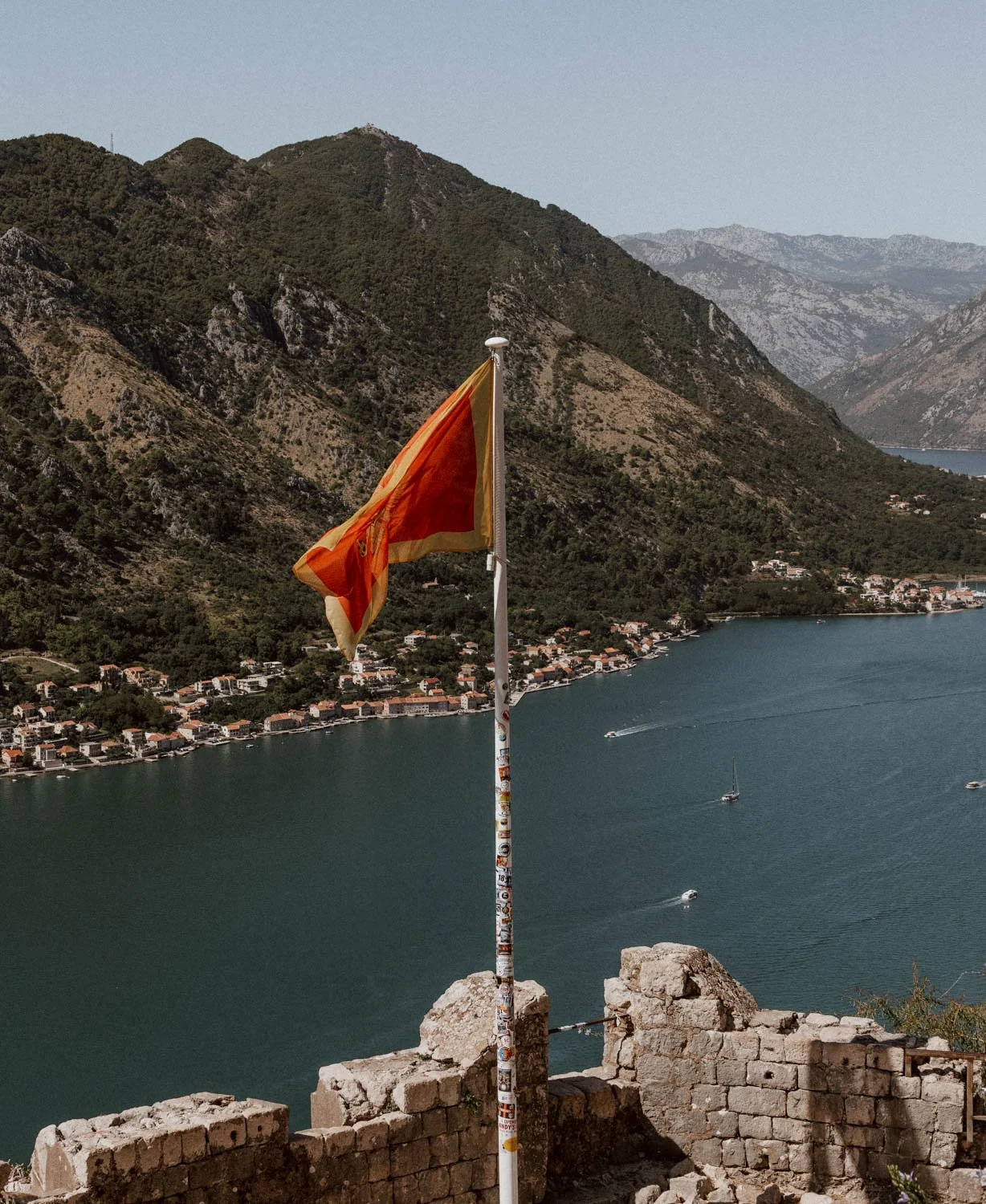
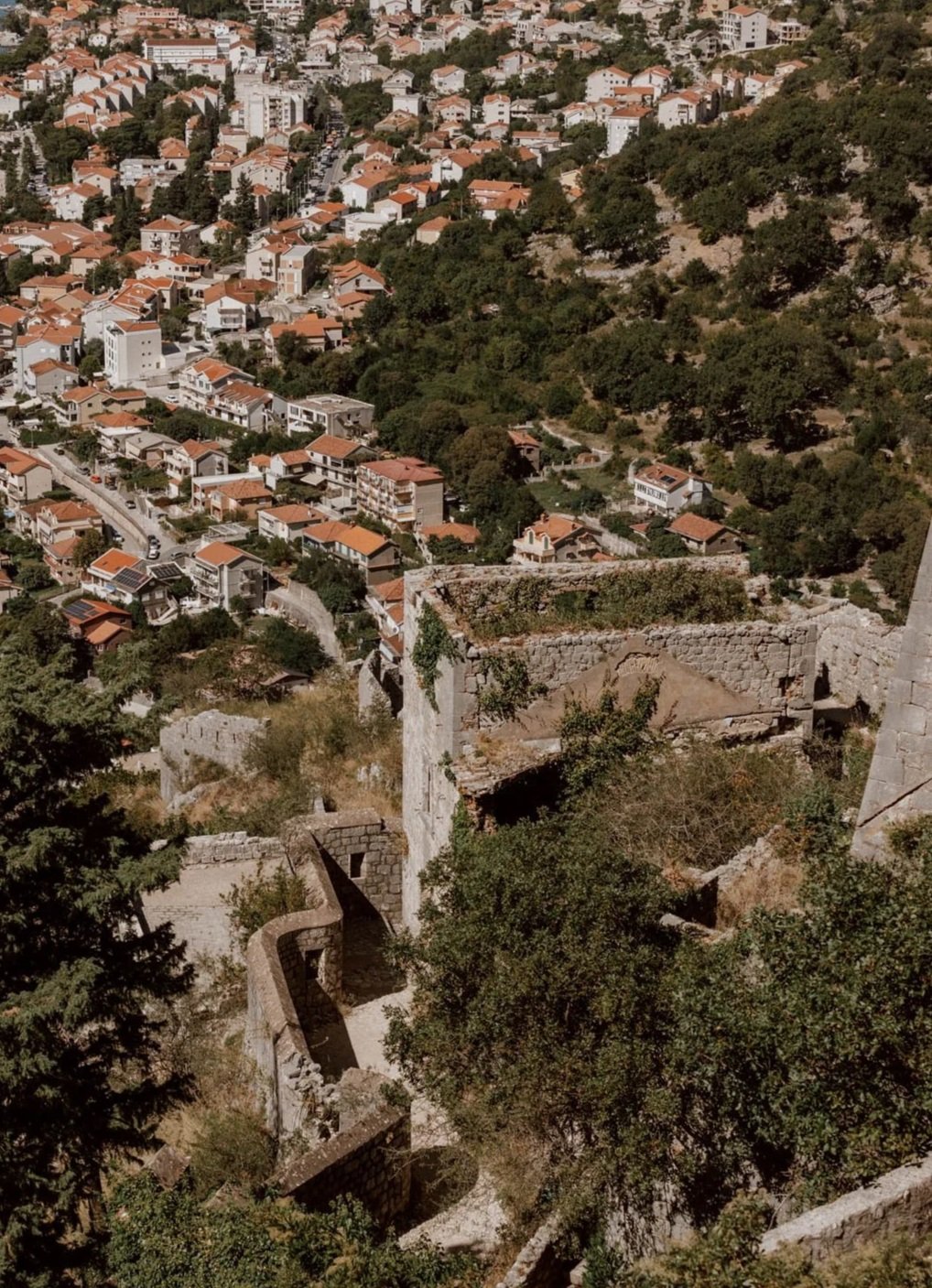
Today, visiting the Fortress of San Giovanni (as it’s officially known) is probably the most popular thing to do in Kotor, but you will have to sweat for the experience.
The climb to the top involves a series of 1,300+ steep, narrow steps, which can really take a toll - and then you have to do them all again on the way back down! Along the way there are the ruins of churches, a few information boards, and plenty of fantastic viewpoints.
However, the fact of the matter is that the entry price of €15 per person is ridiculous. It was at a much more reasonable €8 a couple of years ago, but there doesn’t appear to have been much investment into information boards or upkeep. It’s therefore difficult for us to give a full-throated recommendation, especially for travellers who may be on a stricter budget - especially when the Ladder of Kotor offers a free alternative.
Where + When | There are two entrances from the old town up to the Fortress - one by the North Gate and one by the by the South Gate - and you can go up and exit from either. Now, we have to warn you that you’ll see almost everyone on the Google Reviews for those two entrances calling them ‘scams’: this isn’t true.
These are the official Kotor Fortress entrances + exits, and it’s the tourists that are wrong in this case; this is mostly because they’ve read the wrong information about the Ladder of Kotor hike.
It’s €15 for adults and free for children under 12 years old, with cash and card accepted (although there are sometimes issues with card payments). You will receive a receipt, and make sure you don’t lose the ticket.
They’re open from 8am-9pm summer, and 7am-8pm outwith. If hoping to visit earlier, you can usually enter for free and then pay on exit.
Know | For avoidance of doubt, there’s no point visiting Kotor Fortress unless you plan on going to the very top of it (this a ruin primarily, rather than a castle you can walk around). If you come before 10am, most of the path up will usually still be in shade and that will make everything more pleasant - we do not recommend starting your walk up between 12-3pm. If you’re just going up to the top of the fortress and back down, you’ll need around two to three hours for the activity.
It’s a good idea to bring a hat, plenty water, and suncream - and wear trainers rather than sandals if possible.
The stairways are very narrow and bottlenecks occur often, so a bit of patience and give/take is required of everyone.
The Alternative // As mentioned, there are two alternative ways to visit the Fortress and/or combine it with the Ladder of Kotor loop and, depending on your route and choices, these can be done for the same €15 entry or for free. These have become quite popular in recent years, but there is a lot of confusion and wrong information about this online, whilst access isn’t always guaranteed.
We’ve done our best to clear everything up in this post: The Ladder of Kotor Fortress Hike Explainer
A Day Trip to Perast & Our Lady of the Rocks
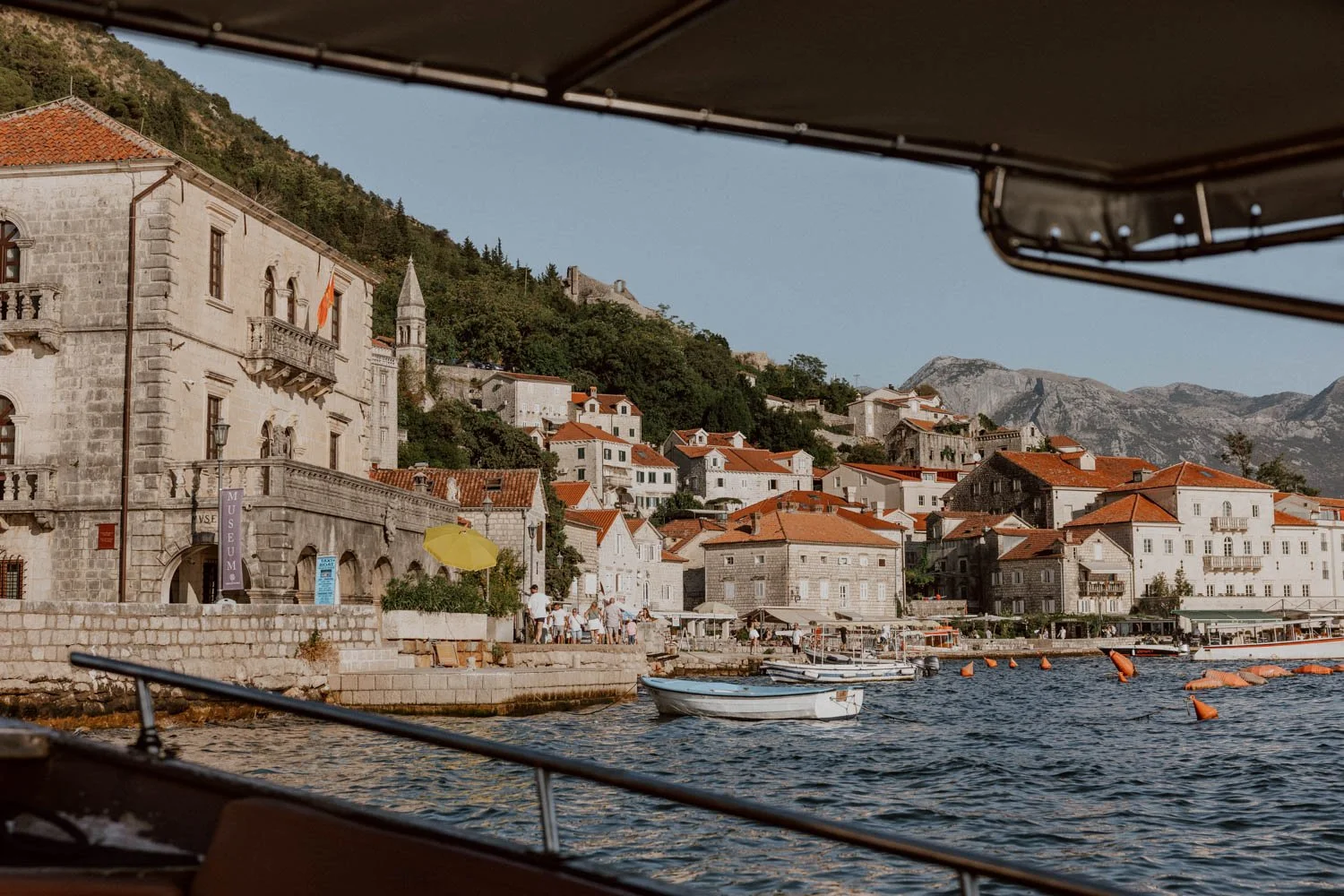
Perast is deserving of the title of Montenegro’s prettiest village, and we both regretted not spending a night or two there.
A single seafront street of pale-stone palazzi, a baroque bell tower rising above the square, and two small islets lying just offshore as if placed deliberately for the view, it’s the Bay of Kotor at its most cinematic.
It’s just a 30-minute drive from Kotor, but you may also recall that it’s included as a stop on most Bay of Kotor boat trips, and therein lies the nub: the village can get totally overwhelmed from about 10am to 4pm by day trippers in peak summer. This can make it difficult to enjoy the beauty and setting, and could actually ruin it if you’ve only got a few hours to play with!
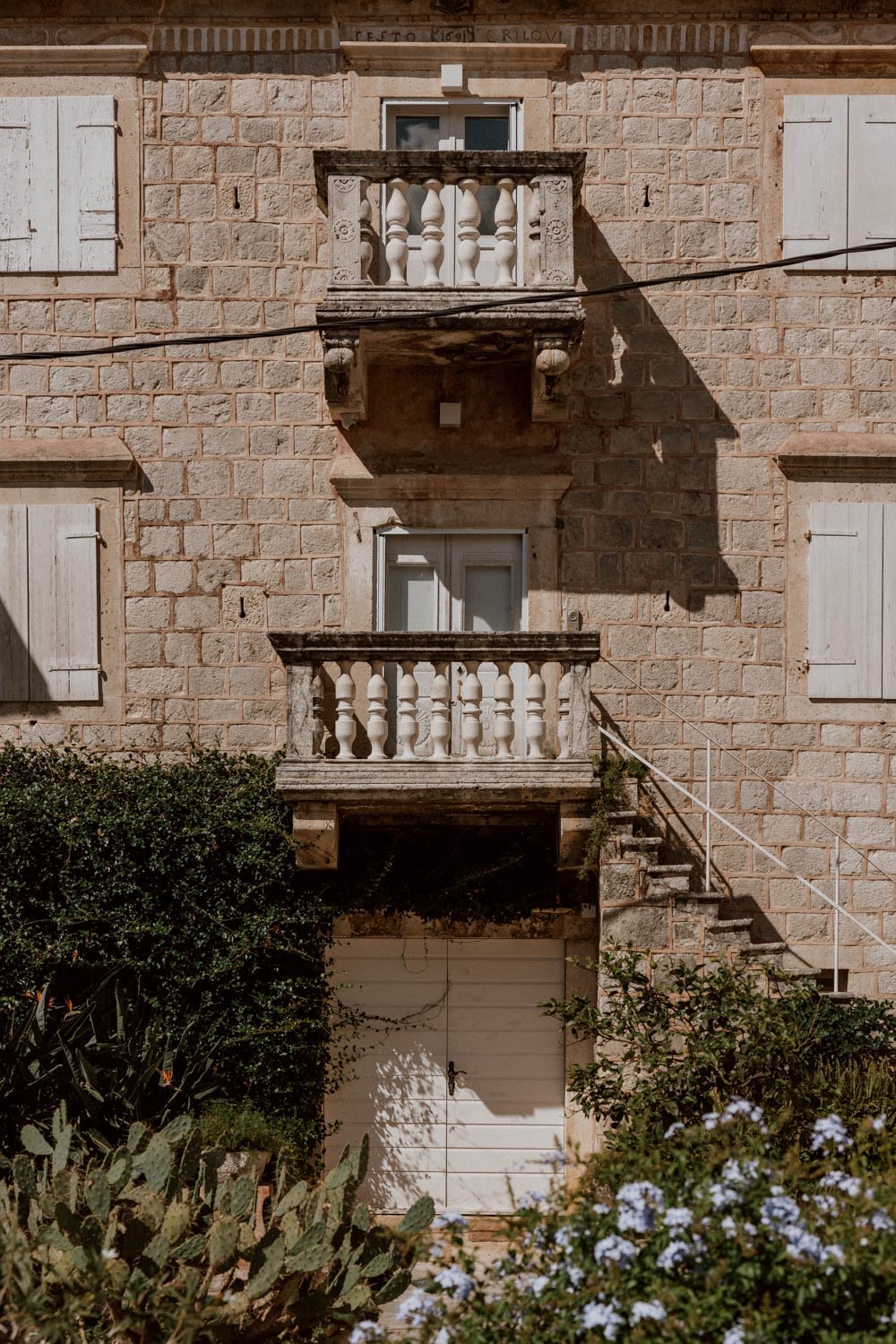
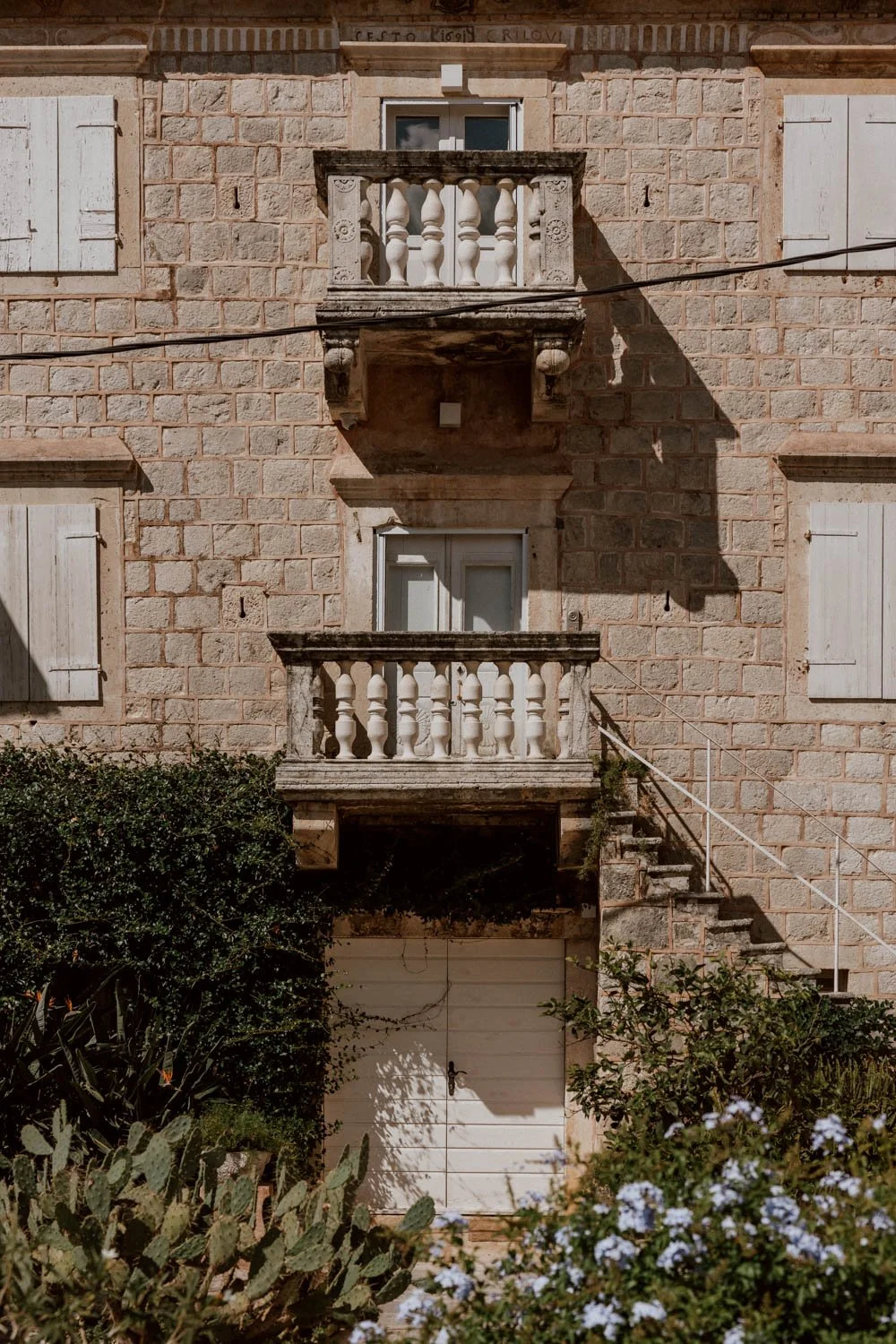
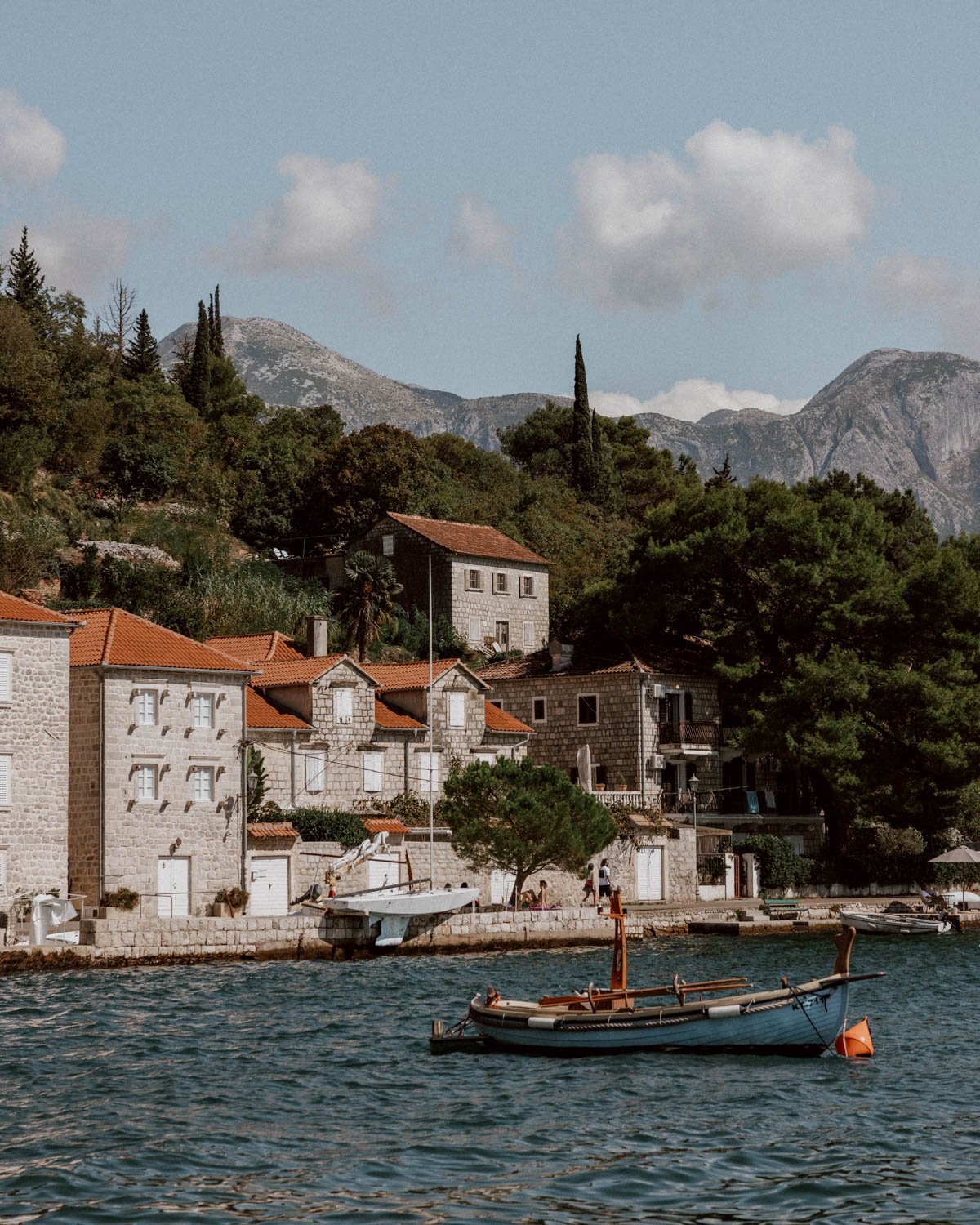
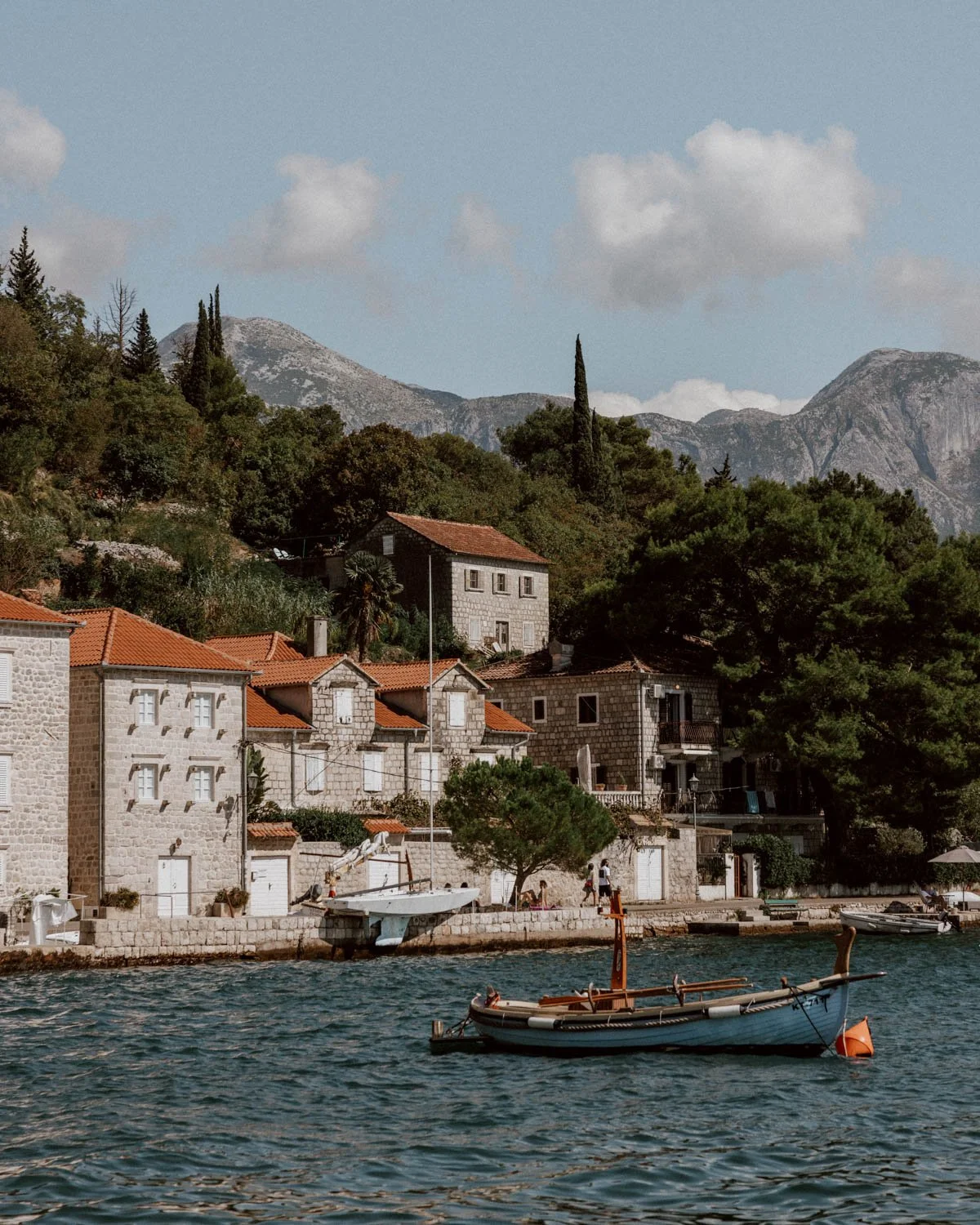
So, if you’ve got the time or inclination to have a proper day trip to Perast from Kotor, we’d recommend those heading out by bus or with their rental car try to arrive earlier or linger around until late. If choosing between the two, then an early evening seafood dinner on the waterfront would be all sorts of magical, but there’s also a few good swimming / sunbathing spots either side of the village.
Everyone visiting on a day trip should also take the five-minute water taxi over to Our Lady of The Rocks, an extraordinary man-made islet slowly built up over centuries by sailors who promised to lay a stone each time they returned safely from sea. What began as a small rock formation eventually grew into a stable surface large enough to support a church, completed in 1630 and rebuilt after earthquakes and storms.
Book | Boat Trip from Kotor to Perast Old Town & Our Lady of the Rocks
Stay | If you’d rather use Perast as your base, consider ultimate luxury at Heritage Grand Hotel or Santa Boka, whislt Hotel Admiral is a solid mid-range choice. There are lots of excellent Airbnbs, but you’d be hard pushed to beat this one
Plan // Our Perast Travel Guide
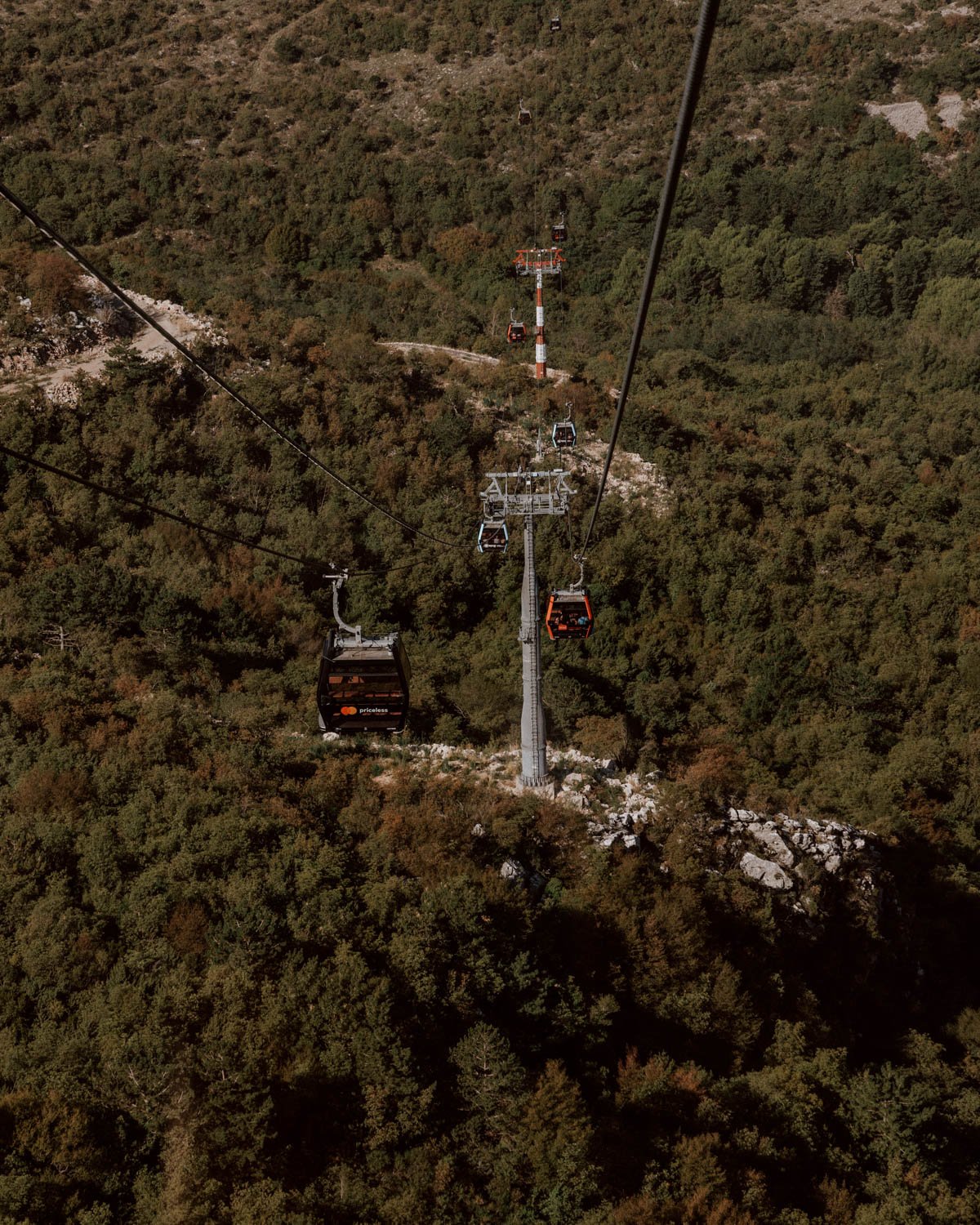
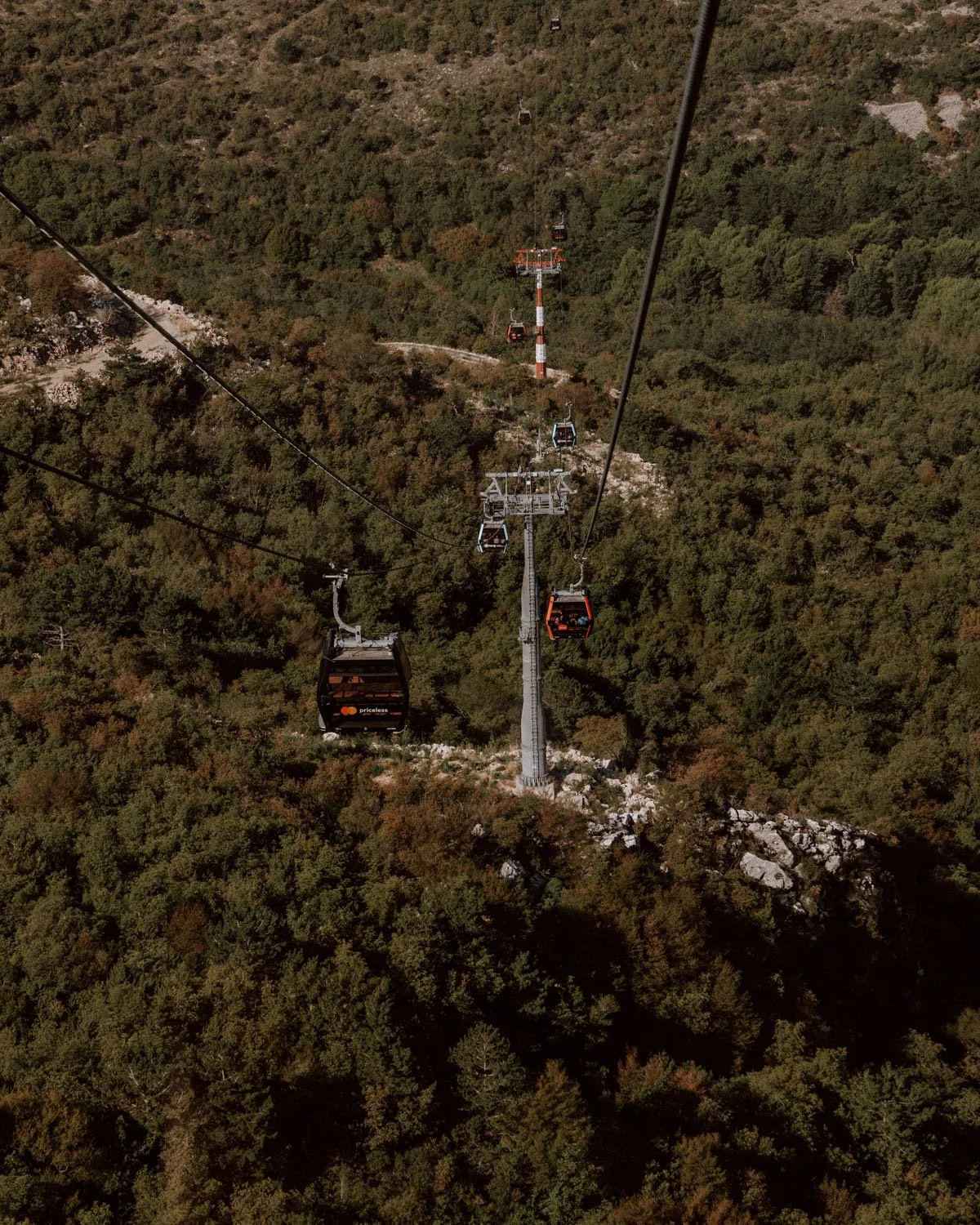
Ride The Kotor Cable Car & The Alpine Coaster
The Kotor Cable Car doesn't actually start or end in Kotor.
Opened in summer 2023 - remarkably just over a year after construction started - Montenegro's newest headline attraction was created to give locals and tourists quick, easy access to the summit of Mount Lovćen and its breathtaking views over the Bay of Kotor, surrounding mountains, and the Adriatic coast.
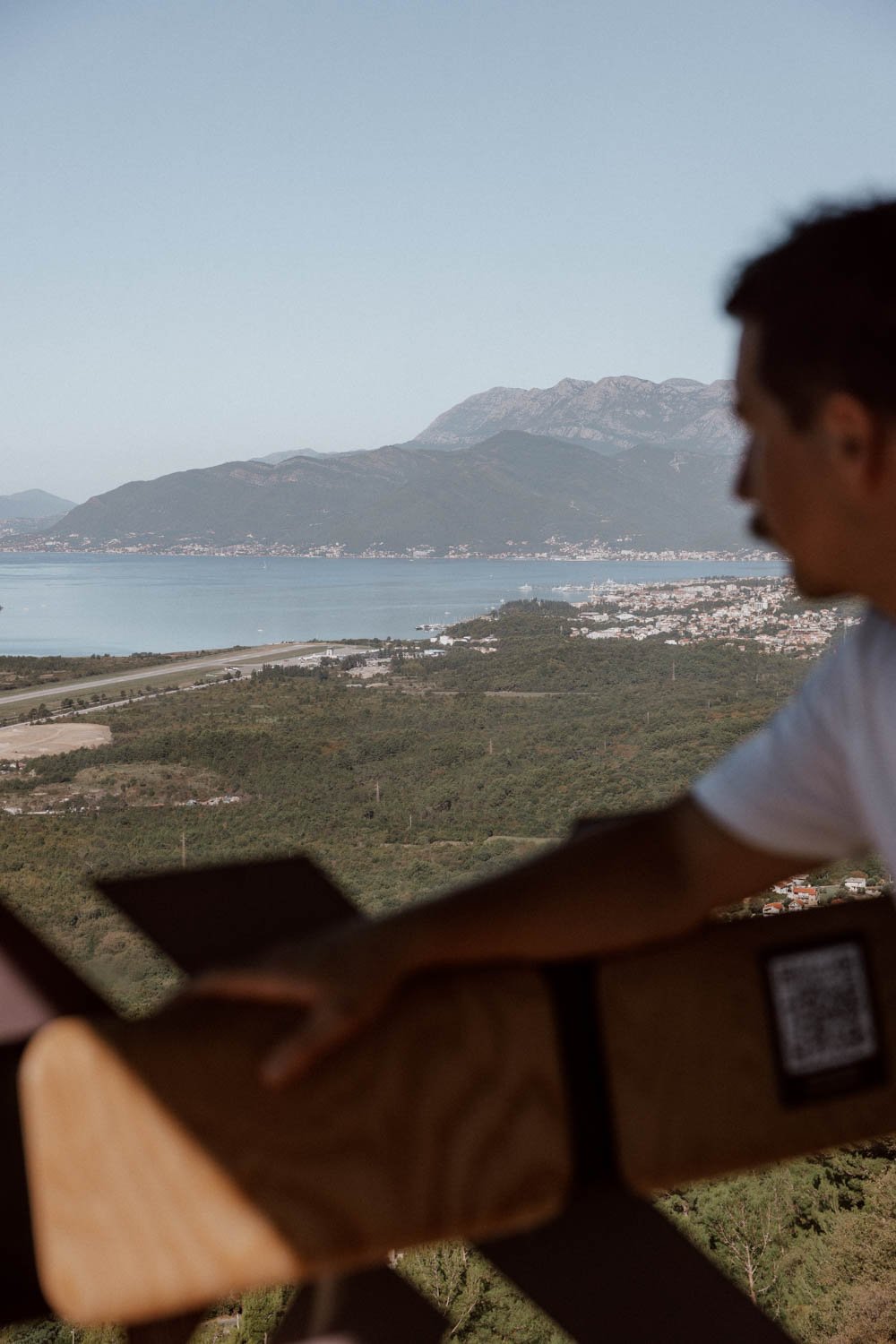
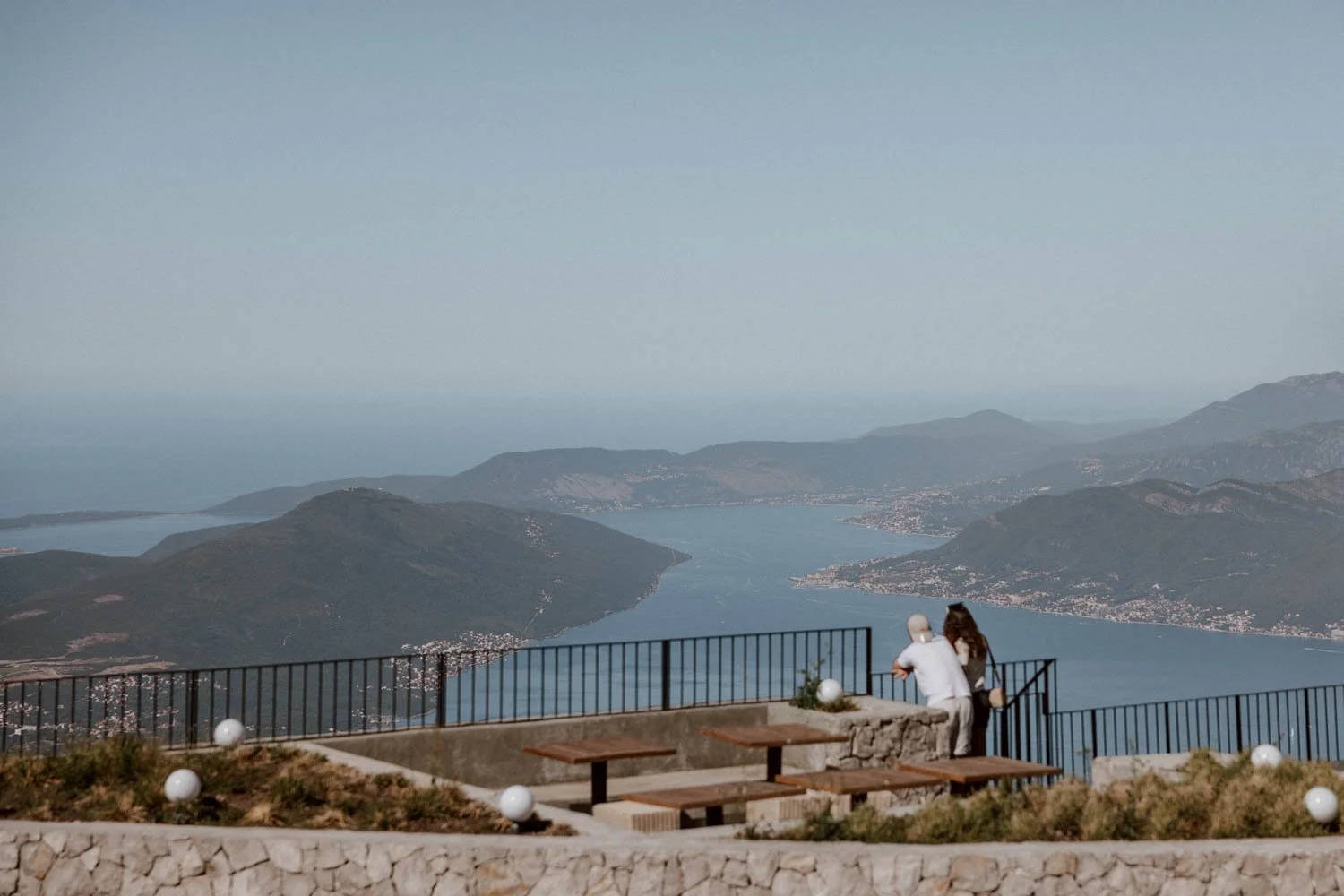
The cable car makes its dramatic 3.9km journey over the steep terrain in a zippy 11 minutes, offering a memorable way for everyone, regardless of age or fitness, to enjoy one of the most famous vistas in Montenegro from 1,350 metres above sea level. For families, those focussed on coastal trips, and any traveller unable to access the country’s gorgeous mountains and hinterland hikes, the reason to ride up is clear: epic views without the hike.
But, in our case, the main reason was the Alpine rollercoaster.
For, whilst the cable car is itself becoming one of the most popular things to do in Montenegro, for many it's just as much about what else it leads you to atop the mountain. The unimaginatively named Kotor Cable Car Complex is a modern, well-executed space - part-shopping mall plaza, part-adventure park - on the fringes of Mount Lovćen National Park, offering bikes rides, short walks, and several other activities.
It’s also the place to be for sunset drinks.
A word of warning though: some of the prices are as steep as the mountainside, and if you eat, drink and do a few activities it will end up being a very expensive day out!
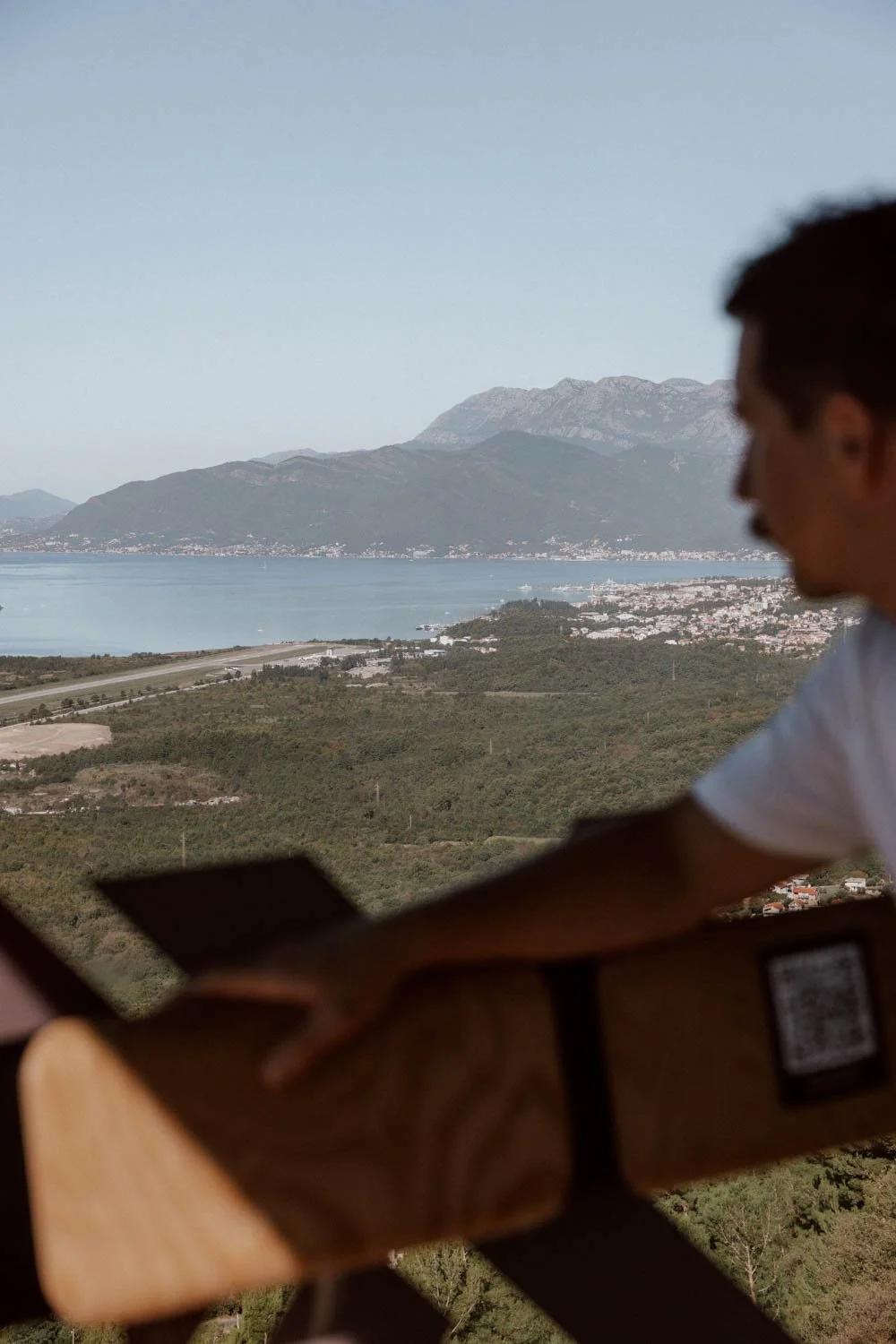
Where | The ride begins from a place called Dub, which10-15 minutes by car from Kotor town and actually closer to Tivat - find it here on Google Maps
Roadtrippers can just go to the large official car park (€1/hour), but there’s no public transport. Instead, you’ll need to opt for official Cable Car shuttle bus service from Kotor which has departures every half hour from 8am from the main bus station in summer. The station is about a 10-minute walk from the historic centre.
Shuttle bus tickets are €10 single or €15 round-trip, or you can save by choosing the €30 cable car + shuttle combo ticket. For children under 12 years old, it’s €5 one-way, €10 round-trip. You can buy them online, but there’s also a ticket office at the station.
When | Opening times are a little uncertain as they vary according to the season and sunset hours! In the summer months, it generally operates from 9am to 10 pm, with the last gondola heading up between 8.30pm and 9.30pm, and the last down between 9pm and10pm. The longer the nights are, the later the last departure will be! On Tuesdays, the service starts at 10.30am.
As the schedule is so changeable, it’s a good idea to confirm hours and the last up/down times here on the official website before setting out.
Tickets | Adult round-trip tickets cost €23 in summer and €12 for children, but there are various combos and discounts available.
Tip | We recommend heading to Monte 1350 Bar (maps), which is a ten-minute walk along the 01 trail or five minutes along the main tarmac road. It’s a much more relaxed open-air hangout named for its setting 1,350-metre above sea level, and its prices are more reasonable than elsewhere in the complex. It’s also one of the most popular sunset venues in Kotor - just make sure you triple check the time of last cable-car down (and leave with a few minutes to spare).
Plan // How To Visit The Kotor Cable Car
Where To Stay in Kotor
As we mentioned earlier, where you stay in Kotor can have an impact on your overall experience of the city.
A beautiful period property in the old town (whether that’s a hotel or an apartment) will give all the feels and put you straight in the middle of the action, but you may find the crowds a little overwhelming at times. Alternatively, you could opt for something towards the village of Dobrota or on the opposite side of the bay - like we did - but this will mean a 10 to 15-minute walk into the centre.
It will also make your parking easier, and give you a different perspective on both the town and the bay beyond.
We will be writing a full ‘where to stay in Kotor’ guide, but until then, here are some of our recommendations.
Note that, as is common across Montenegro, there are far more apartments in Kotor than there are hotels or guest houses.
Hotels & Guesthouses
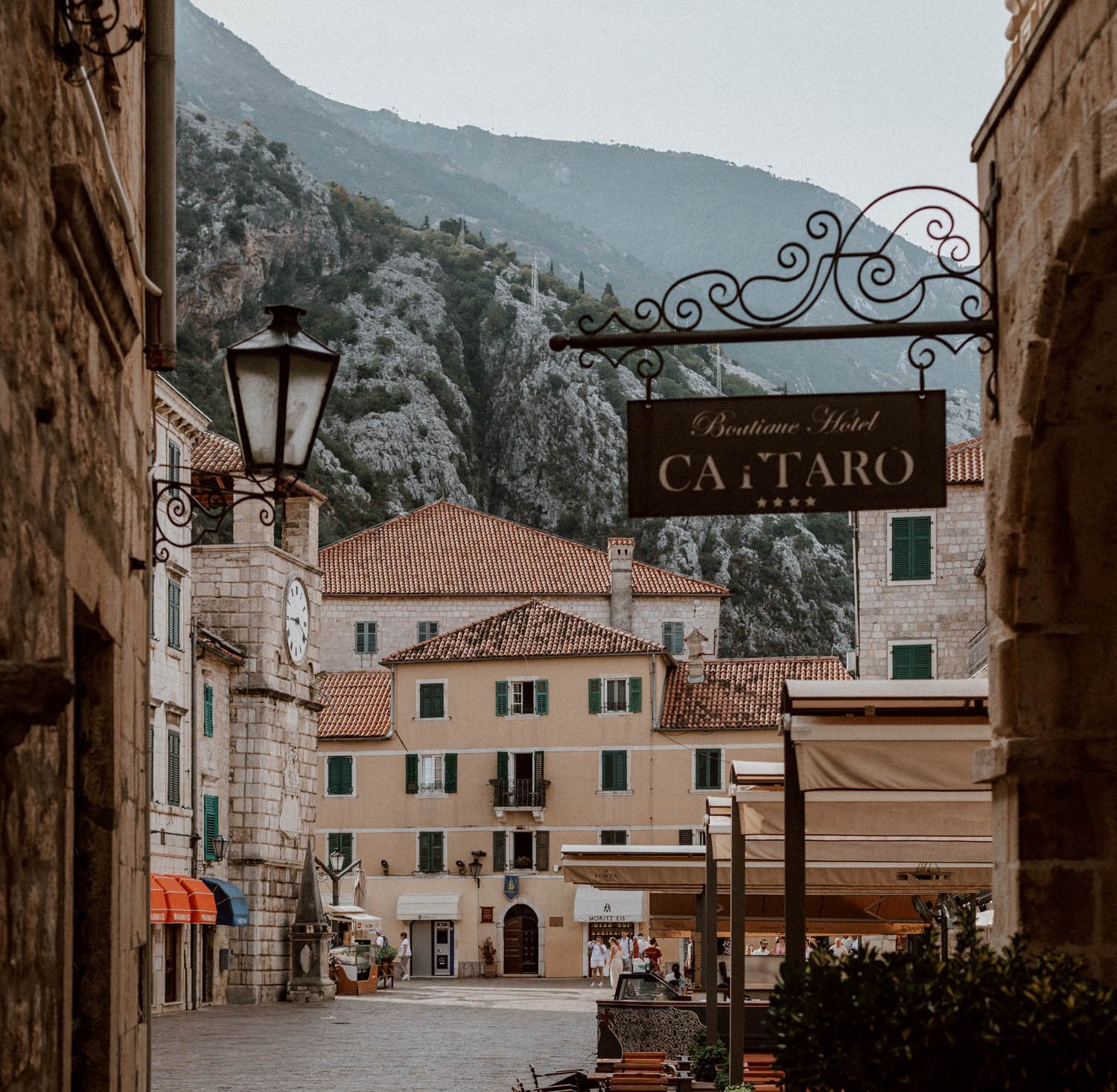
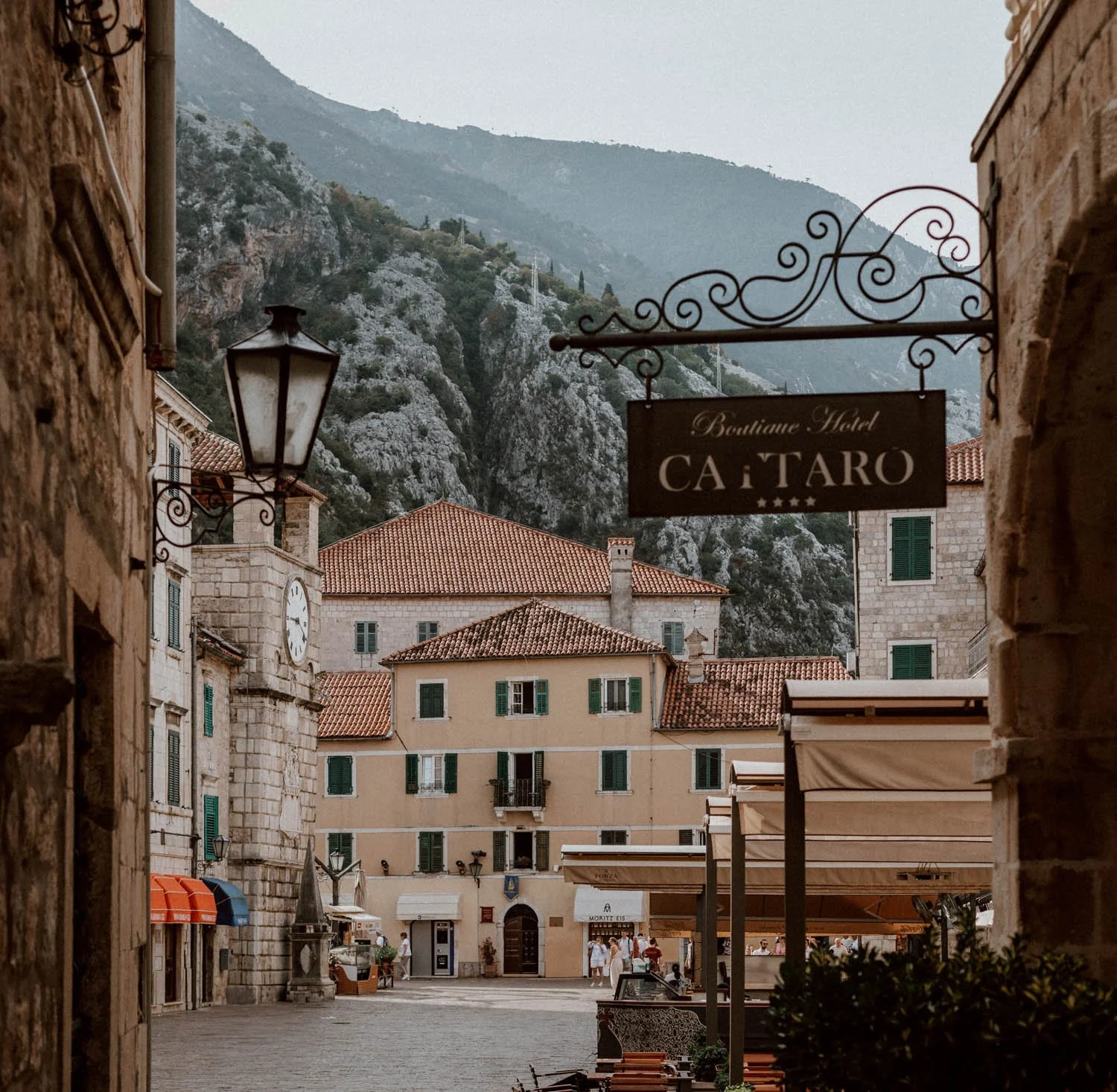
Historic Boutique Hotel Cattaro | This luxury hotel is housed in a cluster of meticulously restored 16th and 17th century buildings (including the former town guard tower and Napoleon Theatre) that now blend heritage with comfort. The rooms draw on maritime and aristocratic references - original stone, wood detailing and artwork inspired by the sea - while the hotel’s restaurant and terrace open directly onto the main square.
Hotel Monte Cristo | This hotel sits in the heart of Kotor’s Old Town, in a 13th-century building that once belonged to the city’s first bishop. The rooms are cosy, with traditional heavy wooden furniture and upholstered chairs that make the space feel lived-in rather than styled, and the location is ideal for exploring both the old lanes and the marina. Do note, though, that being so central means you may hear some late-night noise from nearby bars.
If you’d prefer something more contemporary, take a look at the wonderful Kerber-Graz 1860.
There is nothing sexy about Hotel Vardar, but it’s popular, highly-rated, has an excellent location in the old town and offers a traditional, comfortable stay in Kotor.
Step to Kotor Bay | Guesthouse vibes (but with the option of dorm beds for those who want to save a few euro), this relatively new, tastefully renovated property offers simple but comfortable private rooms near the old town - at a really good price.
If affordability is something you’re looking for, please do check out Hotel Marija. The rooms are a little old-fashioned, but it’s located in the heart of the old and has an excellent breakfast included.
Airbnbs & Apartments
Romantic Chic & Stylish Heirloom Suite | This charming one-bed apartment set within a old stone building eschews a lot of the tired decor that can be found in Kotor with something that is light, bright, and considered and furnished with antiques.
Rooftop Palace Loft | A stylish, newly renovated rooftop apartment in a centuries-old stone house, updated without losing its original character, with warm wooden details and views over the Old Town’s terracotta rooftops. A shared terrace offers a quiet spot for coffee or a glass of wine, and you’re only a few steps from Kotor’s cafés, bakeries, and restaurants.
HealthyStudio512 | This cosy studio is small but has everything a couple needs for a lovely stay - including a peaceful backyard from which you can enjoy the views away from the crowds.
We’re suckers for beautifully designed spaces, and this one-bedroom, Venetian-era vintage style apartment in an historic 18th century building nails it. Great location too, right at the South Gate of Kotor’s Old Town walls.
Other Airbnbs that caught our eye are the Three Square Apartment, Rooftop Panorama Apartment, the three-bed Karampana, and Decatera.
Properties in the old town are really quite expensive in the summer, even if they’re - objectively - not great. A couple of fantastic options if you’re looking for a bit of a bargain are this contemporary studio with views of St Tryphon's Cathedral, Town's Edge Studio, this Cute and Nice Old Town Apartment, and this highly-rated duplex.
Alternatively, if you don’t mind being high up, this basic studio has fantastic views from the private little patio.
Šufit | We stayed in this charming - and surprisingly roomy - one-bedroom attic apartment across the bay from Kotor (but still only a 15-minute walk from the old town). It was so well thought-out, designed and decorated with a stylish flourish and offered everything we could possibly need - plus a free private parking space!
Over this side, if you need a little more space and want somewhere to chill out next to the water, Stone House by the Sea is definitely worth taking a look at.
If you’re travelling with a large group, this four-bed townhouse is stunning, located in the heart of the Old Town and offers a wonderful terrace over the rooftops.
Hostels & Campervans
Hostels tend to party hard in Kotor, and if this is what you’re looking for, we have two popular recommendations: Old Town Hostel in the historic centre and Montenegro Hostel 4U, which is a short walk away in the village of Dobrota.
The excellently located Hostel Centrum is a good shout if you’re looking for somewhere more chilled
If you’re travelling by campervan, Camping Bex (maps) is a good shout.
Drinks, Food & A Few Kotor Travel Tips
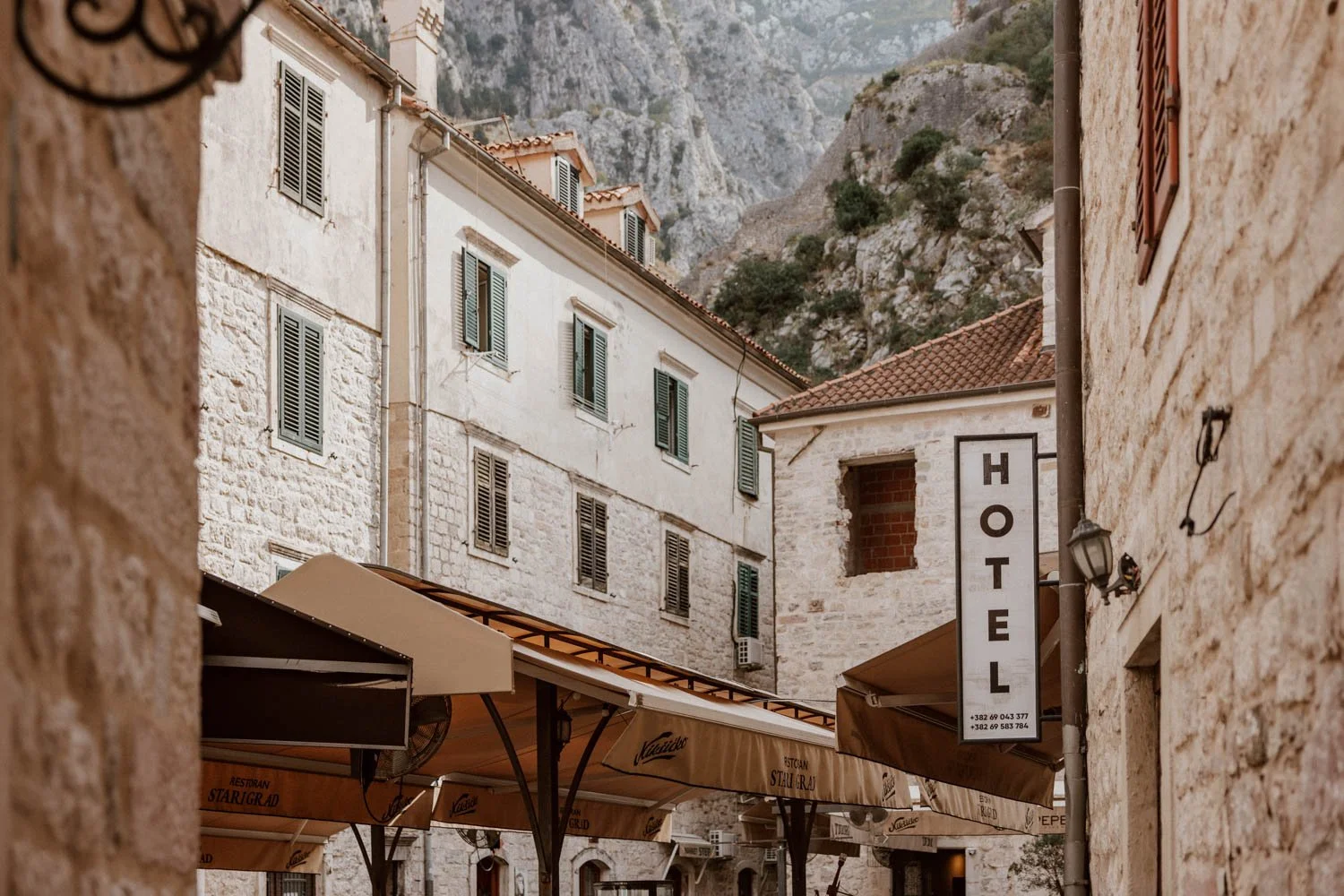
There are a lot of bad and ridiculously overpriced restaurants in historic Kotor, so we recommend eschewing spontaneous choices and checking reviews before you decide. We both strongly advise against Konoba Giardino, where we had a memorably awful meal and they charge €28 for a bottle of bad local wine that’s €4 in the supermarket.
Due to the above, we actually ended up mostly cooking for ourselves back at our Airbnb, but several followers we trust highly recommended Restoran Atrium and Konoba Scala Santa. For something more casual and lower on the price scale, consider Restobar Taraca in the new town, whilst you’ll find a bunch of affordable kebab/grill places outside the walls - BBQ Tanjga was ridiculously popular whenever we walked by.
Speaking of being ridiculously overpriced, we passed The Nitrox Pub earlier in the day and thought it would be a great shout for cocktails. Returning that evening, we saw a spritz cost €16 and a craft beer was €12, and decided to give it a miss. That is genuinely the most expensive spritz we’ve seen anywhere on our travels, and it would also have been the most expensive beer ever. So, whilst they offer a specialist selection, their cocktails look decent, and they have excellent reviews, we thought it necessary to give you a heads up before you blow your budget on a couple of drinks.
Thankfully, we then found Bandiera a short walk away. A no-frills bar that spills out into the pavement and has a healthy number of locals, its cocktails aren’t anything to write home about at all, but the prices and atmosphere make it a great shout at night. Open until 1am, it’s right next to Hostel Old Town Kotor
Jazz Club Evergreen is right in the heart of the old town and a good option if you want somewhere in the evening with good cocktails and a bit of buzz - find it here on Google Maps
The best place we found for a decent flat white is Small Talks, a few minutes outside the city walls in ‘new Kotor’ - the traffic outside can be a bit much if you’re already hot and bothered though. CAVE Coffee Specialty was also on our list but we never made it.
Despite its proximity to the water, Kotor isn’t a destination to chooses for beaches or swimming. There are small patches of platform, shore, or concrete to sunbathe either side of the town, but you are better off in nearby Prčan and Ljuta, or Perast and Herceg Novi if that’s what you’re looking for in the Bay of Kotor.
For anyone on a road trip or depending on public transport, bear in mind that congestion and traffic jams on only the road in, out and through Kotor is very common, and can double your journey time if you’re unlucky. Factor this in for day trips and onward journeys.
The famous Serpentine Road can be a real test of patience. Traffic is often heavy with logjams on the tight bends, and several people we spoke to spent two hours stuck on it. If you’re short on time, it’s going to better to avoid it when possible - there are plenty other twisting roads to contend with when driving in Montenegro.
When it comes to central parking in Kotor, options aren’t great, stress-free or cheap: we suggest heading this one (maps) or this one (maps) for convenience on day trips. Alternatively, this car park (maps) is much cheaper on the per hour/day rate and just a 20-minute walk from the start; you’ll also find a few other similarly-priced ones on that same road. If you find a better or cheaper alternative, let us know in the comments!
As mentioned, our excellent loft Airbnb had free parking and we highly recommend it for any couple on a road trip. If you’re hoping to stay within the historic centre, then you should clarify parking options with accommodation in advance and factor in extra to your budget.
If the crowds in this historic centre and the traffic in the new part become too much, we suggest walking toward this area where there’s a local’s cafe / bar next to Camping Bex (here on Google Maps). Nothing special to look at, but found it to be an ideal escape for a few cold beers by the water.
Whether you access it via the cable car or head there separately, Mount Lovćen National Park is a popular add-on for those based in Kotor. The closest of Montenegro’s five national parks, the main attraction is the summit of Mausoleum of Njegoš, a monumental tribute to the 19th-century prince-bishop and poet Petar II Petrović-Njegoš, one of Montenegro’s most revered figures.
If you’re looking for groceries, then your best bet is to head outside the town walls. This IDEA Supermarket (maps) is closest but not great, and you’ll be better offer going to this VOLI if you want more choice (maps)

Travel Better in the Bay of Kotor
A Curated Travel Guide to Herceg Novi, Montenegro
How To Hike The Ladder of Kotor
How To Visit The Kotor Cable Car
A Short Guide to Perast | Montenegro’s Prettiest Village
Where to Stay in Kotor (published soon)